Tag: Jam

  • Wimbledon viewing party snacks

    Wimbledon viewing party snacks

    Wimbledon is back on our tellies! I don’t know about you but the sound of subdued applause, grunts of exertion and low-tone commentary on a point system that has no reason or rhyme is the nostalgic sound of summers gone by.

    As a travel blogger who has been grounded by the pandemic for 15 months (at the time of publishing) I’ve had to think outside of the Royal box (laugh at my tennis joke!) so here I am, serving up (laugh again) ideas for your Wimbledon-at-home experience this and every summer that Wimbledon is on, or any tennis championship for that matter.

    Whoever you’re watching the tennis with this year, these drink and snack ideas will help level up your experience whilst watching Wimbledon at home.

    To be as inclusive as possible all of my suggestions below are suitable for vegetarians and can also be made vegan, and to make things easy for you I’ve also put a shopping list together at the end of this post.

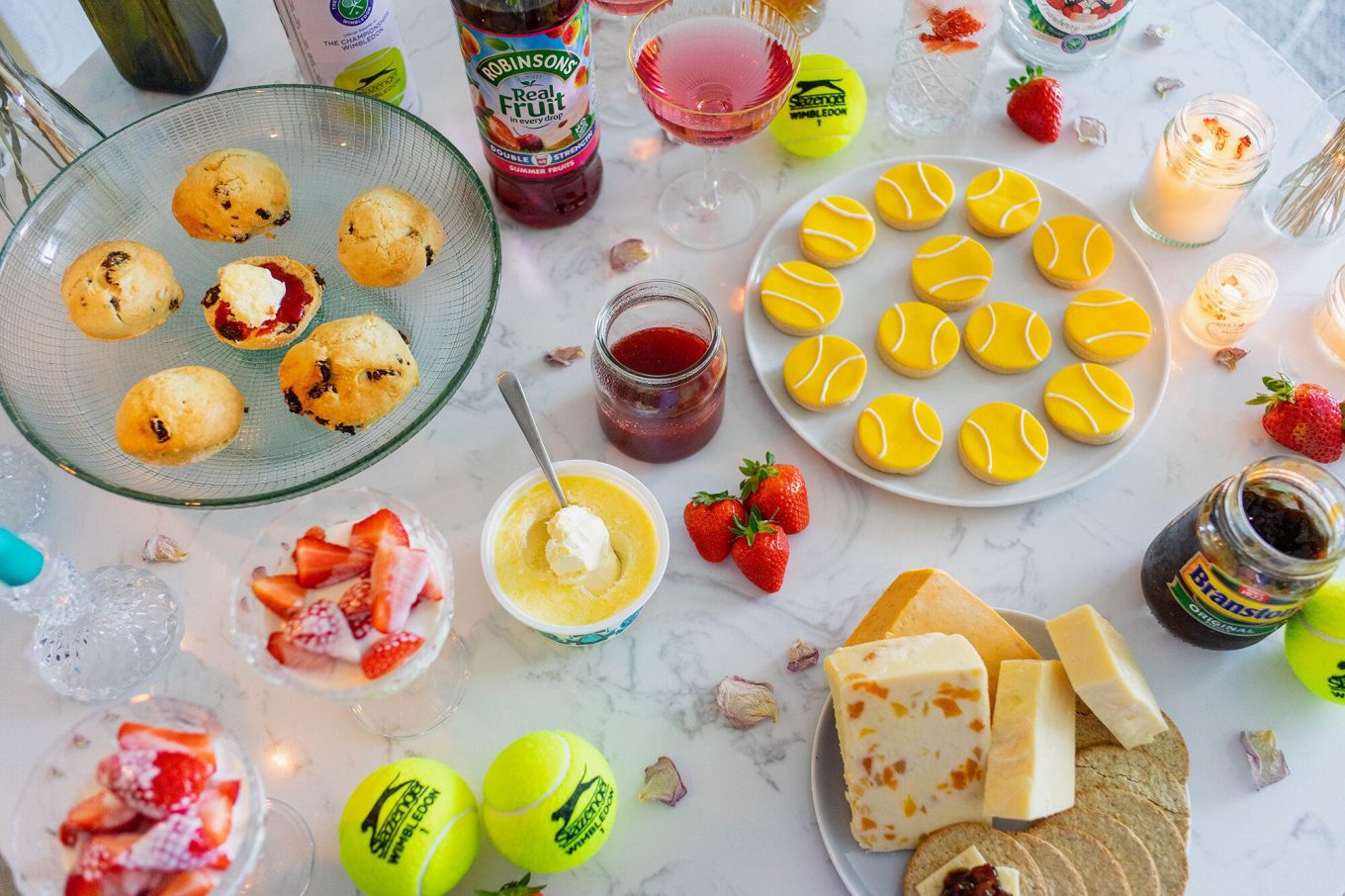
    Here are the drinks and snacks you need to serve up the perfect spread for a Wimbledon viewing party.

    Wimbledon viewing party drinks

    Pimm’s No1 Fruit Cup

    Drinking Pimm’s in the summer is synonymous with watching Wimbledon. 

    Pimm’s is a spiced and fruity gin-based spirit served as a long drink with lemonade or ginger ale.

    Learn more about the origin of Pimm’s No1 here.

    How to make the perfect pitcher of Pimm’s

    Recipe Here

    What you need to make a simple glass of Pimm’s 


    • 50ml Pimm’s No1


    • 150ml lemonade


    • 1 sliced strawberry


    • 3 slices of cucumber (1 for garnishing)


    • 1 sprig of fresh mint


    • Ice


    If you want to make the perfect pitcher of Pimm’s then take a look at my popular summer recipe blog post.

    Gin & tonic

    The G&T is the most classic English cocktail of all time. Celebrate the Wimbledon Championships  being back on our TV sets with official gin of Wimbledon: Sipsmith. Serve an ace (see what I did there) and make your gin and tonics with Sipsmith’s Strawberry Smash gin, their special edition Wimbledon themed gin.

    Sipsmith’s Strawberry Smash gin has been distilled with Hugh Lowe’s (the official strawberry supplier for Wimbledon) 2020 strawberry harvest. 

    Serve Sipsmith’s Strawberry Smash with tonic and strawberry slices or take a look here at Sipsmith’s suggested cocktail recipes.

    Robinsons squash

    Robinsons is the official soft drink of Wimbledon and is perfect for those who won’t be drinking alcohol. 

    Robinsons make concentrated squashes and cordials ready for you to dilute with water into a refreshing drink to quench your thirst whilst watching the tennis. Robinsons has turned almost every fruit into one of their squashes so there’s one to please everyone (who likes fruit).

    PFH Fun Fact: Robinsons squash was created at The Championships, Wimbledon in 1935. Their first flavour was Lemon Barley Water for the players to keep them hydrated during their matches.

    Get double strength to reduce the amount of plastic you purchase as you only need half the amount and recycle your bottle responsibly if you don’t plan on upcycling it.

    Wimbledon viewing party snacks

    Pimm’s Drizzle Loaf Cake

    Recipe here

    Strawberries and cream

    Strawberries and cream were first combined during the reign of Henry VIII in the 1500s, since then it has been a firm British favourite during the summer.

    The tradition of serving strawberries and cream at the Wimbledon tennis championships originated in 1877 but no one really knows why. Popular beliefs are that strawberries were in season during the tournament and that eating strawberries was very popular during the Victorian Period. Consider them the Victorian equivalent of a grande Starbucks cup that appears all across your social media feeds (please try to use reusable cups).

    PFH Fun Fact: the strawberries sold at Wimbledon are picked on the Hugh Lowe farm at 4am on the day that they are to be served.

    A serving of strawberries and cream at Wimbledon includes at least 10 strawberries. Serve them with oat cream for a vegan alternative.

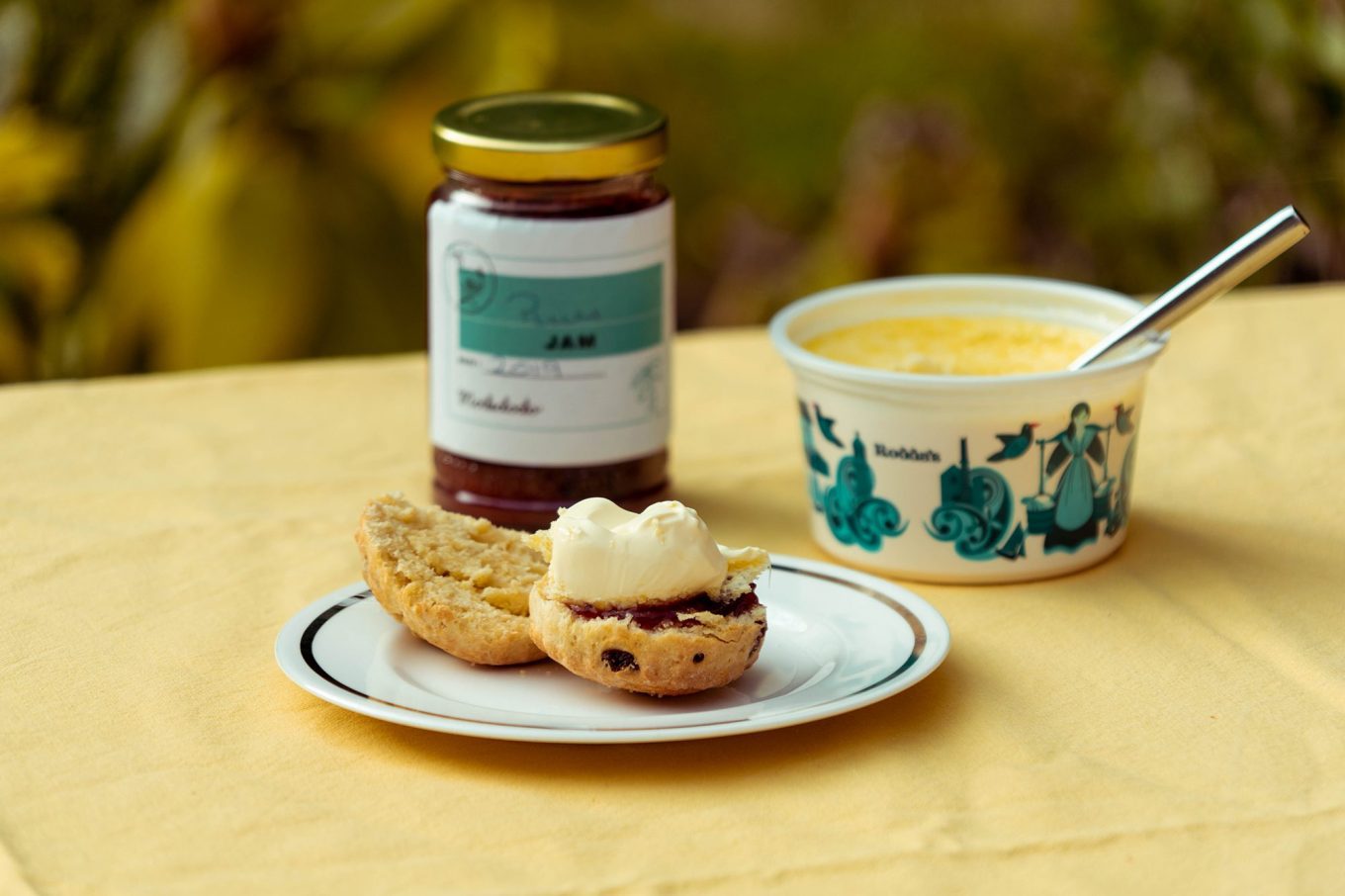
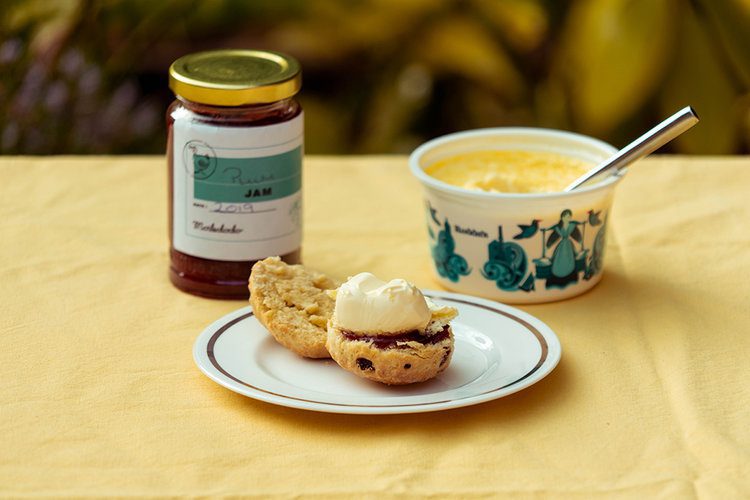
    Scones served with clotted cream and homemade strawberry jam

    Few sweet treats are as quintessentially British as a scone served with clotted cream and jam. As it’s a Wimbledon themed spread you’re putting together I suggest serving strawberry jam, or to make things really special why not try your hand at making fresh strawberry jam with my homemade jam recipe blog post. I made a jar of strawberry jam for this blog post in under one hour and it tastes better than any strawberry jam I’ve ever had. To speed up your jam making process, blend your strawberries in a smoothie maker or food processor before adding them to the sugar.

    As for your clotted cream, it can’t be anything other than Rodda’s, made in Cornwall. In saying that I am aware that if you’re reading this in North America and want to put this tennis themed spread together you won’t be able to get your hands on the best cream in the world. For you I suggest whipping up some double cream.

    English fruit scone recipe

    Recipe Here

    Learn to make freshly baked scones with my recipe blog post here. To make vegan scones simply swap out the egg for 3tbsp of chickpea water, the butter for margarine and the milk for any milk alternative.

    Tennis ball sugar cookies

    My sugar cookies take less than an hour to make and once cool you can decorate them in under half an hour. They only take 8-10 minutes to bake, require very little baking skills, are easy to decorate and really pull the theme together. Click here for the recipe.

    If you’re not vegan don’t worry, my sugar cookie recipe wasn’t originally vegan. Where I use egg replacement use 1 egg and you can use dairy butter instead of margarine.

    To make tennis ball sugar cookies, use a round cookie cutter and find a yellow fondant icing. Mix up some icing sugar into a thick consistency and pipe on the white curves or you can purchase pre packaged piping icing if you don’t have your own bag at home.

    English cheese and crackers

    For your savoury accompaniment to all of these sweet treats serve up some crackers and classic English cheeses such as cheddar, Wensleydale and Double Gloucester. Take a look in your local deli to support a small business.

    Easy Sugar cookie recipe

    Read here

    Compliment your cheese and crackers with a pickle. For a crowd pleaser go for Branston pickle – it’s a sweet pickle chutney and for a British classic serve Piccalilli – it’s a mustard pickle that was inspired by south asian pickle – or, if you feeling like something different why not give my Mauritian spiced vegetable pickle a go, I’ve linked the recipe here.

    Wimbledon viewing party shopping list


    • Strawberries (at least x2 punnets, one for making jam and one for serving with strawberries)


    • Cucumber


    • Lemon


    • Mint


    • Cheddar cheese


    • Double Gloucester cheese


    • Wensleydale cheese


    • Clotted cream


    • Cream or oat cream


    • Milk or milk alternative


    • Margarine


    • Pickle


    • Tin of chickpeas (for the water as egg replacement or buy eggs)


    • Crackers


    • Caster sugar


    • Plain flour


    • Self raising flour


    • Baking powder


    • Fondant icing


    • Icing sugar


    • Caster sugar


    • Vanilla extract


    • Currants


    • Robinsons Squash


    • Lemonade


    • Indian tonic


    • Pimm’s No1 Cup


    • Sipsmith Strawberry Smash gin


    Don’t understand the rules of tennis and want to grasp it quickly? Take a listen to the Calm app’s sleep story “But seriously, The Rules of Tennis” read by the legend himself John McEnroe.

    Game, set, match and snack!

    Do more on & for the planet, 

    Gabriella 

    Pin this post.


  • Homemade raspberry jam recipe

    Homemade raspberry jam recipe

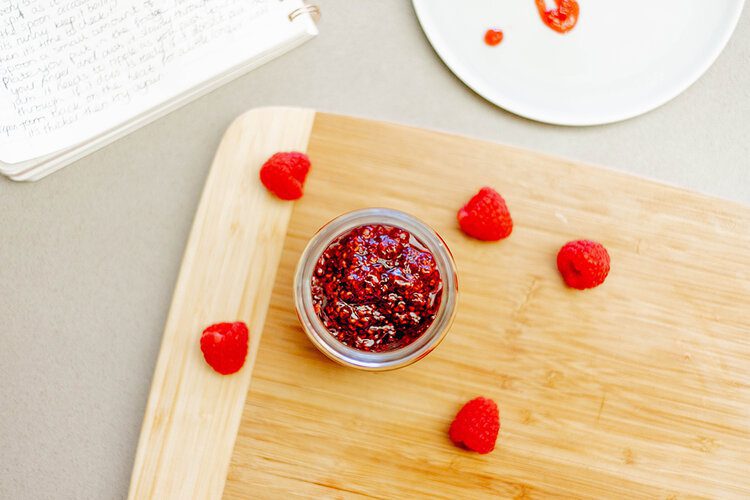
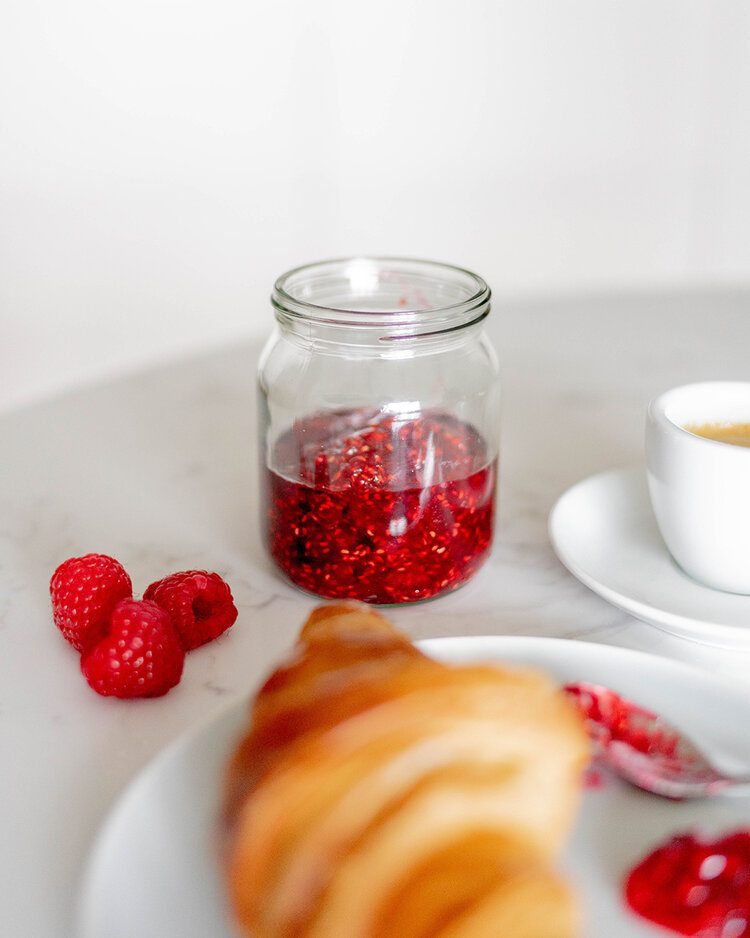
    As you are aware, this homemade jam recipe blog post has been published in the midst of a worldwide pandemic. I haven’t left England in over a year and I don’t have any trips booked for the foreseeable future. Giving you fresh travel content is tricky, but I want to keep giving you blog posts that can at least keep you occupied whilst you also wait for your borders to open, so here I am publishing my Mum’s jam recipe. 

    Her homemade jam is stashed in just about every corner of her kitchen so we can all trust that she makes a good jam. You didn’t come here to read an essay about why you’re getting a homemade jam recipe though as the chances are you’re here because you just want a jam recipe, right? If that’s the case scroll down for the recipe. Everything that comes between now and the recipe is me answering some frequently asked jam related questions, so if you find yourself thinking “how long will this jam last Gaby?” check back here and I won’t judge you for skipping these paragraphs before the recipe – we all do it!

    Notes on making homemade jam

    Homemade jam is really easy to make, plus it’s a really cute gift if you’re trying to give more eco-conscious presents – it uses minimal ingredients, it preserves the fruit for much longer and it gives a greater purpose to your upcycled jars.

    PFH Top Tip: Wear an apron or something dark coloured that you’re not precious about as the jam will spit.

    Can I take jam on a plane?

    Making jam out of fresh fruit is also a really neat and easy way to preserve fruit to bring it home from your travels in your suitcase, should you be staying in accommodation with a kitchen. 

    Border restrictions prevent you from being able to enter a country with fresh fruit but the sugar in jam preserves the fruit and eliminate the risk of pests and diseases that can spread with fresh fruit.

    Of course, the jam is a liquid so you will have to pack it into your checked luggage to be able to bring it back. Make sure it’s protected within your luggage so it doesn’t break when your suitcase gets tossed around behind the scenes.

    Jars are super easy to get hold of in homeware stores so should you go coconuts for some juicy mangoes on your tropical travels, you can make them into jam and bring them home to enjoy! I actually made a raspberry and mango jam with this recipe (if you add another fruit then increase the amount of sugar to match the weight of all the fruit) and it was delicious!

    How do I sterilise up-cycled jars?

    It’s super simple to sterilise old jars to give them a second life such as holding your homemade jam. Place the jar into a container filled with warm soapy water and leave for a few hours to remove the labels and the sticky residue. Then either wash out the jar or put it in the dishwasher to clean the inside.

    To sterilise it before using it for food storage (leftovers, jam etc.), pour some boiling water into it  and let it sit for a few minutes. Wear oven gloves/mitts or use a tea towel to touch it to pour out the water so you don’t burn your hands. Dry it and it’s ready to use.

    You may also be interested in my Mauritian achard légumes recipe, a vegetable pickle you can store in your sterilised jars!

    How much jam will this recipe make?

    This is a small batch jam recipe and will make one jar of jam. A 150g punnet of raspberries (which is a standard measurement in British supermarkets) will make one 350g jar of jam.

    Although I give quantities of the ingredients below the rule of thumb for jam making is to have equal sugar to fruit. The quantities in my jam recipe are based on the punnet of raspberries I bought, so just check the weight of the punnet you buy and adjust your sugar to equal it. 

    Take into consideration this is based on weight not volume.

    How long will homemade jam keep?

    If you store homemade jam in a cool and dry space that is out of direct sunlight it will last for 12 months. 

    Once opened, your jar of jam should be consumed within a couple of months. 

    Store opened jars of jam in the fridge.

    Use a clean spoon/knife (as opposed to one with butter on it) to prevent it from getting contaminated.

    How will I know my jam is the right consistency?

    I explain the process for checking your jam is the right consistency in step 9 of the recipe below but if you’re just looking for this answer then the test goes as follows:

    To test if your jam is ready to pour into your jar push your finger through the centre of the jam. If the jam ripples in resistance to your finger nail and your finger leaves a clear path through the jam then your jam is at the right consistency.

    If you’re still unclear then take a look at step 9 for a GIF that perfectly illustrates what I mean.

    What you need to make jam

    Wooden spoon

    Medium saucepan

    Small saucepan

    Scales/measurement cups

    Tbsp measure

    Small plate

    Jam jar with lid

    Homemade raspberry jam ingredients 

    150g / 1 ⅓ cups / 5.3 oz of fresh raspberries

    150g / ¾ cups / 5.3 oz of Billington’s golden caster sugar

    1 tbsp lemon juice

    Raspberry jam recipe

    1. Put a small plate in the fridge. This is for checking if your jam is the right consistency before pouring into your jar to set.

    2. Pour some boiled water into your jar to sterilise it. Set it aside until you’re ready to pour the jam in.

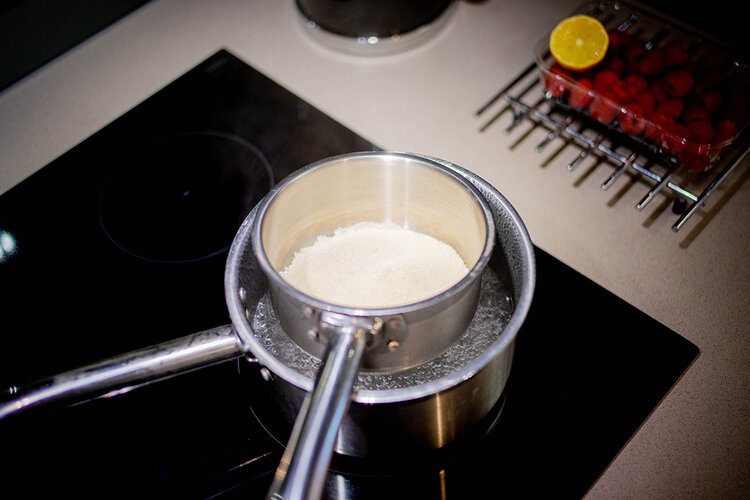
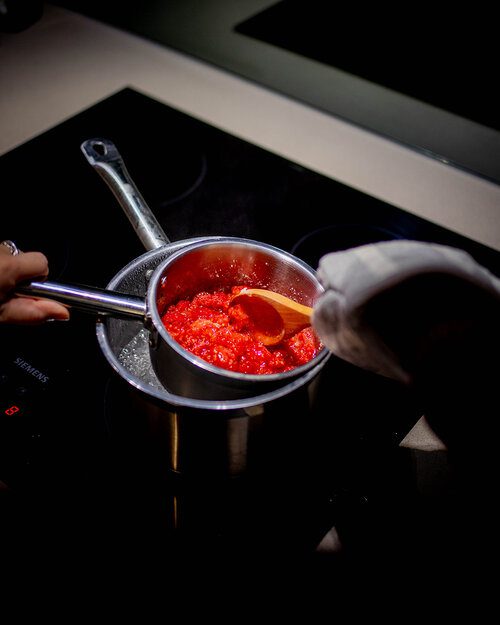
    3. Set up a double boiler by placing the smaller saucepan into the larger saucepan and bringing enough water to the boil in the large saucepan that it heats the small one but doesn’t touch the bottom. Once the water is boiling, turn it down to a simmer.

    4. Add your sugar to the small saucepan and leave it to gently warm the sugar, this will encourage the fruit to melt rather than burn when you add it. Stir the sugar every few minutes to make sure it’s heating evenly.

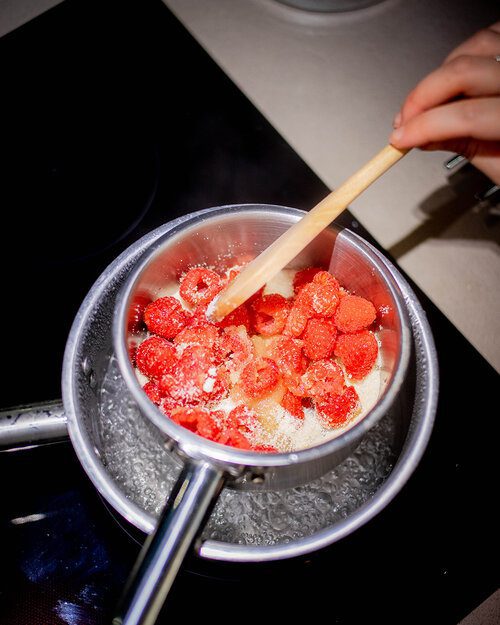
    5. Once the sugar is warm to the touch (it should only take about 8 minutes) add your raspberries (or fruit of choice) and lemon juice.

    6. Gently stir to encourage the fruit and sugar to melt together.

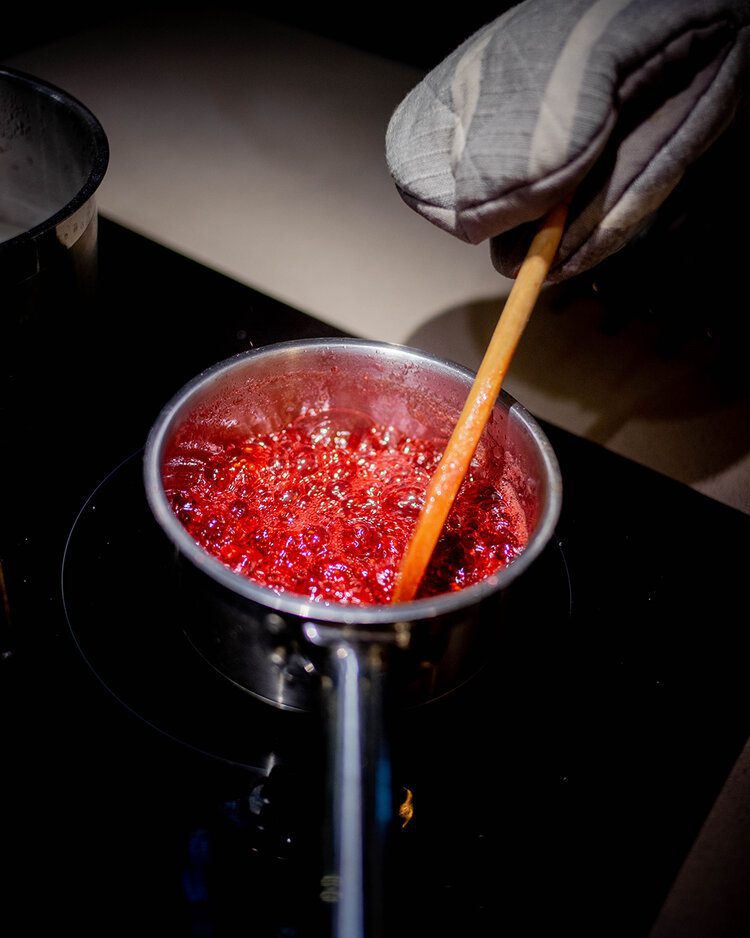
    7. Once the fruit and sugar has combined, remove the small saucepan from the large one and place it directly onto the hob (giving the bottom a quick wipe dry before) and increase the heat until you have brought the mixture to a boil, stirring it consistently every 5 seconds. WARNING, the jam mixture will spit as it boils so wear oven gloves/mitts to protect you hands.

    8. After 10 or so minutes boiling, the consistency should go from runny to sticky. If it is still runny then continue to boil and stir it. You want to keep an eye out for when it starts to stick to the sides of the saucepan.

    9. Once you see the jam starting to stick, take your small plate from the fridge and use the spoon to drop a small amount of jam onto it. To test if your jam is ready to set, push your finger through the centre of the jam, just like I’m demonstrating in the GIF below. If the jam ripples in resistance to your fingernail and your finger leaves a clear path through the jam then your jam is at the right consistency. If it doesn’t ripple and looks as though your finger was never there then continue to boil and stir the jam until it appears thick enough to try this test again.

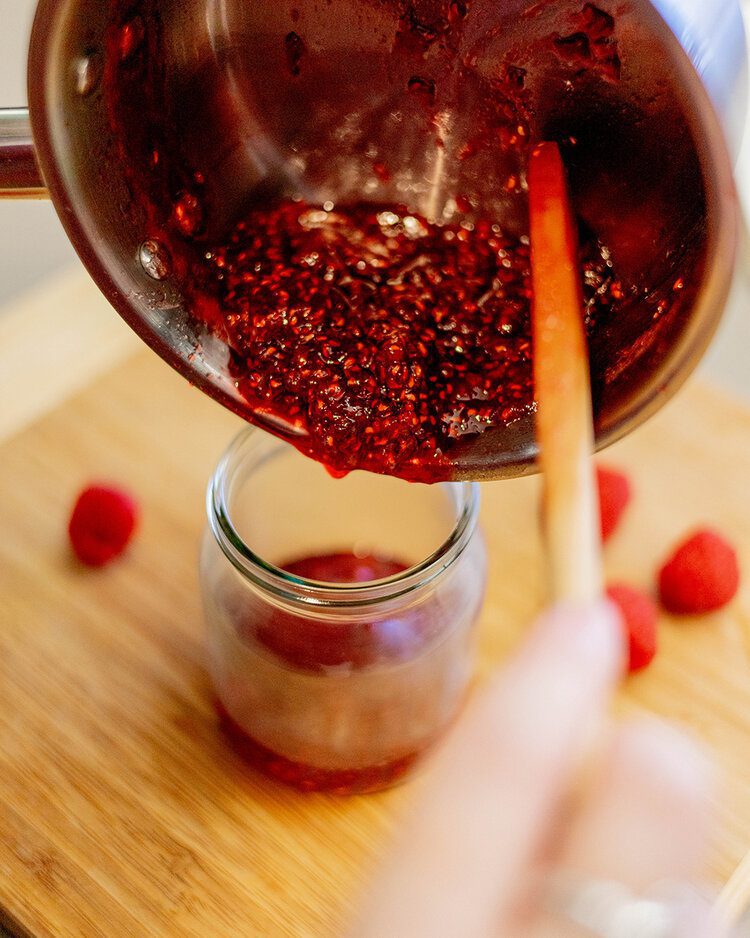
    10. Once your jam is the right consistency on the plate, take the saucepan off the heat. Pour the water out of the jar, dry it and pour the jam in. Place the lid on whilst the jar is still warm so that it forms a seal (as it cools you’ll hear a pop as the lid expands to form a seal).

    11. Leave it out to cool completely so that it sets. You can keep your unopened jam in a cool and dry place for up to a year. Once opened, store it in the fridge where it will last for a couple of months.

    Bon appétit!

    You may also be interest in my vegan sugar cookies recipe.

    Do more on and for the planet, Gabriella

    Pin this post


  • 5 best things to do in and around Colchester, Essex

    5 best things to do in and around Colchester, Essex

    Dating back over 2000 years to the Iron Age, Colchester in Essex is Britain’s first ever city and former capital of Roman Britain.

    We based our trip to Colchester around me wanting to visit the adorable pastel beach huts on Mersea Island beach and to visit Tiptree Jam Museum and Tearooms for afternoon tea. I sure was blown away by what Colchester had to offer, it was the first I learnt of the long history of the town and I found it to be such an informative trip. I strongly recommend a staycation in or trip to Colchester to learn more about England’s history plus you can combine it with time at the seaside.

    Here’s 5 of the best things to do in and around Colchester, from exploring ancient Roman ruins to having afternoon tea served by one of the best jam producers in the world.

    1. Visit Colchester Castle Museum

    Built in 1100 – commissioned by William the Conqueror in 1076 – Colchester Castle is the largest Norman keep in all of Europe.

    It wasn’t the first building to be constructed upon this land though. Shortly after the Roman invasion by Emperor Claudius in AD 43, Romans built the Temple of Claudius. The temple stood until AD 60 when it was burnt down in an attack on the Roman city by Boudica, Queen of the Iceni tribe. It was rebuilt, along with a wall around the city. It remained until the Roman decline between 330 and 410. In 450, the Anglo-Saxons and Normans took control of Essex but it wasn’t until 917 that Colchester was re-founded.

    In 1076 (over 1000 years since the construction of the Temple of Claudius) the construction of the castle we can see today began upon the foundations of the Roman temple, using stones from other Roman buildings as there was a lack of quality stone in the surrounding area. Originally built as a fort, it is now a museum and has been since 1860.

    If there’s one thing you should do in Colchester it’s visit the castle museum as it extensively documents Colchester’s rich history of thousands of years from the Iron Age right through to modern day. Their collection consists of Celtic coins, a vessel from the Bronze Age, the best preserved Roman statues in Britain, medieval paintings and civil war armour. 

    Colchester’s castle didn’t just go from Norman keep to present day museum. Through the middle ages the castle was used as a prison (you can explore some of cells on your visit) for around five centuries, even when the castle’s interior was in near ruins. Some of the the most infamous prisoners were victims accused of witchcraft, who now have a memorial rose garden in tribute to their cruel treatment.

    In 1727 Charles Gray restored the castle, though his belief that it was a Roman construction led to him tiling the roof in a Mediterranean style that doesn’t match the main structure of the castle.

    Fascinating, right?

    Opening hours

    Monday – Saturday 10am – 5pm

    Sunday 11am – 5pm

    Last admission 4.30pm

    Ticket cost

    Adult £10

    Child  (4-16) £5.95

    Student £6.95

    2 adults & 1 child £23

    1 adult & 3 children £25

    2 adults & 2 children £28

    COVID-19 restrictions

    Please use the provided hand sanitiser before and after entering.

    Pay for tickets and souvenirs by contactless card.

    The castle museum has a one way system.

    Wear a mask at all times indoors.

    All interactive exhibitions are closed.

    Please refrain from touching anything.

    Please stay 1-2 metres away from others.

    2. Take a stroll through Castle Park past the riverside cottages

    Castle Park surrounds Colchester Castle in the north east of the town. The Roman wall divides it into an upper and lower park, perfect for taking a stroll on a dry day. Its picturesque river flowing past, lined by weeping willows and park benches offers up the perfect spot to picnic or sit with your thoughts.

    Be sure to end your walk at the riverside cottages; the row of pink Tudor houses opposite the River Colne, just next to North Bridge are so photogenic.

    The park is also home to various music concerts and festivals across the year.

    Opening hours

    Everyday from 7.30am – 6.30pm

    3. Explore ancient ruins

    As mentioned above, ancient Romans settled in Colchester 2000 years ago and made it their capital in all of Roman Britain. Back then they called Colchester, Camulodunum: “dunum” meant fortress and Camulos meant God of War. The name was inspired by the preceding settlers in the Iron Age who also used Colchester as their fortress.

    Though many of the ancient ruins have been destroyed by attacks to the settlement from Boudica (AD 60) and her people and succeeding settler William the Conqueror and the Normans (450 – 1076), there are still many Roman ruins across the city that you can see.

    As mentioned, the Romans weren’t the only settlers in Colchester, people came before and after, so there’s also relics and ruins survived from the Anglo-Saxon, Norman and medieval periods dotted around the town ready for you to explore. Here are my highlights:

    Saint John’s Abbey Gate

    Saint John’s Abbey Gate is a beautifully crafted gatehouse that was once part of St John’s Abbey. Built in the 1400s, St John’s Abbey Gate is the part of the Benedictine abbey that exists today after the abbey was demolished during the 16th century Reformation.

    Its architecture is unusual for Colchester because it uses East Anglian flushwork, which is when the flint blocks are cemented flush to the wall in tight lines, creating a smoother surface which reflects the wealth and importance of the property.

    Saint Botolph’s Priory

    St Botolph’s Priory was once a medieval place of worship during the worship of the Augustinian rule (written around the year 400). Founded between 1093 and 1100, St Botolph’s Priory was one of the first Augustinian monasteries in England until it came to an end in 1536.

    The building itself was made from stones taken from Roman buildings across the town.

    Much of the building was destroyed in the siege of Colchester in 1648, but what remains of the Grade I listed building is free to explore and with many of the arches and columns intact, it’s still quite a sight to see.

    Balkerne Gate

    Balkerne Gate is the oldest and best surviving Roman gateway in Britain, it’s also known to have been the largest one. It was built into the town wall that went up shortly after Boudica’s attack on Colchester in AD 60 and gives access to the town from the road to Londinium (London).

    The Grade I listed building was made up of two arched passageways, wide enough for carriages, side-by-side and on either side of those were much smaller arched footways. It’s known to have been the largest because there were no other 4 entranced Roman gates in Britain. Most of the gatehouse has fallen and now only the south footway arch remains, which you can still walk through, and it gives a good indication as to how big Balkerne Gate was in its heyday.

    It’s a pretty amazing thing to walk through, the footway that ancient Romans used to pass through either to get in or out of their capital roughly 2000 years ago.

    Unfortunately no one knows the origin of the name Balkerne.

    4. Have afternoon tea at Tiptree Jam Museum and Tearooms

    Tiptree conserves are world famous, they are sold in over 70 countries and are served in luxury hotels and by top airlines all around the world. They received their first Royal Warrant from George V in 1911 and have remained Royal Warrant holders as purveyors of ‘Tiptree’ products to Her Majesty, Queen Elizabeth II.

    Tiptree Jam Museum and Tearooms is located just on the edge of Tiptree village and is just a 20-30mins drive from Colchester.

    With a museum documenting the 135 plus years of history of Wilkin & Son’s Tiptree jam production, a tearoom where you can try their many conserves with afternoon tea, cream tea or lunch and a gift shop where you can buy anything you ate in the tearooms and more, it’s easy to spend a long morning or afternoon here.

    I strongly advise getting the cheese and chutney sandwich with your afternoon tea as their onion chutney is amazing and their signature Little Scarlet Strawberry Jam is a must with your scone!

    Opening hours

    Summer hours 

    Monday – Saturday 9.30am – 4.30pm

    Sunday 10am – 4.30pm

    Winter hours

    Everyday from 9am – 4pm

    COVID-19 restrictions

    Due to the current one-way system, the museum is only accessible as the exit to the tearooms.

    Please use the provided hand sanitiser before and after entering.

    Wear a mask at all times indoors when not eating.

    Please refrain from touching anything in the museum.

    Please stay 1-2 metres away from others.

    5. Visit Mersea beach huts

    Recently the row of identical pastel painted beach huts, owned and rented out by The Little Beach Hut Company, has become a frequently Instagrammed spot in England. As I mentioned at the start, it is why I wanted to go to Colchester in the first place, to get closer to the beach huts. Having grown up surrounded by beach huts, I can confirm that they are the cutest ones I’ve ever seen and well worth the visit. 

    Visiting Mersea Island beach isn’t just about the beach huts though, the 13 mile long beach that wraps around the coast means there’s plenty of space for you and whoever you’re with to set up for the day and soak up the sun, or take a long stroll on a cooler day.

    How to get to Mersea Island

    Mersea Island is just a half an hour drive from Colchester. The Strood is the only road taking you to and from Mersea Island. Constructed into marshland, it floods upon high tide so it’s important that you check the tide times here. You must allow up to an hour and a half either side of high/low tide to make the crossing safely.

    Park up your car in either of the following car parks:


    • West Mersea Beach


    • Victoria Esplanade Parking


    • Sea View Public Parking 


    The closest car park to the pastel beach hurts is the Victoria Esplanade Parking.

    .

    A fascinating history lesson, a beautiful beach and a cute spot for afternoon tea; why not take a trip to Colchester!

    Gabriella

    Pin this post


  • Classic English fruit scones recipe

    Classic English fruit scones recipe

    Tell me a more quintessentially British thing to do in the afternoon than indulge in a cream tea or afternoon tea? Of course, absolutely no afternoon tea is complete without good old fashioned fruit scones served with jam and clotted cream. So here I am to bring a little British culinary culture to your home with a very simple and easy recipe for baking fruit scones. 

    To learn more about proper afternoon tea etiquette, take a look at my blog post, Traditional British meals every traveller needs to try.

    Usually my recipe blog posts are inspired by my travels, but the recent glorious sunny days we’ve been having out in the Norfolk countryside has got me thinking about the Great British Summer and it inspired me to look a little closer to home this time.

    Remember everyone, it’s “scone” like “gone” not “scone” like “bone”.

    Scones can come in many shapes and tend to be made using family recipes that have been passed down. So I will be sharing the recipe my Mum uses.

    The recipe below makes approximately 10 scones. 

    Ingredients

    225g self raising flour (plus extra for rolling)

    1 level tsp baking powder

    40g softened butter

    25g caster sugar (and a couple of pinches for sprinkling over the scones)

    1 egg

    150ml milk (plus a dash extra for brushing the scones)

    55g currants

    Jam

    Clotted cream

    Equipment

    Measuring scales

    Sieve 

    Large mixing bowl

    Tsp measurement

    Wooden spoon

    Bowl

    Fork

    Rolling pin

    Round cutter (approx. 6cm wide)

    Pastry brush

    Baking tray

    Reusable tray liner (or greaseproof paper, but try to buy a reusable greaseproof liner)

    Wire rack

    Method

    1. Preheat the oven at 180˚C

    2. Measure out all of your ingredients

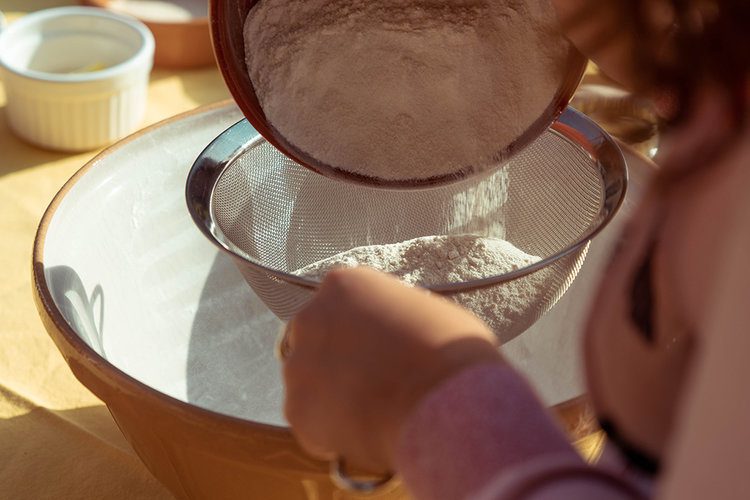
    3. Sieve the baking powder and flour into a large mixing bowl


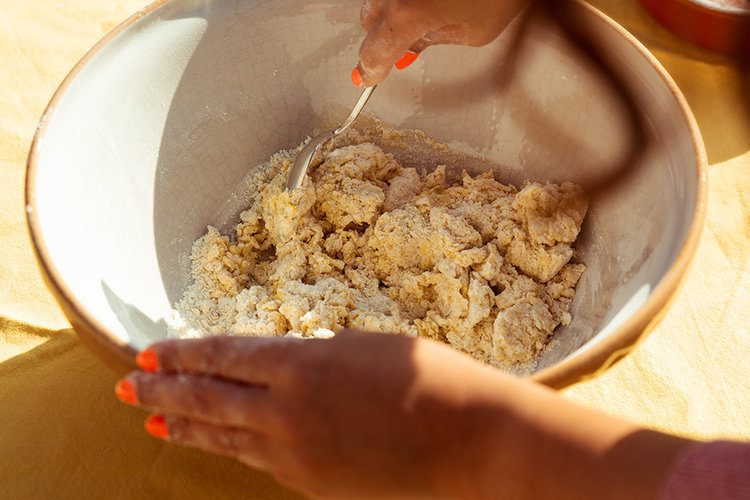
    4. Add the butter to the flour mixture and rub ever so lightly with your finger tips until the mixture resembles breadcrumbs

    5. Stir in the sugar

    6. Break the egg into a separate bowl and whisk with a fork whilst adding the milk

    7. Stir the egg mixture into the large mixing bowl to make a soft dough

    8. Stir in the currants

    9. Your dough should be in-between dry and sticking, if it is too wet and sticky sprinkle flour over it until it is soft rather than sticky

    10. Lightly flour a flat surface for rolling out the dough

    11. Once you have gathered the dough into one lump, remove it from the mixing bowl and place it on your floured surface


    12. Knead the dough very gently

    13. With flour dusted on your rolling pin, roll out the dough to a thickness of 2cm (3/4”)

    14. Using a 5cm (2”) round cutter, cut the dough into as many rounds as you can, placing each one on your lined baking tray

    15. Gather the remaining dough, roll it out to the same thickness and cut what’s left

    You should have approximately 10 scones, I managed to get 11 out of mine so it can vary

    With the scrap of dough left, roll it into a ball to bake – don’t waste anything!

    16. Using the pastry brush, brush the tops of each scone with milk and sprinkle with a very small amount of caster sugar, this will make the tops of the scones go golden brown

    17. Place the tray on the middle shelf of the preheated oven to bake for 10 minutes, if they are not golden brown quickly turn the tray around and bake for 2-3 more minutes, but no more than that

    18. Remove them from the oven and place the scones on a wire rack to cool down

    To serve


    • Cut in half


    • Spread jam on each half


    • Top with clotted cream


    There you have it, your perfect addition to your afternoon or cream tea. 

    Remember, proper afternoon tea etiquette is to keep those pinkies down and never bang your spoon on your tea cup!

    If you give these a try let me know how it goes. Tag me using @gabriellawisdom and the hashtag #postcardsfromhawaiiblog so I can share it on my Instagram.

    Enjoy!

    Aloha, Gabriella 

    Pin this post