Learn how to make simple homemade pasta from two ingredients with this simple recipe. If you’re intentionally eating a more plant based diet then there’s no need to be scared off by the word “vegan”, this recipe doesn’t substitute anything it’s just an eggless fresh pasta recipe.
This pasta recipe will help you to make pappardelle pasta which is like spaghetti with a whole lotta junk in its trunk – it’s about 2-3 times wider than tagliatelle. You don’t have to make pappardelle though, you can make any shape you fancy with this pasta dough.
Yes my homemade pappardelle pasta is on the floor, it was the only spot with natural daylight when I made it.
This fresh pasta recipe is super easy and quick to whip up and is really handy if you’ve run out of pre-made pasta, looking for a pretty simple way to impress your dinner guest, want something fun to cook with kids or are feeling extra come dinnertime. It’s also a neat way to honour a beautiful country whilst we can’t travel to Italy just yet.
I have chosen to serve up my fresh pappardelle pasta with pesto sauce, mixed baby tomatoes, pine nuts, parmesan and basil but you can serve your homemade pasta with any sauce of choice.
Ok so anyone who isn’t just here for the recipe and hasn’t already skipped down (no judgement here) I’ve answered a couple of questions you may have about this vegan fresh pasta recipe and then I share the ingredients, equipment and method.
How much will this vegan fresh pasta recipe make?
1 ½ cups of plain flour will make enough pasta to serve two people.
Important tips for making homemade vegan fresh pasta
The most important part is to make sure you have enough flour underneath and on top of your rolled out dough so that when you cut out your chosen shapes it doesn’t stick to itself.
Does it have to be pappardelle pasta?
Nope I’m just lazy and pappardelle shaped pasta requires very little effort.
What you will need to make homemade vegan fresh pasta
Ingredients for homemade vegan fresh pasta
204g / 1 ½ cups of plain flour plus extra for dusting
330ml / 1 ⅓ cups of cold water (approximately)
Teaspoon of salt
Equipment for homemade vegan fresh pasta
Cup measurements
Dessert spoon
Fork
Rolling pin
Sharp knife
Saucepan
Wooden spoon
Colander
Method for making homemade vegan fresh pasta
1. Measure out the flour onto a clean surface, alternatively you can use a mixing bowl.
2. Using a dessert spoon make a well in the middle of the flour, you can use the GIF below as a reference. Making a well in the flour makes it easier to gradually mix in the water so your dough doesn’t become lumpy.
3. Add the water approximately one tbsp at a time and use the fork to mix the flour in. You want to gradually take flour in from the edge of the well you made and whisk it into the flour to combine it. As the dough becomes less sticky add a little more water and continue to mix the flour in. To make things easier, you can mix the dough in stages.
Note that you might not need all of the water, use as much as you need to form a dough with all of your flour.
4. Once you have mixed all of your flour into a dough, dust your surface with extra flour and knead your dough for about 4-5 minutes or until it becomes smooth and elastic. This helps the pasta to keep its structure once you shape it whichever way you please.
5. Dust your surface again with flour and your rolling pin and roll out one half of the dough to a thickness of 3mm/0.2”. Be sure to dust flour onto your surface every time you move and flip your dough to make sure it doesn’t stick. If it’s easier you can work your dough in two halves.
How to shape pappardelle pasta
Before we continue, you don’t have to make pappardelle pasta, you can make whatever shape you like. I’m just lazy and pappardelle is easy.
6. Bring a saucepan of salted water to the boil as you continue with steps 7-10.
7. Sprinkle and smooth out a layer of flour onto the rolled out dough. You don’t want to smother it with flour but it needs enough so that neither side is sticky.
8. Take one edge of your dough and lightly roll it in and continue to roll the whole dough so it resembles a Swiss roll. Be careful to roll lightly so the dough will unravel easily after you’ve cut it.
9. With a sharp knife slice your rolled up dough (gently if you choose not to use a chopping board as to not damage your surface). To make pappardelle pasta cut your slices 2-3cm/3⁄4–1inch wide.
10. Lightly flour your hands and gently unroll your pappardelle pasta.
11. Place your pappardelle pasta into the boiling water, stir and cook for 2 minutes. Make sure you don’t overcook your pasta as it will become gloopy, lose its shape and be unpleasant to eat.
12. Drain your pasta, add a little butter and stir in your sauce of choice, I used vegan green pesto. Add any extra you like such as pine nuts and tomatoes, add a sprinkling of parmesan and garnish with fresh basil.
A period packing list is an underrated one for sure but when you plan ahead for a period that lines up with your travels, being prepared with the following products will eliminate a lot of the stress that comes with menstruating, especially when you’re not in the comfort of your own home.
I’ve put together this low-waste period packing list with cramping, comfort and cravings in mind as well as, of course, options that have a reduced impact on the planet whilst you explore it.
The following products will not only empower you by letting you be your best self on your period but they also empower other women too. The two brands I have worked with to create this period packing list for you, Coconut & Cotton and Saalt, are female-owned brands who also support organisations that offer menstrual health education and products to women in need around the world.
Every day girls all around the world miss school on their periods because of discrimination, lack of information or no access to menstrual hygiene products. UNICEF estimates 1 in 10 girls in Africa alone miss school because of their periods.
Patriarchy dictates that we are to feel ashamed of our periods and as a result, education on menstrual health and access to affordable products is lacking all around the world and this is simply unacceptable. We deserve to take back the power and beauty behind the natural process of our periods for all people who menstruate and together we can by supporting companies and organisations that do just this. My personal recommendations are:
The products recommended in this period packing list not only help to empower you and other menstruating people, they are also low waste. They have been designed, made and chosen to last you years and eliminate as much single-use waste as possible.
This period packing list is also handy for putting together an environmentally-conscious period care package for someone you know who has just started their period for the first time or is finding menstruation more challenging than others.
To purchase any items from Coconut & Cotton or Saalt simply click on the underlined links or on the photos below and you’ll be taken to their online store where you can add them to your basket.
Let’s start with what a menstrual cup is if you aren’t too sure. A menstrual cup is a silicone cup that is worn like a tampon but rather than absorbing the blood and only being good for one use, it collects the blood and can be washed out and reused for 10 YEARS!
Though the upfront cost seems significantly higher than a box of tampons, the price of a menstrual cup will end up saving you dollar, dollar for years to come.
Saalt has created a very exciting calculator to help you find out roughly how many period products you will prevent from polluting the planet if you switch to a menstrual cup. Calculate how much waste you will divert with Saalt here.
Before finally switching to a menstrual cup, after I had used what I thought was all of my tampons (they turned up in various handbags and drawers for about a year after), I was eager to use it for the benefits to the environment but I was TERRIFIED. I was scared that it was too big for its purpose, that it would go off on an adventure inside me and need to be removed by, eek, another human being, the idea of emptying it seemed gross and I was really scared that removing it would sting like a bish. Valid fears but once I started using it I found those fears faded away and were replaced by feelings of empowerment and confidence.
Regular – recommended for people with a high cervix or who have carried a child to term. They hold 3-4 tampons worth and are ideal for those with a medium-heavy flow.
Small – recommended for people with a low cervix, first time users over the age of 18 and those with a light-medium flow, it will hold 2-3 tampons worth of blood.
Teen – Saalt recently introduced a smaller size designed specifically for menstruating people under the age of 18. The silicone softness is between the soft and the original which makes it ideal for young menstruating people. It will hold 1-2 tampons worth.
Saalt also offers two types of silicone in the regular and small sizes. Their original silicone menstrual cup is firmer, opens more easily and is ideal for those with an active lifestyle. Their soft silicone is better for those with sensitivities such as increased cramping or bladder pressure.
Saalt offers a Twin Pack which gives you the opportunity to try both their original and soft silicone cups for a reduced price.
If you’re uncertain about which menstrual cup you need, take Saalt’s cup quiz for extra guidance. You can also reach out to the friendly folk at Saalt for advice.
Cost
£24.99 for a single cup and £38 for a Twin Pack or Duo Pack.
$29 (USD) for a single cup and $49 for a Twin Pack or Duo Pack.
Switching to a menstrual cup is scary when you haven’t used one before, even transitioning from tampons to a menstrual cup is a big jump for so many – it was for me. For those who don’t feel comfortable using a menstrual cup on their period or want a cheaper reusable alternative to period panties (see more below) reusable sanitary pads are the answer to your low-waste menstrual health needs.
This reusable Eco Femme organic cotton sanitary pad from Coconut & Cotton comes in fun patterns and recyclable packaging but there’s so much more to the brand Eco Femme that Coconut & Cotton supports.
Eco Femme products are ethically made by empowered women in Auroville, India. The production of these handmade sanitary pads provides women in rural areas with a living wage and the sales surplus helps to sustain Eco Femmes educational programmes for Indian girls and women as well as provides them with affordable menstrual products.
When you purchase an Eco Femme pad they give one to a girl in rural India.
How to wash a reusable sanitary pad
First soak the used sanitary pad in cold water for half an hour then wash by hand or in a washing machine on a 30ºC eco wash with Tru Earth’s Biodegradable laundry detergent sheets (see more about these below). Hang to air dry naturally.
Each pad is designed to last for at the very least 75 washes which will cover 3-5 years of period protection! That’s at least 75 plastic sanitary towels that have been avoided!
Each single-use sanitary pad made with plastic (most leading brands) takes over 800 years to decompose. Build a collection of pads to rotate during each menstrual cycle and you will be protecting the environment from thousands of single-use plastic waste over your remaining periods.
This Eco Femme sanitary pad is a day pad and is made with 6 layers and offers medium protection from leakage. Coconut & Cotton also sells reusable panty liners and a plus pad that has 7 layers for extra leakage protection.
An alternative to menstrual cups and reusable pads are period panties, but what are period panties? Period panties/knickers/undies are underwear that are designed to absorb period blood.
I love them because they’re basically a discrete version of a menstrual pad. I haven’t used every brand but I can speak to the quality of Saalt Wear, Saalt’s very own period panties, and they are amazing. They’re so light that they feel like regular underwear with a slightly thicker gusset. They are soft and sensitive and come in various cuts including a thong that absorbs 1-2 tampons worth of blood and high waisted briefs that absorbs 2-3 tampons worth.
Saalt Wear or any period underwear for that matter can be used either in place of a menstrual cup, pad or tampon if you haven’t made the switch yet they can be used as an extra layer of protection with any of the aforementioned period products.
They are made from an antimicrobial and moisture-wicking material that draws moisture away from your body and prevents odour, they’re also stain resistant.
What I particularly love about them is that each pair of Saalt Wear is made with three post-consumer recycled plastic bottles! So you’re not only saving plastic waste but you’re also giving it a second life.
I own a thong in Volcanic Black and bikini cut in Quartz Blush both in medium. The thong is perfect on the lighter day at the end of my period when a cup won’t collect much blood but I still have spotting and I want to avoid VPL.
Saalt wear comes in a size range of XS – XXL. The sizes run small so I recommend sizing up.
A bar of soap is already the perfect plastic-free washing alternative on your travels so if you’ve already made the step towards a plastic-free bathroom it’s likely you’ll already have this on your packing list.
Allow me to nudge you towards this Friendly aloe vera soap from Coconut & Cotton. As well as washing your hands and body you’ll need soap to keep your menstrual cup (if you choose to use one) clean. It’s very simple to do and only requires a quick wash with cold water and some soap but I encourage you to be mindful of the soap you use. To avoid irritation to your most sensitive area use a perfume-free and gentle soap such as this aloe vera soap.
Aloe vera has antibacterial properties which is ideal for washing a menstrual cup between uses.
Friendly Soap use recycled and recyclable packaging and their soaps are free from preservatives, palm oil and cruelty.
Accidents happen but don’t let it ruin your clothes. If your menstrual cup doesn’t quite form a seal or your period starts earlier than you anticipated you may accidentally leak into your underwear, clothing and sometimes bedsheets (we’ve all been there). If you don’t have a washing machine where you’re staying, have a couple of laundry detergent sheets in your luggage. Rinse the area with blood under the cold tap, dissolve a little of the detergent strip (for frame of reference I use half a strip for a light load of washing) into cold water in the sink or bathtub and leave the garment(s) in there to soak for a few hours (judge it on how stubborn the stain is). Once it looks like the stain has washed out, rinse and hang out to dry.
I switched to Tru Earth laundry eco-sheets in 2020 and I see no reason to go back when there’s all these amazing reasons to use them:
They’re dissolvable and biodegradable
They’re sensitive
They’re vegan
They’re phosphate-free
They’re paraben-free
They’re free from chlorine bleach
They’re hypoallergenic
They have absolutely no plastic packaging, and the packaging is compostable
They’re flat so they are perfect for packing on a trip
They’re liquid free so there’s no risk of leakage in your luggage
Shop either the fragrance free, scented or baby True Earth laundry detergent eco-sheets from Coconut & Cotton.
Cost
£13
Sweatpants
One of the best things about wearing a menstrual cup is that you can wear whatever you want without fear of leaking (provided it’s inserted correctly). I never felt comfortable wearing light colours with a tampon, especially on heavy days when the string would absorb blood and stain my underwear. After just a couple of periods I knew I could trust my Saalt cup and I don’t even hesitate putting on a white swimsuit.
Let’s be realistic though, we don’t feel like serving up looks in white swimsuits every day of our period and that’s okay! So pack some sweatpants or something equally comfortable for when you feel bloated and need to just lounge about. Remember to listen to your body and hold space for how to feel.
I rarely eat chocolate but come my period it’s all I want and it never tastes as good as when my uterine lining is packing its bags.
If chocolate is your period craving too then take a look at Cocoa Loco chocolate from Coconut & Cotton. Cocoa Loco chocolate is organic, vegetarian, Fairtrade and is free from Palm Oil. Your craving can satisfy you and care for the planet too.
Most of us who menstruate crave something salty or chocolate on our periods and though studies can’t really confirm why, we know our bodies want it. So if you’re going to be on your period or premenstrual on a flight, long train ride or road trip then pack some of your personal cravings so you don’t have to go too long without them.
Cost
£3.50
Lavender headache gel
On the 2nd day of my period, like clockwork, I wake up with a terrible headache that is guaranteed to limit what I will achieve that day if I leave it untreated. In recent years I have reduced the circumstances in which I will take painkillers – I’m not against them, I just don’t want my body to rely on them to alleviate pain – instead I use natural remedies. So when my inevitable period headache comes around I use the lavender headache gel from Norfolk Lavender.
This translucent gel made with lavender and peppermint oils soothes tension and alleviates stress. Trace some of the headache gel across your forehead and gently massage it into your temples. You’ll know it’s working when it starts to tingle.
The tiny pot won’t take up much space and can be reused after (unlike packets of painkillers).
If you’re a Norfolk local or on holiday/vacation in Norfolk, you can shop Norfolk Lavender products from Norfolk Lavender, Jarrolds and Cromer Gift Shop (which has the second biggest stock of Norfolk Lavender products after their own gift shop).
If you have lavender essential oil knocking around, simply dab a little onto your temples.
Cost
£3.75
Rechargeable hand warmer
If you suffer from cramps like so many of us who menstruate do, applying heat to your abdomen will help to relax your womb muscles and alleviate cramping. You may find that a hot water bottle or a soak in the bathtub does the trick at home but who really wants to pack a hot water bottle on their travels if you’re not going somewhere frosty?
If you know heat helps to relieve your period cramps consider getting a reusable hand warmer. It’s compact, rechargeable, heats up quickly, has multiple settings and doubles up as a phone charger (any kind of portable phone charger is a traveller’s friend right?).
Then come winter (or if you travel somewhere cold) this reusable hand warmer will keep your mitts toasty and you’ll be so grateful to yourself and period cramps for purchasing it.
Cost
£21.24
.
Coconut & Cotton is a female-owned, environmentally conscious business located in Shaftesbury, south-west England. Both their store and online shop sells affordable plastic-free and low-waste products. Living a life of low impact on the environment is their focus and each one of their products will enable you to live a more mindful and less wasteful lifestyle. When you order from Coconut & Cotton you can trust that it will be sent out plastic free and in reused and reusable packaging.
If you ever find yourself in Shaftesbury then be sure to pay the owner, Lucy, a visit as she is a ray of sunshine and will be more than happy to share information about her products so you can live a more environmentally-conscious life.
Saalt is a female-owned menstrual health brand who create clean, ethically made and sustainably sourced menstrual products. Their products enable people who menstruate to care for themselves whilst protecting the environment by using a plastic-free menstrual cup that will last 10 years. Saalt is a certified B Corp and gives 2% of profits to help further educate people around the world about menstrual health and sustainability.
Go follow Saalt on social media for tips on how to use your menstrual cup and better care for ourselves and the planet. Just like Postcards from Hawaii they openly talk about periods to challenge the social stigma surrounding them.
This article is a sponsored piece with Coconut & Cotton and Saalt. I was originally and still remain a customer of Saalt and Coconut & Cotton. I highly recommend purchasing your low-waste menstrual health supplies from both of these brands as their advocacy for our environment and menstrual health is unparalleled.
As a Saalt Partner I may earn from qualifying purchases made using my affiliate link.
Whether it’s a staycation within the UK or you’re coming from far and wide (post pandemic) a holiday/vacation to Cornwall in south-west England will be one of your best adventures in Great Britain.
If you haven’t already take a look at my previous travel guide for Cornwall, 8 beautiful places to visit in Cornwall part 1 and part 2 to learn about everything you don’t want to miss on your trip. There’s something for everyone from indulging on Cornish pasties and cream teas to riding waves and hiking to medieval castle ruins.
To help you prepare for your best trip to Cornwall I’ve put together this pinpointed packing guide for some key things that will make life so much easier on your holiday/vacation to the Cornish coast.
Wetsuit
One of the most ideal things to pack for a trip to Cornwall is a wetsuit as it’s one of the top locations in the world for water sports. It will insulate you when the water is chilly and protect your skin from board rash so if you already have one this is definitely the trip to pack it.
If you don’t have a wetsuit, don’t panic as you’ll have plenty of options for renting them out at a low cost and some tourism companies include wetsuit rental in their prices – check ahead of time just to be sure.
Swimsuit
Unless you are going in the middle of winter and have no intentions of getting into the sea, the first thing you should be packing for a trip to Cornwall is your swimsuit.
The beaches in Cornwall are the best I’ve been to in the UK. Golden sands + turquoise waters + warm sunshine = the perfect set up for very long and lazy beach days.
Whether you’re jumping into a wetsuit and onto a surfboard, cooling off in the ocean, going for a swim at one of the many sea pools and lidos in Cornwall or laying out in the sun a swimsuit is a Cornwall staycation necessity.
Of course you can wear whatever makes you feel comfortable and if that’s not a swimsuit than I am here for you no matter what you choose. My message is more that if you do choose a swimsuit and it’s time to purchase a new one look for one made from recycled fabric or even biodegradable (yah that’s a thing now, I’m yet to try but I hear good things). I have a few swimsuits made from recycled plastic bottles and you would never know from the texture.
The most responsible thing is to use the swimsuits you already have though so as difficult as it is and I REALLY understand this one, please try to limit your purchases and use what you have.
Another tip for swimwear is to purchase interchangeable sets or reversible pieces for more options on your travels.
Dock and Bay towel/poncho
The most sustainable choice would be to pack a towel you already own but if you need a new one then I recommend one from Dock & Bay. Michael and I been using Dock & Bay products since 2018 for the following reasons:
All of their products are now made from 100% recycled materials.
They’re part of the blue light card discount for NHS staff.
5% of their profits go to one of their partnered environmental charities. Their 2021 partner is WWF and if you purchase one of their two collaborative towels they will donate 20% of those profits to WWF.
They are compact and pack down much smaller than a regular towel.
They dry x3 times faster than a regular towel.
They’re sand resistant so you can shake it right off.
Along with one of the XL towels which are perfect for stretching out on to sunbath or to share with someone else for a picnic, the towel you absolutely need for a trip to Cornwall is one of Dock & Bay’s ponchos.
Their super absorbent towels are the best accessory for any waterspouts from surfing to kayaking and for hanging out on the beach. I forgot to bring mine and Michael could tell you I said “I wish I had my Dock & Bay poncho” every. single. day. As they’re made from the same material as the towel they’re just as absorbent and lightweight but the reason they’re perfect for a trip to Cornwall is because they’re big enough to get changed in and out of your swimsuit in public without revealing yourself to the world.
Dry bag
Dry bags are a must have for me when I’m going anywhere near the water for two reasons:
1. They keep your belongings together and dry on the beach, paddle board, boat etc. You can us it to store suncream, your phone, car keys etc.
2. You can pop your wet swimsuit and towel in it after you’ve changed and it will stop everything else from getting damp.
Look after your dry bag and it will see you through many years of travelling all over the world.
Sandals/trainers suitable for hiking
The South West Coastal Path is the longest walking trail in England. At 630miles long it passes through Somerset, Devon, Cornwall and Dorset. Whether you’re embarking on the full length or just enjoying parts of it, the trail is an opportunity to get some of that fresh sea-air in your lungs – the kind that people say will make you sleep better – to be at one with nature and enjoy some incredible views of the prettiest coastline in England.
The path is natural and therefore uneven so though it wouldn’t be impossible to take it on in flip flops but it would be super uncomfortable. For this reason I think a pair of trainers, hiking boots or some bang-on-trend Dad sandals (like these ones from Dune) is something you need on your feet for enjoying long walks in Cornwall without the risk of rolling your ankle.
To prevent unnecessary waste make sure that when you purchase a pair of shoes or sandals they are high quality, made with care and meant to last. A comfortable pair of shoes is one of the most important things to me and something I value highly in the world (hence why I work with Dune) I believe an uncomfortable pair of shoes can ruin your day let alone your travels – and trust, I’ve been there. So look for shoes that are comfortable for you, sensible and versatile so you can enjoy them for years on your travels around the world.
Biodegradable disposable BBQ
I don’t know about you but BBQs along with Pimm’s are my first thought when I hear the word summer. Was it even summer if you didn’t have a BBQ?
With over a million sold each summer in the UK it’s safe to say disposable BBQ grills are a popular summer accessory HOWEVER safe they are not. Regular disposable BBQs are not-only single use but they are toxic, non-recyclable nor biodegradable.
Of course we love the idea of being able to take a little BBQ out to the beach or the park to cook up a quick feast with friends and family under the sun so what’s the alternative? It’s pretty simple: a biodegradable disposable BBQ grill!
We purchased our sustainable BBQ grill from Casus Grill for the following reasons:
It’s made from 100% natural materials: bamboo, lava stone, recycled cardboard and charcoal
Everything but the lava stone is biodegradable
Remove the lava stones and use on a fire, campfire or log burner – they are a neutral product that will return to earth when burnt
It’s free from fossil waste
It lit quickly (out of the wind) and was ready to cook on within an hour. If you need to purchase a disposable BBQ try to choose a sustainable grill from now on to reduce your impact on our planet. I recognise they are more expensive and not everyone is in a position to buy one but I encourage you to make this choice if you are able to.
DO NOT leave any kind of disposable BBQ in an enclosed space, the carbon monoxide fumes are poisonous and may result in death.
Reusable water bottle
Stay hydrated kids, there are very few things in life more important than drinking water. Please don’t go littering the earth with endless single-use plastic bottles to do this though, instead bring a reusable water bottle.
By law all licensed pubs, bars, nightclubs, cafes, restaurants, takeaway food and drink outlets, cinemas and theatres are required to provide tap water to anyone who (politely) asks for it. Though pandemic rules have made this a little difficult so be smart about it, it is absolutely acceptable to ask for your bottle to be filled with tap water so just think of all the money you’ll be saving as well as plastic!
I always recommend a thermal one as most will keep cold liquids cool for 24 hours and hot liquids warm for 12 hours which is not only super handy on travels around the world but it also cuts out that nasty risk of plastic water bottles poisoning you when you leave them in the car to get warm.
My thermal bottle is from Dopper and if you’re interested in why I love it so much you can read about here.
Waterproof phone case or camera case
This truly depends on the kind of traveller you are. If you love to document your adventures, are outdoorsy or even clumsy then a waterproof case for your camera or phone will suit you on Manu of your travels, however if you like to be in the moment and reduce your screen time then this won’t necessarily be an accessory you need on your packing checklist for Cornwall.
If you do want one, look for one that fits multiple phone makes and models so that you don’t need to buy a new one when you get a new phone.
Better still, though it is more cumbersome, invest in a waterproof camera case so that you have better quality photos and are less likely to need a new camera case as cameras last far long than phones.
Reef-safe sun cream
Cancer doesn’t discriminate folks the sun will cause damage to everyone’s skin so always protect it from harmful UV rays by wearing suncream/sunscreen/sunblock – whatever you call it, wear it!
Unfortunately chemicals that go into most suncreams to help protect us from the sun have harmful effects on creatures living in the sea so when we enter the water wearing sun protection made with oxybenzone and octinoxate they wash off and cause corals to bleach and die and when they die an entire ecosystems are destroyed. That means no more colourful reefs to explore on your travels.
Over 50% of our planet’s coral reefs have been destroyed in the last 30 years due to Climate Change and pollutants. Next time you purchase sunscreen make sure it doesn’t contain oxybenzone and octinoxate. Instead look for sunscreen that contains zinc oxide and titanium dioxide, these are not linked to coral bleaching and will still protect your skin from harmful UV rays.
You may be thinking, but Gaby I won’t be exploring tropical coral reefs in Cornwall so why is wearing a reef-safe sunscreen important? Our oceans are connected and whether you’re swimming in Cornwall or Mauritius once you’re in the water those chemicals are casing harm to something in our global waters so please try to purchase reef-safe suncream when your current one runs out.
I have been using Shade – sold through Coconut & Cotton – as it is a natural suncream that is free from any harmful chemicals plus the package is plastic free and reusable.
Other reef safe suncream brands I use (but have reduced as they are sold in single-use plastic bottles) are Australian Gold and Hawaiian Tropic.
Raincoat
Though for the most part the weather is beautiful in Cornwall the weather can drastically change should a storm roll in from the Atlantic. Whilst in Cornwall towards the end of September the weather went from shorts-and-tshirts weather to wet, windy and cold overnight.
To be prepared pack a raincoat no matter the time of year you’re going – after all it’s not the weather than can hold you back from having a good time it’s how you dress for it.
If you don’t own a good waterproof coat look for one with taped seams for extra protection from wet weather. I’ve had my Joules one for years and it has seen me through freezing cold and wet conditions in Scotland so I highly recommend it but you don’t have to spend heaps on a rain coat, Michael has one from Mountain Warehouse which was much cheaper and it saw him through the same weather.
Looking for a raincoat with taped seams will ensue that coat is more durable which means will have better longevity that ultimately means it’s a more sustainable way forward than buying endless cheap raincoats or worse single-use plastic ponchos.
.
Do more on & for the planet, Gabriella
Pin this post
As an Amazon affiliate I may earn from qualifying purchases.
As you are aware, this homemade jam recipe blog post has been published in the midst of a worldwide pandemic. I haven’t left England in over a year and I don’t have any trips booked for the foreseeable future. Giving you fresh travel content is tricky, but I want to keep giving you blog posts that can at least keep you occupied whilst you also wait for your borders to open, so here I am publishing my Mum’s jam recipe.
Her homemade jam is stashed in just about every corner of her kitchen so we can all trust that she makes a good jam. You didn’t come here to read an essay about why you’re getting a homemade jam recipe though as the chances are you’re here because you just want a jam recipe, right? If that’s the case scroll down for the recipe. Everything that comes between now and the recipe is me answering some frequently asked jam related questions, so if you find yourself thinking “how long will this jam last Gaby?” check back here and I won’t judge you for skipping these paragraphs before the recipe – we all do it!
Notes on making homemade jam
Homemade jam is really easy to make, plus it’s a really cute gift if you’re trying to give more eco-conscious presents – it uses minimal ingredients, it preserves the fruit for much longer and it gives a greater purpose to your upcycled jars.
PFH Top Tip: Wear an apron or something dark coloured that you’re not precious about as the jam will spit.
Can I take jam on a plane?
Making jam out of fresh fruit is also a really neat and easy way to preserve fruit to bring it home from your travels in your suitcase, should you be staying in accommodation with a kitchen.
Border restrictions prevent you from being able to enter a country with fresh fruit but the sugar in jam preserves the fruit and eliminate the risk of pests and diseases that can spread with fresh fruit.
Of course, the jam is a liquid so you will have to pack it into your checked luggage to be able to bring it back. Make sure it’s protected within your luggage so it doesn’t break when your suitcase gets tossed around behind the scenes.
Jars are super easy to get hold of in homeware stores so should you go coconuts for some juicy mangoes on your tropical travels, you can make them into jam and bring them home to enjoy! I actually made a raspberry and mango jam with this recipe (if you add another fruit then increase the amount of sugar to match the weight of all the fruit) and it was delicious!
How do I sterilise up-cycled jars?
It’s super simple to sterilise old jars to give them a second life such as holding your homemade jam. Place the jar into a container filled with warm soapy water and leave for a few hours to remove the labels and the sticky residue. Then either wash out the jar or put it in the dishwasher to clean the inside.
To sterilise it before using it for food storage (leftovers, jam etc.), pour some boiling water into it and let it sit for a few minutes. Wear oven gloves/mitts or use a tea towel to touch it to pour out the water so you don’t burn your hands. Dry it and it’s ready to use.
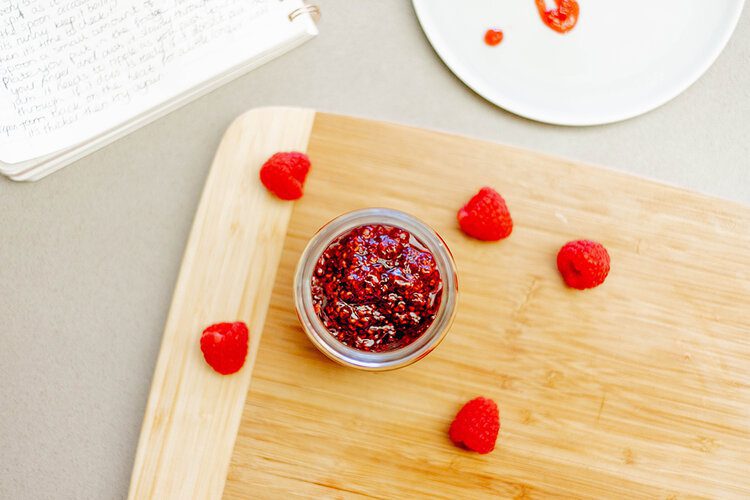
This is a small batch jam recipe and will make one jar of jam. A 150g punnet of raspberries (which is a standard measurement in British supermarkets) will make one 350g jar of jam.
Although I give quantities of the ingredients below the rule of thumb for jam making is to have equal sugar to fruit. The quantities in my jam recipe are based on the punnet of raspberries I bought, so just check the weight of the punnet you buy and adjust your sugar to equal it.
Take into consideration this is based on weight not volume.
How long will homemade jam keep?
If you store homemade jam in a cool and dry space that is out of direct sunlight it will last for 12 months.
Once opened, your jar of jam should be consumed within a couple of months.
Store opened jars of jam in the fridge.
Use a clean spoon/knife (as opposed to one with butter on it) to prevent it from getting contaminated.
How will I know my jam is the right consistency?
I explain the process for checking your jam is the right consistency in step 9 of the recipe below but if you’re just looking for this answer then the test goes as follows:
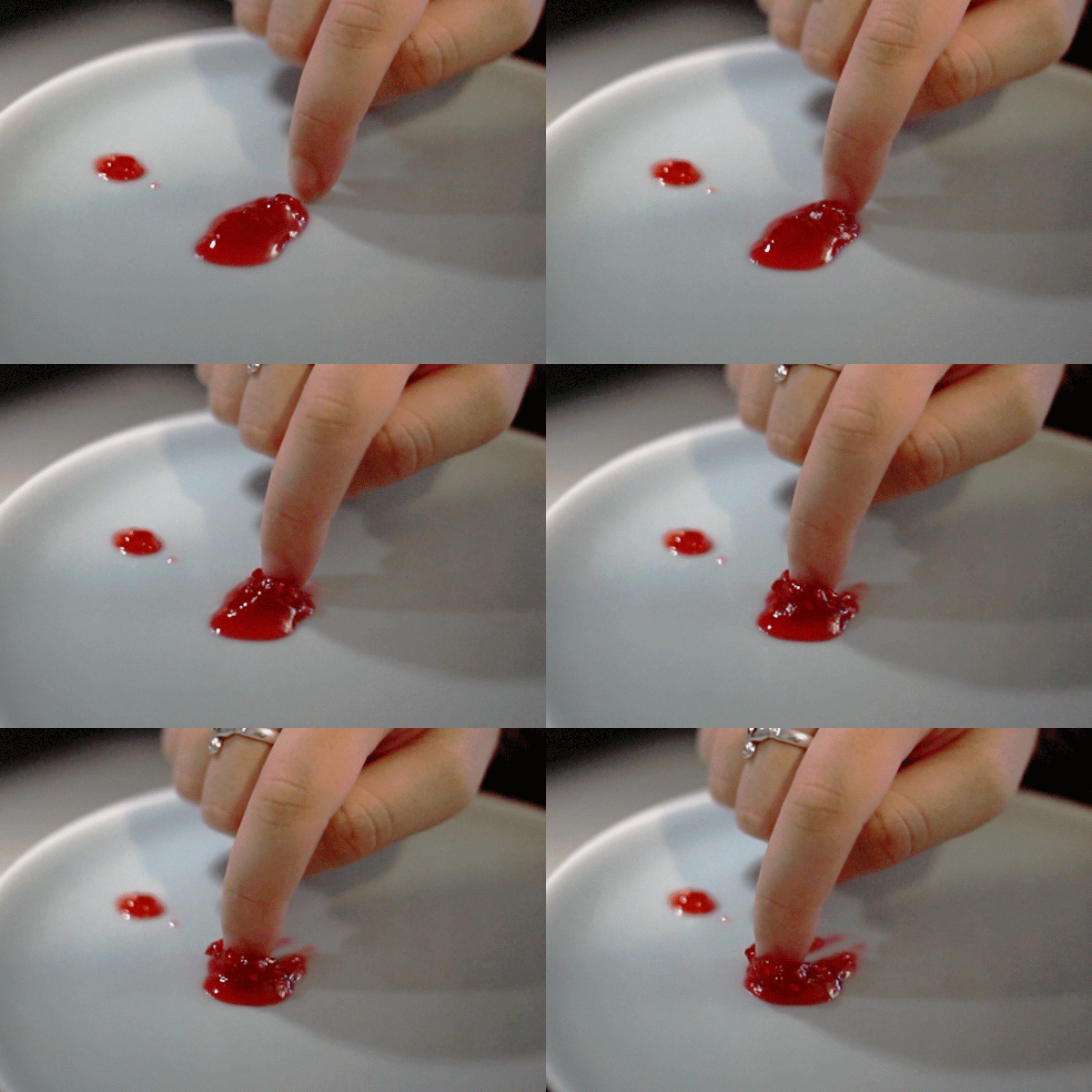
To test if your jam is ready to pour into your jar push your finger through the centre of the jam. If the jam ripples in resistance to your finger nail and your finger leaves a clear path through the jam then your jam is at the right consistency.
If you’re still unclear then take a look at step 9 for a GIF that perfectly illustrates what I mean.
What you need to make jam
Wooden spoon
Medium saucepan
Small saucepan
Scales/measurement cups
Tbsp measure
Small plate
Jam jar with lid
Homemade raspberry jam ingredients
150g / 1 ⅓ cups / 5.3 oz of fresh raspberries
150g / ¾ cups / 5.3 oz of Billington’s golden caster sugar
1 tbsp lemon juice
Raspberry jam recipe
1. Put a small plate in the fridge. This is for checking if your jam is the right consistency before pouring into your jar to set.
2. Pour some boiled water into your jar to sterilise it. Set it aside until you’re ready to pour the jam in.
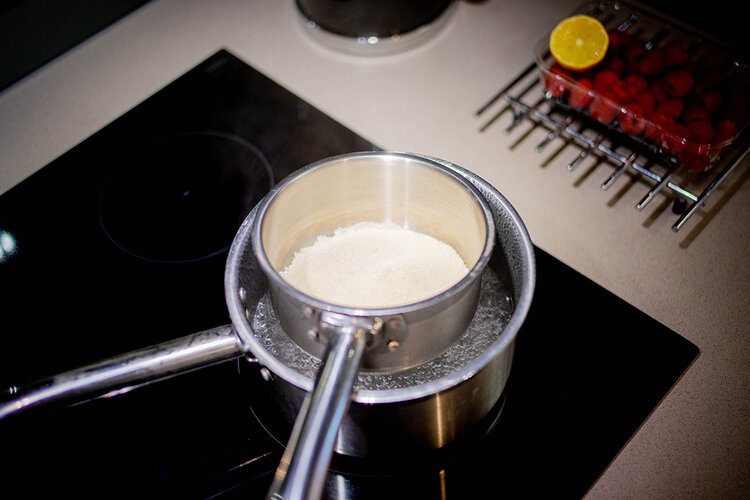
3. Set up a double boiler by placing the smaller saucepan into the larger saucepan and bringing enough water to the boil in the large saucepan that it heats the small one but doesn’t touch the bottom. Once the water is boiling, turn it down to a simmer.
4. Add your sugar to the small saucepan and leave it to gently warm the sugar, this will encourage the fruit to melt rather than burn when you add it. Stir the sugar every few minutes to make sure it’s heating evenly.
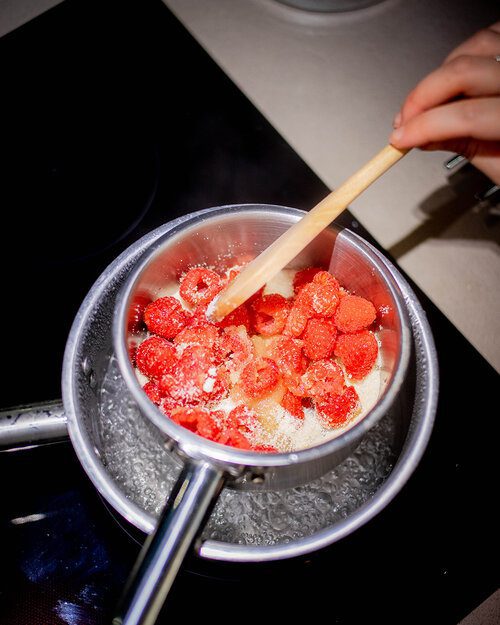
5. Once the sugar is warm to the touch (it should only take about 8 minutes) add your raspberries (or fruit of choice) and lemon juice.
6. Gently stir to encourage the fruit and sugar to melt together.
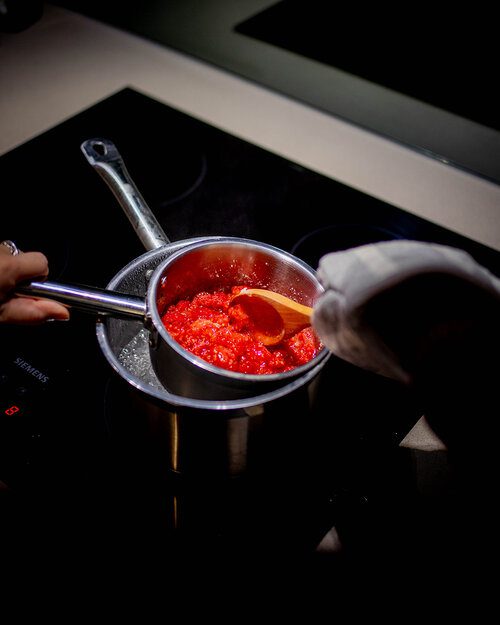
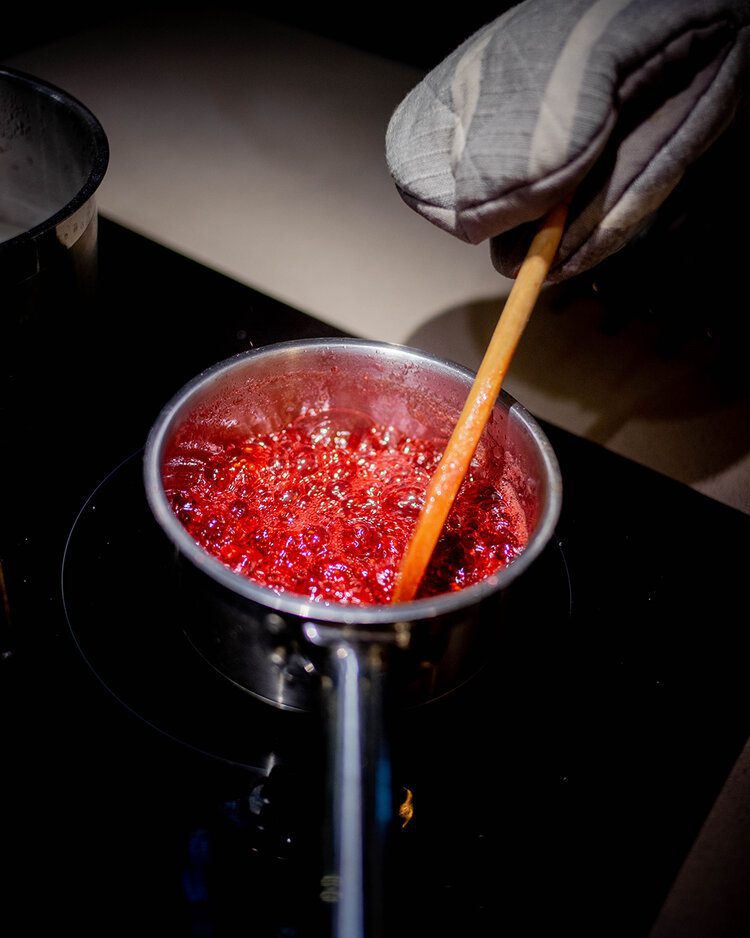
7. Once the fruit and sugar has combined, remove the small saucepan from the large one and place it directly onto the hob (giving the bottom a quick wipe dry before) and increase the heat until you have brought the mixture to a boil, stirring it consistently every 5 seconds. WARNING, the jam mixture will spit as it boils so wear oven gloves/mitts to protect you hands.
8. After 10 or so minutes boiling, the consistency should go from runny to sticky. If it is still runny then continue to boil and stir it. You want to keep an eye out for when it starts to stick to the sides of the saucepan.
9. Once you see the jam starting to stick, take your small plate from the fridge and use the spoon to drop a small amount of jam onto it. To test if your jam is ready to set, push your finger through the centre of the jam, just like I’m demonstrating in the GIF below. If the jam ripples in resistance to your fingernail and your finger leaves a clear path through the jam then your jam is at the right consistency. If it doesn’t ripple and looks as though your finger was never there then continue to boil and stir the jam until it appears thick enough to try this test again.
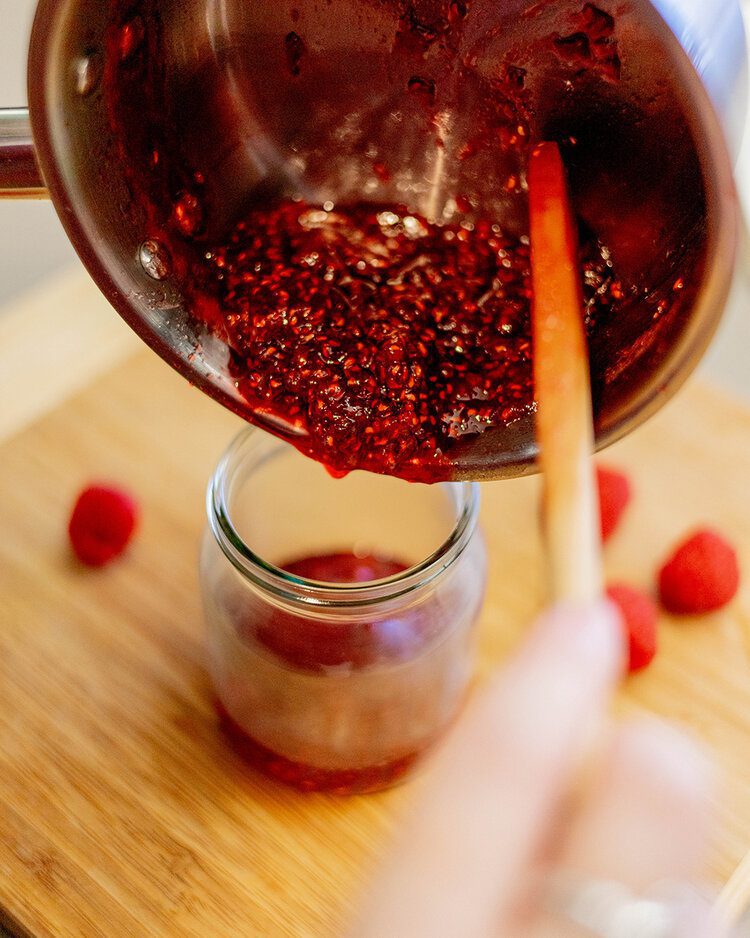
10. Once your jam is the right consistency on the plate, take the saucepan off the heat. Pour the water out of the jar, dry it and pour the jam in. Place the lid on whilst the jar is still warm so that it forms a seal (as it cools you’ll hear a pop as the lid expands to form a seal).
11. Leave it out to cool completely so that it sets. You can keep your unopened jam in a cool and dry place for up to a year. Once opened, store it in the fridge where it will last for a couple of months.
New to crochet? Want to learn how to make something you can take on your travels around the world to keep you warm? Something you made with your very own hands and are very proud of?
GOOD! That’s why I made this beginners step by step crochet tutorial for my chunky beanie hat. Well, that and a lot of you requested it.
I learnt to crochet Summer 2020. With no travel in sight, I needed something to occupy my mind and I always love trying something new. Yes, the summer of 2020 was the summer of crafts, I learnt to crochet, tie-dyed half of my clothes, made my own candles, made a bunch of hair scrunchies from Michael’s old jeans and I taught you how to make the best banana bread ever (so I’ve heard).
Since I started, crochet has taken a special place in my heart. As someone who has dabbled in knitting, personally I think crochet is easier and far more enjoyable. It’s easier to correct mistakes, to transport when you’re travelling and it’s really quick! So let’s get started.
To make this as easy as possible to follow if you’re a beginner, I have added some extra guidance in italics under most steps of the pattern. In these additional steps I go a little slower and give you a step-by-step guide for completing a double crochet (US) stitch which is the main stitch for this chunky beanie crochet hat. If you’re a crochet whizz or simply understand how to follow a shorthand pattern, then go ahead and breeze past those extra words of encouragement.
Sizing for this chunky beanie crochet hat
This free crochet pattern for a chunky beanie hat will fit a small-medium adult head. If you want to make it bigger then simply add a couple of extra rows. For reference, 32 rows fits me and 34 rows fits Michael.
What you need to crochet my chunky beanie hat
5.5mm hook.
100g Chunky yarn/wool (between double knit and super chunky), minimum 135m/147 yards. I used Amelia Cake by Canan for no other reason than all the yarn/wool shops are closed during lockdown and it’s all I could get my hands on in Wilko. I highly recommend finding a yarn/wool that is made from recycled or natural materials.
Darning needle (if you don’t know what this is, it’s a chunky needle with a large eye for the wool/yarn).
This pattern uses US terms (because that’s what I learnt to crochet in) but here’s a quick translation to UK crochet stitches:
Double Crochet (US) is a Treble Crochet (UK)
Abbreviations
ch = chain
dc blo = double crochet in the back loop only
st – stitch
sl st = slip stitch
yo = yarn over
Make a slip knot and ch 39.
1st row: 1 dc in 3rd ch from the hook (the first 2 ch on the hook acts as your turning ch which lifts you up to work on the next row). When you reach the end you should have 37 stitches.
I’ve placed a stitch marker in the 3rd ch from the hook to help you identify it.
How to do a Double Crochet (US) or Treble Crochet (UK) crochet stitch in the back loop only:
With one loop already on the hook, bring the yarn over the hook so it looks like you have two loops on the hook.
Insert your hook vertically down through the stitch (through the little “V”) and push it out the back, so your needle goes under the back loop of the little “V”.
Yarn over and bring it it back up through the stitch (“V”). Now you will have 3 loops on your hook.
Yarn over and bring the hook through the first two loops on your hook. You should now have two loops on your hook.
Yarn over again and bring the hook through the final two loops on your hook. You should now have one loop on your hook.
Congratulations you have completed your first double crochet in the back loop only (dc blo) stitch!
2nd row: ch 2, turn your work, work 1 dc blo in each of the 37 stitches.
Remember how you skipped the first two stitches on your first row and I said it’s your turning chain to raise you up to the next row, that’s what this “ch 2” is every time you reach the end of a row to begin a new one. When you have chained two, you work into the first stitch in the row you previously worked. You should have 37 stitches when you finish your 2nd row.
To turn your work is to flip it around so you can begin working back across the row you just made.
Continue to do a double crochet stitch in the back loop only that I explained above across all 37 stitches before moving on to the next row.
How to turn your work.How inserting into the back loop looks in a row that isn’t the starting chain.
3rd row: repeat instructions for 2nd row. Now continue to repeat this row until you have 29 more rows (32 row altogether).
You’ve got this!
You will now have a rectangular piece that looks like a luxury bedspread for a Barbie doll, right? Great!
Fold the rectangle in half taking the two short edges together. Now you’re going to stitch them together using your crochet hook.
Join the two edges by working 1 sl st in each st.
Insert your hook through each stitch you made on your last row and through to the other side of the other edge, yo and pull it through both edges and continue to pull it through the loop already on your hook. Continue to do this across all 37 stitches.
Fasten off leaving a tail of 15”/40cm
To fasten off, ch 1 and cut your yarn leaving 15”/40cm (for this pattern) then use the hook to pull the loop on the hook up until the end of the yarn/wool comes out. Pull on the tail of yarn/wool gently to form a knot that will prevent your crochet piece from unravelling.
You should now have a crochet tube, got that? Perfect!
You’re nearly there!
Thread the end of the tail of yarn/wool through the darning needle and from the joining seam you just made, begin to weave it in and out of the open edge of the hat, you want to keep the thread close to the top edge.
As you weave in and out, gently pull on the thread so you draw the top of the hat closed as you go along.
Once you reach where you started, pull the yarn/wool gently so that the top of the hat closes and leaves no hole. Remove the needle and tie the yarn/wool to the tail of yarn/wool from your original chain.
Turn the hat inside out so that the seam you created is on the inside.
If you want to add a pom pom then thread the longest end of your yarn/wool onto the darning needle, thread the yarn/wool up through the top of the hat, just off to the side of the centre. Take your pom pom and thread the yarn/wool through it, then thread the needle back into the inside of the hat, this time insert the needle just off to the other side of the centre.
Putting space on either side of the top of the hat when you attach the pom pom makes it more secure and less wobbly on the top.
Pull the yarn/wool tight and secure the pom pom by lopping the yarn/wool tail to a stitch on the inside of the hat then weave in the two ends.
If you don’t want to add a pom pom then weave in your ends.
How to weave in your crochet ends
Thread the end of the yarn/wool onto the darning needle and simply weave the needle under stitches within your work piece. You preferably want to do this on the inside of anything you make so that it’s not visible on the other side. In this case, you will do it on the inside of the hat.
You can go down one row and come back on yourself in the next, or you can simply go straight down one row. You don’t need to do anything fancy but the more you weave, the more secure the end will be.
Once you’re happy with how much you’ve weaved in, simply cut the yarn/wool close to piece.
Fold up the bottom edge of the beanie hat and now it’s ready to wear!
Congratulations on successfully crocheting my chunky beanie crochet hat! I’m proud of you!
Valentine’s Day is just around the corner but for many of us this year will be spent indoors as we observe the advice from the government to stay home to save lives. Yes, unfortunately a worldwide pandemic where we’re all encouraged to stay away from each other doesn’t exactly bring forth romance and passion, especially as most of us have been cooped up with our partners for months on end and they’re becoming a little less desirable and a little bit more irritating. You get it.
If you’re in the heartbreaking position where you aren’t living with your partner and you’ve had to isolate yourself without them, my heart goes out to you star-crossed lovers. For you I particularly want to share my How to make long distance relationships work blog post, who would have thought down-the-road could qualify as a long distance relationship!
Then there’s those who aren’t in a relationship and going on a hot date has been reduced to eating a meal you cooked yourself on a video call with a stranger who you hope won’t notice that you’re still wearing your PJ bottoms.
Yes, Valentine’s Day in a global pandemic doesn’t exactly have us dressing up for a night on the town but on the plus side, at least we don’t have to fight for reservations months in advance and can avoid competing with other couples for who looks the most in love in restaurants, like you haven’t…
So Coconut & Cotton – a plastic-free, earth conscious store that helps you to live a more sustainable lifestyle – and I are here to help you make the most of your Valentine’s Day indoors by turning it into an at-home spa day! Whether you’re at home with your partner or friends or are living independently we will help you to treat your mind, body and soul to a relaxing day of self-care and self-love that you deserve and it’s environmentally conscious too! To quote the late, great Whitney Houston, “learning to love yourself is the greatest love of all”.
Nothing says self-care and self-love more than a massage and facial followed by a full body exfoliation with a soothing soak in the tub accompanied by hot tea. Sounds like a dream right? Well all of the products sold by Coconut & Cotton that I’m about to introduce you to in this blog post will help you to enjoy every one of those luxurious treatments at home. So don your fluffiest robe, press play on my spa day playlist below, light your favourite candles and let’s get started.
To purchase any items from Coconut & Cotton simply click on the links in pink or on the photos below and you’ll be taken to their online store where you can add them to your basket.
Coconut & Cotton makes some lovely gift boxes but this one is my very favourite. It smells wonderful – like a bouquet of fresh roses – the moment you open it and is packed full of so many opportunities to treat your skin the way it deserves.
It’s a particularly perfect Valentine’s Day gift as it’s all rose scented and each product will help to protect delicate skin throughout winter by giving it the extra nourishment and hydration we all need during the colder months.
It comes gift wrapped (plastic free and recyclable of course) with a label for you to write a loving message to your partner, friend or yourself and it contains a card that explains how to use each product.
For a deeper insight into Coconut & Cotton’s Luxury Rose Pamper gift box I’m going to take you through each product included below. You can buy each item in the gift box individually too if that better suits you!
Marseille soaps are my favourite soaps in the world (which is why you’ll see them recommended a few times in this blog post). They’re little bars of heavenly-scented cleanliness that is enriched with shea butter so it doesn’t dry out skin and they lather up like a dream. The range of scents goes beyond your imagination and each fragrance smells exactly like the real thing. All the ingredients are natural and are particularly favourable to sensitive skin.
Use in the bath or shower and leave smelling like a bouquet of red roses without the extortionate Valentine’s Day price tag. Pairs well with the organic sisal hemp pouch for exfoliation too.
Roses aren’t just a lovely treat on Valentine’s Day, they’re also known for their anti-inflammatory qualities, so not only does this bar of rose geranium Friendly soap smell wonderful but it also helps to reduce any facial redness – excluding blushing cheeks upon receiving this Luxury Rose Pamper gift box.
Friendly Soaps’ bars of soap are free from cruelty, preservatives, palm oil and plastic but better yet they’re the kind of gift that just keeps on giving. For every sale, Friendly Soap donates 10p to Just A Drop who will provide less fortunate communities with safe hand washing stations to reduce the impact of the Coronavirus. They’re also partnered with Treesponsibility to reduce their production’s carbon footprint.
Also their packaging is not only recyclable, it’s made from recycled paper too.
This organic sisal hemp soap pouch is ideal for making the most of the last bits of your soap. Pop any bars of soap that are on their last legs into this pouch to increase its longevity and prevent it from taking a deep dive down the drain.
One of the best spa treatments I’ve ever experienced was a full body exfoliation in a hammam in Marrakech so I highly recommend some kind of exfoliation for your at-home spa day this Valentine’s Day as it will make you feel rejuvenated and not to mention silky smooth!
Using toner draws out dirt from pores and the witch hazel in this Flawless rose and lavender hydrating face toner encourages them to reduce in size which will lessen the chances of breakouts. The anti-inflammatory qualities of the rose will help to reduce redness whilst the antibacterial qualities of the lavender will help to fight off breakouts.
Use it as part of your at-home spa day facial for the ultimate pore treatment.
Facial oil or how it’s otherwise known in the beauty industry: serum, has many benefits. They help to tighten, brighten, plump, moisturise and even act as anti-ageing treatments. If a facial oil hasn’t made its way into your skincare routine then receiving the Luxury Rose Pamper gift box will fix that!
Applying this organic rose geranium facial oil will be the final step to your at-home facial during your Valentine’s spa day that will leave you feeling like you’ve actually spent the day at a spa. It’s the luxury you deserve.
I highly recommend using facial oil particularly in winter as it will be the extra hydration skin needs during the harsh, colder months. Use it after moisturiser to help lock in the moisture you’ve just applied. Oils can penetrate moisturiser but not the other way around so make sure you use it after applying your moisturiser.
No spa treatment is complete without a glass of fruit infused water or a serving of aromatic herbal tea, but why are we served boujee water post massage? Hydrating straight after your treatment helps to sooth your muscles that have just been worked on, flush out the toxins that your massage released and it also helps to reduce any soreness you may encounter the following day because not all of our partners give sensual massages; some have you preferring the pain of a stiff neck because it’s a less painful ordeal than one of their massages. I speak from experience and it’s why I recommend the round bamboo massage brush from Coconut & Cotton below.
Back to the tea, now that we know why we are encouraged to rehydrate after a massage, why leave this part out of our at-home spa day? Included in Coconut & Cotton’s Luxury Rose Pamper gift box – perfect for Valentine’s Day – is their rose earl grey loose tea. This black tea infused with bergamot and rose not only makes for a rather romantic cup of tea on Valentine’s Day but the rose petals are high in Vitamin C so they’re good for your immune system too (not a bad benefit during a worldwide pandemic).
Coconut & Cotton have a large selection of loose teas that will tickle any fancy from English Breakfast for the first cuppa of the day to calming chamomile for your last one at night.
Need help infusing that loose tea? No worries, also included in Coconut & Cotton’s Luxury Rose Pamper gift box is a ball loose tea infuser. Half of the UK’s leading tea brands use a single-use plastic skeleton in their tea bags which means millions of our beloved cuppas will be contributing to the world’s plastic pollution crisis. To ensure that your brew doesn’t make matters worse, opt for loose tea. I switched to loose tea on Christmas Day 2019 and not only have I saved myself from using hundreds of tea bags but it also brews a far superior cup of tea.
Spoon a couple of teaspoons of the rose earl grey loose tea into your tea infuser and leave it brewing in boiled water for 2-5 minutes (depending on how strong you like your tea). Perfect for your Valentine’s Day breakfast or for rehydrating after your self-care spa day.
A spa day without a massage is not a spa day I’m interested in. What’s that you say, you don’t have a professional masseuse at home for your self-care spa day? Bummer! Good job Coconut & Cotton have a round bamboo massage brush then.
Their round bamboo massage brush means that you don’t have to rely on your partner’s tricky hands, instead they can use the brush in a circular motion across your body and you can do likewise for them. Don’t have a partner? Then you can still use the brush over the parts of your body you can reach, much like dry brushing it increases blood circulation and encourages lymph flow/drainage but to make it a little more luxurious for your at-home spa day, use the organic cedarwood, lavender and juniper berry body oil (see below).
As well as using the organic cedarwood, lavender and juniper berry body oil to give skin the maximum moisture it deserves, use it in a bath in place of bubble bath. Sure, bubbles are fun, I mean who doesn’t love a bubble bath, but if a luxurious spa-esque soak is what you desire for your self-care Valentine’s Day, then oil is where it’s at. Oil penetrates the outer layer of skin and ultimately traps moisture leaving skin hydrated and feeling silky soft. Combined with the warm water the oil will infuse the steam produced which will open your pores and let the beneficial qualities of the botanicals in the oil get to work.
A facial absolutely must include a face mask and Coconut & Cotton has the perfect one for your Valentine’s Day spa day! Their Ancient pink clay powder face mask is made from 100% kaolin clay which is a natural cleanser that draws out impurities from the pores and lifts dry skin cells away leaving skin feeling soft.
To use it add 2 teaspoons of the Ancient pink clay powder face mask to water in a small bowl and combine until it becomes a paste. Using either a brush or your fingers to smooth it over your face, let it do its work for at least 15mins before washing off with warm water.
As I mentioned above, Marseille soap is the loveliest of all the soaps. These ones sold by Coconut & Cotton have been made by the same family for over 90 years. This passion fruit scent is one of the most divine of the collection, when I opened my package from Coconut & Cotton it was the first thing I smelt and it had me so eager to jump into the shower with it. Given the choice between a bouquet of roses or a few bars of Marseille floral scented soaps, I know which I’d prefer.
Since Coconut & Cotton started stocking the Marseille soap on a rope I’ve had one hanging in my shower. Not only does it look good but it eliminates the need for a soap dish in the shower and lasts twice as long as the usual bars. My favourite part of having soap on a rope though is that I don’t drop it nearly as much because I keep the rope around my wrist whilst I wash. If you’ve switched to using bars of soap to eliminate single-use packaging then you know exactly how slippery those suckers are in the shower and can appreciate this perk.
Marseille soaps make for such pretty gifts too, they just make me yearn for rustic French bathrooms somewhere deep in the countryside of Provence.
Here is an idea of how your at-home spa day can look with these luxurious and environmentally conscious skincare products from Coconut & Cotton on Valentine’s Day.
Apply the Ancient pink clay powder face mask to clean skin and lay back for 15mins with a couple slices of cucumber fresh out of the fridge over your eyes to reduce any puffiness, plus it looks legit. Gently remove the clay face mask with warm water and apply the Flawless rose and lavender hydrating face toner to draw out any lingering dirt that may be clogging your pores and follow with the organic rose geranium facial oil to rehydrate your skin better than most moisturisers. To finish off either use a face roller or gua sha to make sure your products deeply penetrate (it’s Valentine’s Day after all) your skin. Alternatively you can use your fingers to massage the oil into your skin.
I recommend applying your face mask before getting into the bath and applying the toner and oil once you’re out.
Then cosy up under a blanket on the sofa with another cup of rose earl grey and pop on a rom-com classic.
.
Coconut & Cotton is an Earth-conscious, female owned shop located in Shaftesbury, south-west England. Both their store and online shop sells sustainably sourced and plastic free household products that encourage less waste and are very affordable. Sustainability is their focus and each one of their products will encourage you to live your best environmentally-conscious life. Better yet, each one of their packages sent out are plastic free and in reusable packaging.
I highly recommend you follow them on Instagram too – @coconut.and.cotton – as Lucy, the founder of Coconut & Cotton provides some very entertaining and relatable content on her daily Instagram Stories. She also shares product reviews, new products, tips for living a low-waste lifestyle and she does frequent shop tours which is a very fun way to shop during the pandemic.
This article is a paid piece for Coconut & Cotton. I was originally and still remain a Coconut & Cotton customer. I highly recommend purchasing your low-waste household supplies from Coconut & Cotton as their products are high quality and the customer service is exceptional.
Tayvada is an environmentally-conscious, female-owned business based in the USA. Founder Linda Bogdanov’s vision for her brands is to empower everyone to practise self-care in a responsible way that puts the protection of our planet at the forefront of our minds as we do so. Tayvada’s first product is the reusable makeup remover pads that are growing in popularity and recently featured on Glamour.com as one of their top picks for reusable makeup removers.
I’ll be taking you through why I love using Tayvada’s reusable bamboo pads, how I use them in my daily skincare routine, why they’re a responsible choice as a sustainable swap in your bathroom and what to expect when you order your own.
Why reusable pads are better for the planet than single-use cotton pads
“I started thinking about my own beauty habits and how I was using a lot of disposable cotton pads to take my makeup off and I was using makeup wipes when I travelled.” – Linda, founder of Tayvada.
The most important thing I want to start off with is explaining why reusable pads are better for our environment than using single-use cotton pads or wipes so with this, let’s explore the difference between the cotton that goes into the single-use pads and the bamboo that goes into reusable pads that should be replacing that daily waste.
Bamboo vs cotton
Bamboo is an evergreen plant which means it remains fresh and functional all year round. It is a highly adaptive plant that grows quickly and is resilient to many pests. According to the Guinness World Records, the fastest growing plant is bamboo with one species having grown 91cm/35in in a day. Despite originating in China, with adequate soil conditions, bamboo can grow in different climates around the world. The use of bamboo can be traced back 7,000 years to the Shang Dynasty in clothing, food, housing, weapons and more. Its durability, strength (bamboo is actually stronger than steel) and renewability means it’s the ideal material for making sustainable products, especially as it naturally biodegrades at the end of its usage.
Cotton might be the most profitable non-food crop in the world but the methods used to create the cotton that goes into approximately half of all fabrics worldwide are not sustainable and are causing a great deal of waste and pollution.
Extensive use of pesticides and insecticides to control pests and risk of disease to the cotton plants are polluting the water, air and soil and is causing poor health to the people working on the production line. Not to mention that it takes approximately 20,000 litres of water to create 1kg of cotton before it even becomes something else.
The average makeup-wearing womxn will use three single-use cotton pads in their daily skincare routine. It takes about 1,000 litres of water to create a pack of 100 single-use cotton pads (which usually comes in a single-use plastic packet) and that pack will only last the average womxn 33 days. Now compare that to Tayvada’s bamboo reusable pads which will last up to 1000 uses! Not to mention one gets thrown into the washing machine whilst the other gets thrown into a landfill.
When the production of a product that can only be used once is far more damaging to the planet than one that can be used x1000 more, the choice seems obvious, right?
Unboxing Tayvada’s reusable pads
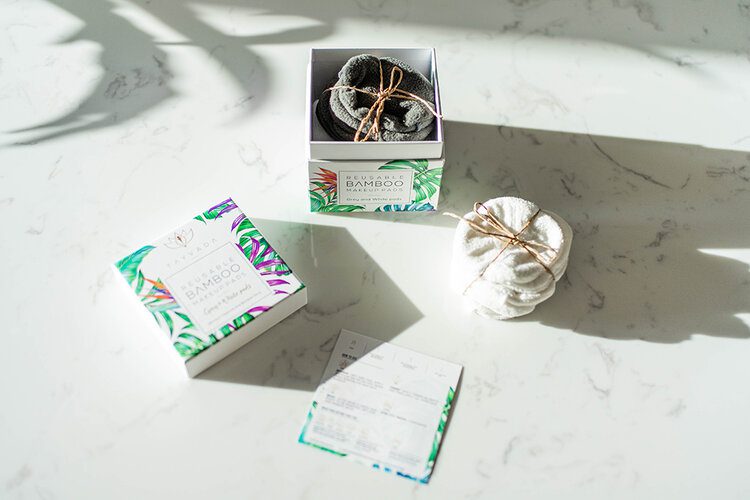
The packaging for Tayvada’s reusable bamboo pads is minimal, 100% recyclable and can all be repurposed. The box is compact and high quality so you can use it for storage – I currently use one of mine to store some crafting supplies such as twine and tape – but the pretty Bird of Paradise illustration on the box is enough of a reason to keep it around – plus the twine and tissue paper can all be used again.
Inside the box you receive 14 pads, seven are bamboo charcoal and the other seven are bamboo terry cloth. What’s the difference? Good question.
Bamboo Charcoal pads
The grey fleece charcoal pads are the softest of the two types. They are ideal for makeup removal as they are buttery soft and won’t cause irritation to sensitive skin types. They can remove makeup with just water.
Charcoal bamboo absorbs moisture so when you use the grey pads with just water to remove your makeup, your face is left clean of excess product and not wet, unlike if you were to use micellar water or an oil based product which leaves residue on your skin.
Bamboo charcoal also naturally draws out dirt, oil and toxins from deep inside pores to cleanse the skin. This is ideal because it reduces the size of pores and the likelihood of getting acne, it also makes for a more effective makeup removal process.
Bamboo terry cloth
The terry cloth pads are still soft but compared to the charcoal pads they have a textured surface made from minute loops that help to exfoliate by lifting up excess makeup, dirt, oil and dry skin from your face and out of your pores.
These terry cloth pads are particularly great for applying your toner to remove any makeup that the naked eye can’t see or for removing face masks and/or scrubs.
This bamboo terry cloth is also the perfect towelling fabric for absorbing moisture, so I recommend having a little stash in your gym bag so you can pat your face dry from that healthy post-workout shine without irritating your skin.
.
There’s one of each for every day of the week so you can get away with washing them just once a week to keep regularity in your skincare routine. I put mine in the washing machine on Sunday morning, naturally air dry them and they’re ready to use by the evening.
Earlier I mentioned that bamboo is resilient to pests, its natural antibacterial and anti-fungal qualities means the pads won’t grow any nasties in the few days you wait to wash them altogether.
The 14 pads come with their own mesh wash bag so they can all stay together and not go to the land of missing socks (I throw my face masks in their mesh bag to wash for that same reason). I wash mine on a 30ºC/86ºF eco wash along with the rest of my darks and/or colours with a dissolvable laundry detergent strip (from Tru Earth) that is free from toxic chemicals and microplastics. Despite them going on a cool wash, the makeup residue gets removed from my Tayvada pads every time with ease.
A comparison between a new Tayvada Bamboo terry cloth pad and one I’ve been using for a year. It’s a little smaller and darker because it’s been washed so many times but the quality has remained.
I’ve been using mine for a year now and, as you’d expect with frequent use, the white terry cloth ones have darkened over time but I’m sure if you were to do a warmer wash (think of the planet though) they would come out whiter.
How I use Tayvada’s reusable bamboo pads in my evening skincare routine
I use the grey bamboo pad with just water to remove my makeup (yes, I use just water and the pad). Winged eyeliner is part of my everyday makeup look and has been since I was a teenager so I know what problematic makeup removal can look like and I have never had a problem removing it with Tayvada’s reusable pads.
Something I particularly love about Tayvada’s bamboo pads is that the little pocket where your fingers slip in allows for better grip and control of the pad on my face plus it means that the full surface area can be used for better makeup remover/product application. I am able to utilise both sides of the pad to remove my makeup with ease and if I’m wearing a little more that day then I simply turn the pocket inside out and use that extra clean surface to utilise it all.
Like with many makeup removal processes one technique doesn’t usually get it all and the naked eye could be missing something, so once I have removed what’s visible with the grey pad, I spray some toner onto a white bamboo terry cloth pad and apply it across my face. This usually lifts the last of my makeup from my skin.
I then exfoliate my face with a coffee scrub which I remove with water and the same white terry cloth pad I just applied toner with. The little loops of the bamboo terry cloth pick the coffee grains up off my skin and prevent me from making too much mess in the sink (if you’ve tried to remove a face mask or scrub with just your hands and water you’ll know exactly the kind of mess I’m referring to).
I then apply a serum and moisturiser before using my gua sha to cool and sculpt my face.
At least once a week I like to apply a face mask – #selfcare – and to again minimise mess and add a little exfoliation to the process of removal, I use one of the bamboo terry cloth pads to take it off and my skin always feels smoother than when I haven’t used it.
Once I’ve finished with the pads I simply rinse the pad of coffee and/or face mask as best as I can, then leave them on the edge of the sink to dry before adding them to the wash bag they came with.
Why they are perfect for travellers
One of the most responsible things a traveller can do is do their best to evolve their travel routine into a more eco-conscious one. Travelling is a top contributor to rising carbon emissions, plastic pollution and food waste (to name a few) but of course only a worldwide Coronavirus pandemic can hold many of us – who are fortunate to have the opportunity to travel – back. So it’s of high importance that we make changes that will reduce our carbon footprint as much as we can so that each time we explore our beautiful planet, we aren’t causing her further pain.
“I had travelled quite significantly and realised the impact this was having on the environment and how my consumption habits in general were impacting our planet. I started thinking about my own beauty habits and how I was using a lot of disposable cotton pads to take my makeup off and I was using makeup wipes when I travelled.” – Linda, founder of Tayvada.
Some of the many things we can do is offset carbon emissions from our air travel (click here for my blog post that explains how you can do that), avoid staying in all-inclusive resorts (their daily food waste is heartbreaking) and pack items that prevent us from using single-use products that will be contributing to that country’s pollution crisis. Some ideas on reusable items you can bring with you are a water bottle (if you’re going somewhere where the water could be contaminated then bring filtration tablets or seek out a bottle with a filter), straws and cutlery, shopping bags, a menstrual cup and bamboo pads such as the Tayvada ones this very blog post is all about. Fancy that!
Ok so you know they’re better for the environment than the single-use cotton pads but need a few more reasons as to why we travellers need them in our toiletry kit? Well I’ll answer that now, I know, I’m good to you like that:
Unlike a bulky pack of wipes or stack of single-use cotton pads, with enough to cover at least three per day that you’re away these reusable pads won’t take up as much space as you won’t need to pack so many. You can just take a few of each and wash them as you go.
They prevent the need for bottles of makeup remover, so there’s less toiletries to pack making your packing process quicker and your luggage lighter.
You can travel with an easy mind knowing that your skincare routine isn’t contributing to further daily waste to where you’re travelling to and to the planet.
They’re soft on your skin which is welcomed when travel, from pollutants to recirculated air, takes its toll on it.
For every box of Tayavada’s reusable bamboo pads sold they offset the carbon footprint that would be created by a an entire year’s use of single-use cotton pads. So you’re not only saving waste by not using them but you’re helping to counteract the impact for someone who doesn’t have the privilege to afford such a product. To read more about their partner Cool Effects, click here.
Shop from Tayvada here
You can purchase your very own pack of Tayvada’s reusable makeup remover pads from their own website here.
You can also shop them on Amazon in the US, UK, Canada and Mexico. They’re Amazon’s Choice recommendation for reusable makeup remover pads as well as mine.
If you are in the US you can also shop the pads on Etsy here.
.
Tayvada has more low-waste products launching in the coming months, all of which have been designed to replace many of the single-use products we use daily and with the intention of levelling up our self-care rituals. I for one am very excited for what Tayvada has coming next and can’t wait to share it with you.
Gabriella
Pin this post
For full transparency I was originally gifted a box of Tayvada’s reusable makeup remover pads but upon finding they are far better than the ones I was using before (which I have repurposed for alternative cleaning), I purchased more as gifts. This article is a paid piece for Tayvada.
As an Amazon associate I earn from qualifying purchases.
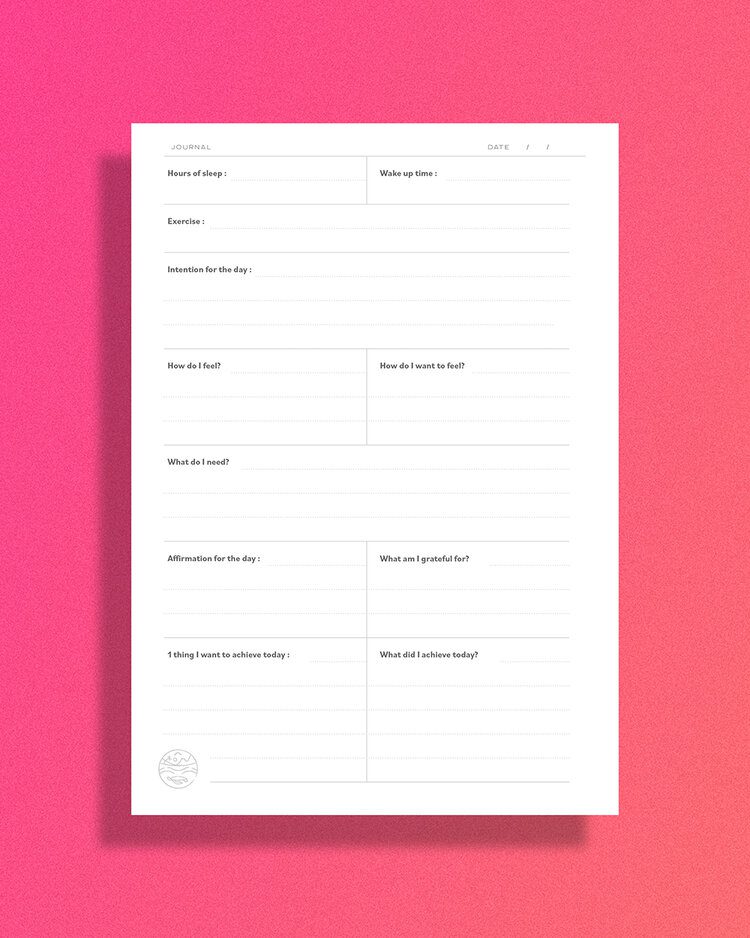
In short, journaling is the process of exploring your feelings, thoughts and goals through the written word. It’s to help you process events in your life whether they’re positive or negative and can be a very important method of self care and growth. Journaling comes in many forms. It could be doodling, an unconscious flow of the written word, a “dear diary” account of your day, manifestations or it could be thoughtful answers to guiding prompts.
I have found prompts to be the best method for me and so after using multiple journals over the last year (many only cover 3 months maximum) I started refining and writing my own prompts that I found most helpful for analysis of my body and mental health, reflection of my achievements and encouragement for setting goals for my life for 2021. Before the new year I gathered them all together and Michael helped me lay them out into my own diary and journal which I would like to share some of today.
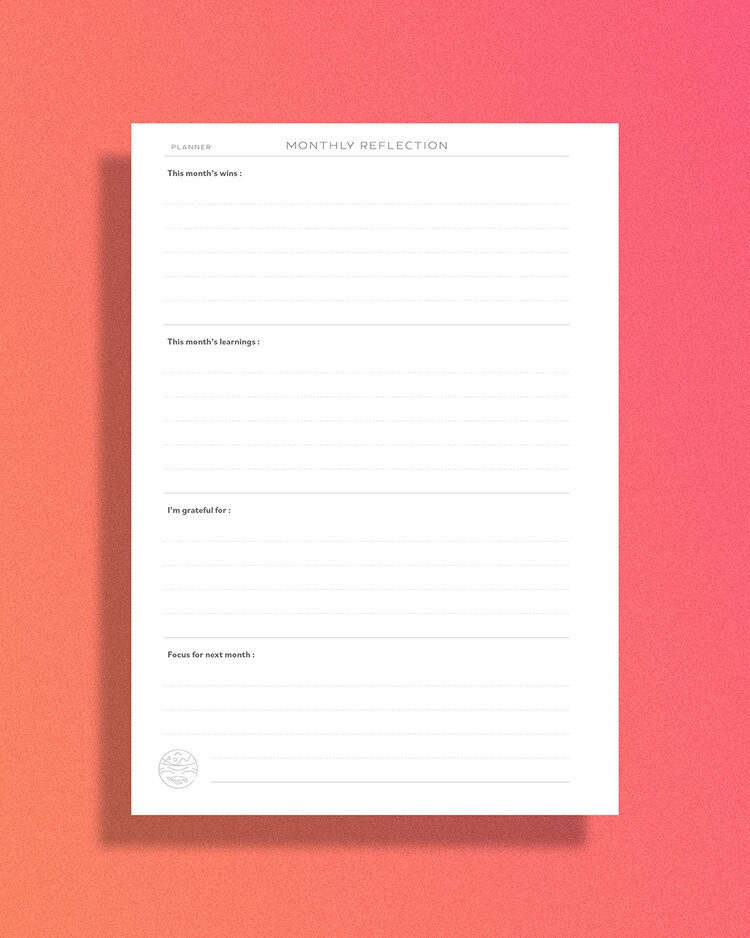
I’ll break down the prompts into sections that cover a reflection of the year just gone, planning for the year ahead, daily self care, a weekly reflection, a quarterly check-in and travel specific ones so you can head to what you think you’ll find most effective for your self development.
Reflect on last year
This section is brief but it’s there to encourage you to look back on the self-growth you’ve already achieved before writing about what you can further do in the year ahead. Use these as a chance to analyse your behaviour so you can decide what you want to continue, improve on or change. Don’t just question what you’ve done for yourself, also look at what you’re doing for your community.
My top 10 highlights:
5 things I achieved:
5 good things I did for others:
5 things I’m grateful for:
5 things I learnt:
Planning for the year ahead – goal setting
This is a big one because if there’s one thing I’ve learnt – this comes from Andi Eaton, author, content creator, spiritual goddess and founder of Oui, We – it’s that you have to be specific with want you want from life/the universe/others and yourself if you want it to materialise. Give these prompts sufficient time so you can be clear with yourself and your page on what you want from this year.
These prompts cover everything from travel to mental health, everything is relevant for helping you to develop what you want to achieve by the end of the year.
What do I want to achieve this year (bucket list/manifestations)?:
What can I do to achieve these?
Top 3 priorities for the next 12 months:
Top travel goal:
Top career goal:
Top financial goal:
Top health goal:
Top relationship goal:
Top community goal:
Top environmental goal:
What are my biggest energy drainers?:
How can I manage my time better?:
What do I need to achieve my goals?
What is going to happen when I achieve my goals?
How will I feel and look when I achieve my goals?
How will others benefit from me achieving my goals?
Where do I want to travel to this year?:
What will be my first trip of the year and why?
Top 10 actions for the next 30 days:
Why are these actions important?
3 things I want to do more of:
3 things I want to do less of:
Habits I’m going to create or change:
Things I want to learn:
Daily check-in journal
If you want to make big moves in life, you have to start with yourself.
It’s all good and well to set the big goals but it’s the little things you do, think and feel every day that will help you progress towards them. Making a note of your sleep (sleep is high up on the list of underrated things that will make you feel better) and what you’re doing to get your body moving (this doesn’t have to be a full on workout, a simple walk outside for fresh air will have a positive impact on your mental health) will help you to keep track of moods. For example, when I was really struggling with a feeling of suffocation and restlessness in the evening I realised from my daily journal I wasn’t spending enough time outside. Likewise, I can also see that my most productive and calm self last year was when I was getting to bed early and rising early, I can see that from where I was clocking in my hours of sleep and what time I was getting up.
Next is to focus on your mental health by questioning and being honest about your feelings and what it is you need from yourself or maybe the day to improve or preserve your mood. It’s not to shame you on how you feel but to be honest with yourself. Goal and intention setting is invalid if you can’t first focus on where you are in the moments that will get you towards them.
Writing down at least one thing you are grateful for whether it’s the coffee that got you out of bed before midday or that the world has recovered from the Coronavirus pandemic and you can embrace people again.
Now that you’re conscious of your feelings and mood give yourself a mini pep talk in the form of your daily affirmation. This should be a positive statement that will help you to work through your negative thoughts and put you on the path of self-love. An example would be “I write interesting blog posts that inspire people to do more on and for our beautiful planet”. Repeating positive affirmations to yourself will encourage you to be kind to yourself, something I know all too well is very hard to do. If you’re struggling with what to write, I suggest logging when someone says something kind or positive about you or your actions that made you feel good about yourself and then using that as inspiration to write your daily affirmation.
The final prompts of the day are to write out the most important thing that you want to achieve that day. Pay attention when I say it doesn’t matter how big or small this is, it’s not an expectation of moving mountains, it’s just a space for you to put out into the universe one thing that will give you a sense of pride, accomplishment, self worth and/or purpose and trust me that can come from something as simple as eating a banana instead of a chocolate biscuit or a banana as well as a chocolate biscuit. “What did I achieve today?” is where I can acknowledge what I did and hopefully that includes what I wrote down as the one thing I wanted to achieve. Sometimes it isn’t though and that’s ok because I will have done something that day and this is my chance to be easy on myself and instead celebrate what I did do. Remember that you have the opportunity to learn something from the goals you don’t achieve, it doesn’t have to be a bad thing but just another part of self-growth.
Hours of sleep:
Wake up time:
Exercise:
Intention for the day:
How do I feel?
How do I want to feel?
What do I need?
Affirmation of the day:
What am I grateful for?
One thing I want to achieve today:
What did I achieve today?
Weekly reflection
This will provide a chance for you to look at the week you’ve just had and assess how you felt, what from the week affected your mood and explore what went well, what didn’t and how you can improve on that for the week ahead. It’s a chance for you to express your discomfort and find a rational response to them. Journaling a reflection of how your week went overall is important for leaving your stresses and worries on the page so that you don’t carry them within your body into the next week.
How did you feel this week?
What can I do to improve my mood?
What went well this week?
What could have gone better?
Is there anything I want to get off my chest?
Make a list of all of my worries:
Write down rational thoughts about my worries:
Monthly reflection
It’s important to celebrate the wins and the progress you’re making as the months go by. Remind yourself what you’ve achieved in the month and likewise analyse what didn’t go well and note what you’ve learnt from it then use these to realign your goals for the month ahead.
This month’s wins:
This month’s learnings:
I’m grateful for:
Focus for next month:
Quarterly goals check-in
Setting your big goals, dreams and intentions at the beginning of the year is great but without checking in on them and your progress, how can you be sure that you’re working towards them? That’s why I have quarterly check-ins to see where I’m at and refocus my trajectory towards my long-term goals for the future.
Top 3 professional goals for the next 3 months:
To 3 personal priorities for the next 3 months:
How will these help me to achieve my long-term goals?
Habits to focus on:
Things I want to learn:
Travel reflection
For a few years before I started blogging which ultimately ended up being a travel journal of sorts for me – where I reflect upon my trip, highlight the good and the bad and share my recommendations – I had tried to keep a travel journal. I attempted to write everything I did and I attached ticket stubs, napkins, brochures and more in a scrapbook manner but I could never keep up with them. I didn’t recognise the potential of focusing on the important facts of feelings and saw it as something that was holding me back from adventuring outdoors so I never finished them.
Since then I’ve developed prompts to keep the information to the point so I don’t feel inconvenienced but reflective, so I have the chance to process my feelings and can jot down the information I might want for future blog posts or conversations. At the very least, this has proven so handy for when I need to recall travel destinations and dates for when I donate blood.
These pages can be filled out in the morning, evening before bed or whilst you’re flying home or to the next destination.
Destination:
Travel dates:
Where did you stay?:
How do you feel about where you stayed?
What was your favourite meal of the trip and where did you eat it?
What are your top 5 moments from the trip?
Did you try anything new?
How did it make you feel?
What from this trip would you recommend to someone else?
Did anything upset you on this trip?
Is there anything you can do to avoid this happening again?
Did you learn anything from this trip?
Would you come back to this place?
If you’ve already started journaling and goal setting, that’s great! Don’t feel like because you have set your goals you can’t add more. I’m constantly editing and setting new ones because my intentions and purpose changes as the year goes on. If I kept to the same manifestations then I wouldn’t have the opportunities I do now and I wouldn’t be true to my own self-growth.
I hope that you find these prompts helpful for refining what you want for yourself and that they will help you to keep track of your most meaningful travel moments. Wishing you safe travels for the year ahead.
A new year comes our way and although there’s a lot of naivety that comes with thinking we can only become our best selves after the clock strikes 12am on the first of January, it’s hard not to get swept up in the “new year, new you” state of mind. Of course I’m not judging anyone for this, I do it too but I also want to encourage you to reflect upon how much you changed throughout the year and not just in January. It’s been an especially tricky one this year too, so celebrate the self growth from the whole year!
I’ve put together 12 suggestions for travel-themed goals and aspirations, not to pressure you into thinking all of these will make you the best globetrotter ever or that you HAVE to do all of them, but to help inspire you to better your own travel experiences and have a more positive impact on our shared environment.
1. Learn a new language
Start to learn a new language or brush up on one you already have an understanding of.
It’s a skill that will always prove useful and be impressive. My top tips for choosing a language to study are:
Pick one that means something to you – though I don’t dedicate enough time to it my choice is French because my Mauritian family speaks French. Michael has been intermittently learning Brazilian Portuguese because he loves the culture.
Pick one that you can practise often – maybe you travel there frequently or have friends and/or family who can help you improve.
Pick one that is widely spoken – Spanish is a good example as it is spoken across many continents and has similarities to other languages that make it a little easier to comprehend them. When I was living in Paris in my early twenties a waiter told me to learn Spanish not French as it is spoken in more countries and it has really stayed with me.
Due to my complexion I have had more people speak Spanish to me around the world than French and I wish I had chosen Spanish over French. Of course, in saying that, there’s no time like the present.
“A year from now, you may wish you had started today” – Karen Lamb.
A great resource for this is the Duolingo app – not sponsored, I just enjoy using it as it presents every lesson as a game.
2. Make sustainable swaps
Make a sustainable swap that eliminates a single use plastic in your daily travel routine.
Travelling around the world, as magical as it is, just isn’t all that good to our planet. Of course I want us all, who are able to, to be able to explore and appreciate the beauty of Mother Earth and explore not only what she has on offer but also self growth and healing that comes from the freedom of travel, but to be able to do so responsibly we must make more of an effort to help to restore her.
Shop Coconut & Cotton here.
How? The most responsible thing you can do to protect and help the environment heal is to use up what you already have before purchasing something else. So start there. Unfortunately choosing to purchase reusable, biodegradable and non-toxic products comes at a higher cost which I appreciate makes things a little more complicated and annoyingly the large corporations who can afford to make these items more affordable haven’t been held accountable enough to do so. The best thing you can do is to use and and reuse what you have. A few examples are:
Instead of purchasing a new tin or sandwich wrap for your lunch use a washed out margarine tub. They’re also great for storing leftovers, cookies and holding your veggie scraps in the freezer until you’re ready to make homemade stock. Sure they don’t look as cute but repurposing is far cuter than overflowing landfills, right?
If you don’t have a reusable coffee cup, aren’t ready to buy one (check out my reusable coffee cup guide when you are), but want to stop using single use coffee cups then dig out an old camping flask or use an old pickle jar for your iced coffee.
Use up your skincare products before buying more. I was so guilty of switching to clean and more responsibly packaged products before using what I had and I didn’t acknowledge it until I was cleaning out my draws whilst packing for Canada in early 2020. I was so proud of myself for reducing my skincare routine to fewer products that were more responsible but I had disregarded the heaps of half used bottles in my drawers. I used up what I could and gave the rest away to friends and family so it wasn’t wasted but it was a big lesson in not turning my back on what I already have. Take advantage of those half full bottles and pack them for your trips – they’ll be lighter than new products and you’ll get through them in no time.
If the hotel you stay in has a bar of soap, pack it before you check out. Some hotels participate in a scheme where it gets reused but if you aren’t aware of them doing that, keep it so you can finish it to save it from getting thrown away.
Naked products from Lush (zero packaging) to reduce your waste on your travels.
When you are ready to purchase eco-conscious products to swap out single-use ones in your day-to-day life and/or travel routine then take a look at the following blog posts I wrote that will help you to make effective, sustainable swaps on your travels:
If 2021 allows it and it is safe for you to do so (be smart about this one) then plan that trip that’s been on your bucket list for who knows how long! If 2020 has taught us anything it’s to seize the moment and book that trip because you really don’t know when that opportunity will no longer be available to you, right?
My top five bucket list trips for your possible inspiration are:
India – I really want to see the Taj Mahal
China – to walk along a part of the Great Wall of China is a major goal of mine
Skiing – I haven’t been skiing since I was 14 and I really want to give it another go (hopefully in Canada), I want some major Wham! Last Christmas music video vibes on this trip
A train ride through some jaw dropping countryside
Polynesian Islands – any one will do!
This one doesn’t necessarily mean you have to spend top dollar to pull it off by the way. Before I was supposed to move to Canada I was a smidge disappointed that I never put in more effort to explore the south west of England as I really wanted to go to Devon and Cornwall. A silver lining to a really pants side effect of the pandemic meant that I was able to safely explore (when domestic travel was encouraged to boost local tourism) both of those places and I had a summer holiday in England that I never expected but absolutely adored. No expensive flights or fancy hotels necessary!
4. Carbon Offset
Carbon Offset all your air travel as the year goes on.
Think positive thoughts! Travel will be a possibility again and when it is you can make a world of difference by offsetting your air travel.
Air travel is a significant contributor to rising greenhouse gas emissions but unfortunately it is often the only practical way to travel overseas. There are ways to lessen the environmental blow to the planet and one is to offset your air travel.
Realistically, reforestation (planting trees) won’t be enough to offset the carbon footprint air travels creates for every traveller on the planet but there are organisations you can donate to that will help to provide clean and renewable energy sources around the world such as hydro power, wind and solar energy. If every traveller made the effort to invest in these causes every time they travelled by air then that would make a difference.
Atmosfair are an amazing company who develop renewable energies and finance environmental education in 15 countries around the world.
To find out more about carbon offsetting your flights for 2021 including other companies that I use and recommend then take a look at my blog post, How to carbon offset your flights.
5. Save pennies
Create or add to a savings account dedicated to your travels.
9 times out of 10 seasoned travellers already have a dedicated travel fund so the advice of starting one will probably be lost on you but I have a few ideas for how you can keep it topped up:
If you have a regular pay cheque then set up a Direct Debit that takes a fixed amount – one that you can comfortably afford to put away – every month and pays into your travel fund.
Say you’re self employed, a regular pay cheque isn’t a luxury you can always count on so try settling on a percentage of each pay cheque to go into that travel fund. (This is what I do).
Most online banking apps allow you to “round up” your spendings and direct that to a specified savings account.
Spare change was already a dying concept but the pandemic really wiped that one out but if you do ever get some then the OG of savings accounts, the piggy bank, is a trusty contributor to your travels.
I’ve been doing at least one of the above since I started working when I was 14 years old and I have always had a travel fund because of that. It might not have always been able to take me around the world, but I never had an empty travel savings account because of these methods. Even for the period when I first moved to Paris, was still applying for jobs and was eating a lot of lettuce and microwaveable fries (I didn’t have an oven… or morals) I was never broke because I had saved a set amount from each pay cheque that summer for my travels.
6. Explore your own country
Take a leaf out of the book of 2020 and make a special effort to explore part of your own country that you’ve never been before.
The path less travelled might be one of the best trips you take. I mentioned earlier in “Tick off a bucket list location” that I was able to see more of England this year and it was a trip I will always cherish. Sure, it is super sucky that I can’t currently get over to Canada and as of the publication date of this blog post it’s been over 8 months since I was supposed to move and I’m still in England but the extra summer I got here (and when it was encouraged to safely travel England to boost the economy – didn’t exactly work out for us all did it, but we’re learning from that mistake) meant that I could see parts of England such as the Cotswolds, Jurassic Coast and Cornwall that I didn’t think I would get the chance to before leaving for Canada.
It was one of the greatest gifts from such a crappy year. At first glance I still think this photo of a beach in Cornwall is Portugal!
Not being able to travel far and wide encouraged so many of us to see what we had nearby and if you didn’t I really do recommend taking the opportunity to, especially whilst we still cannot travel internationally. It will also be a far more cost-effective trip as you can get a train, bus or drive yourself.
This is one that doesn’t have to be achieved right at the start of the year and it’s also something that can happen multiple times throughout the year. These are my favourite kind of goals for the year ahead, one where you can reflect at the end of the year and see what amazing things you achieved that made the whole year one to be grateful for. Even 2020 can be a year of gratitude, I’m serious, take a moment to acknowledge positive experiences from this year. Did you learn to cook something from your travels for the first time (was it my amazing banana bread??), did you take an online course on something you wanted to learn more about, did you start a new exercise regime or did you find inner strength by surviving your most fragile moments during lockdown/quarantine/isolation? These are all accomplishments that can be listed as new things you tried this year just gone.
8. Journal about your travels
Journal about your favourite travel moments so that you can reflect on them in years to come.
I’ve tried to keep up travel diaries and journals, I would attach crumpled plane tickets, scribbled on maps, napkins from my favourite restaurants and ticket stubs and write out everything I did that day but I never end up finishing them because I wanted to live in the moment and before long I’ve forgotten many of the details of the trip like the location of the restaurant I loved or name of the beach I watched sunrise from. It doesn’t mean the feeling has escaped me, that stays, but the details fade. If you too are like this then my suggestion is to write out the following prompts and answer them either on your trip or on the flight home:
Trip location
Travel dates
Where did you stay? Did you like where you stayed?
What was your favourite meal of the trip and where did you eat it?
What are your top five moments from the trip?
Did you try anything new? How did it make you feel?
Would you come back to this place?
What from this trip would you recommend to someone else?
Did you learn anything from this trip?
These examples will prevent you from falling behind on a daily entry from your trip but they will keep the details if you ever need to go back on them. Whether you want to fill in your own blank, recommend to a friend or start a travel blog, these notes will help jog your memory of what was important on that trip.
9. Donate
Donate to a local cause somewhere you are going or have travelled to.
It doesn’t have to be the kind of donation that gets hospitals and libraries named after you, I’m pretty sure that only happens in the movies… but every little helps someone in need and there are so many options:
Disaster relief organisations – say there’s been a wildfire or oil spill, your donation can help to stop and prevent the crisis plus it will help to rehabilitate those whose lives have been gravely affected. The Red Cross is always a good choice.
You can donate some books and stationery to a local school or church in need.
Organisations fighting to end period poverty in lesser developed communities. ActionAid is my recommendation or if you are ready to purchase a menstrual cup then get one from Saalt as they donate some of the profits and cups to communities in need.
You can make purchases form companies such as 4ocean which will help to fund ocean clean-ups on a larger scale that combat our plastic pollution crisis.
Disease relief organisations in countries who don’t have the means to provide medication to everyone – Sightsavers is one of my top choices.
Keep an eye out for a donation basket in the supermarket if you shop in one abroad that is donating food to shelters. Ideal foods to donate are: pasta, rice, jars of sauce, tins of fruit and vegetables and cereal.
Organisations such as Greenpeace, WWF and the Leonardo Dicaprio Foundation are my top choices for environmental projects that cover everything from climate change to poaching.
Find something that means something to you or that affects somewhere you cherished visiting and your contributions will save lives.
10. Travel lighter
Pack less to take a load off your mind, away from the plane and out of the washing machine.
I’ve been working on packing lighter for a long time and I’m finally getting much better! I’m one of those people who likes to be prepared for everything so packing light has always been a challenge but I consider these three main points to focus myself into packing less. It’s less stressful because there’s less to squeeze into my luggage, it makes the aeroplane lighter which saves on fuel consumption and it means I have less to wash when I return home.
Consider packing clothes that form a capsule collection that you can put together multiple outfits with and use accessories to your advantage. The benefits of packing less greatly outweigh having to lug around makeup you didn’t use, shoes you didn’t wear and clothes you didn’t need.
11. Plan a road trip
Road trips are one of the greatest ways to travel! You get more time to experience where you’re visiting, you can add, drop and change things last minute and you can see way more places in one trip than a single destination. It gives you the chance to slow down and savour each moment plus it’s a really good way to help you get into the habit of packing light.
There are so many incredible places around the world to map out road trips but my top countries are:
USA – there’s just SO much choice
Italy – just eat your way across the country
Canada – the national parks are incredible
United Kingdom – from sunny Cornish beaches to the snowy Scottish highlands
Take time off social media to be more present and mindful of your surroundings.
This is a particularly difficult one because we live in an era where everything gets shared on social media in the moment. In this final suggestion I want to let you know that I don’t mean for you to not take photos and videos, but instead of sharing them straight away, take a moment, a few hours or even a day away from uploading them to social media so you can enjoy the moment that you’re taking the photo of.
I’ve had too many moments when I’ve shot videos for Instagram Stories and then spent 20mins uploading them (adding captions, GIFs and sassy comments) and missed something whilst I’ve had my head down. If it doesn’t need to go live right that second then simply save it and upload it later on. This way you get content but you also get to enjoy what you’re doing, it’s less scary than you think.
Bonus
Pledge to read your favourite travel blog, Postcards from Hawaii, every week!
.
Remember none of these have to be done from the first day of the year to be successful or impactful, do that at your own pace and when it feels right to you. When you feel more financially secure, when you’ve used up products you already own and when you can dedicate more time to yourself. New Year’s goals are to improve your whole year not just the first week of the month.
As a follow up to my annual gift guide for environmentally-conscious travellers, Low-waste Christmas gift guide for travellers 2020, Coconut & Cotton and I are bringing you 8 gift ideas for filling the stockings of the travellers in your life with little goodies that they can use on or to remind them of their travels, plus they’re all low or zero waste!
To make things better, not only will these gifts be given and received guilt-free, they’re also under £5 each so you can gift responsibly and with love whilst saving pennies which seems to be becoming increasingly hard to do as the festive season rolls around each year.
It might be the most wonderful time of the year but it really can’t be ignored that Christmas is also the most wasteful. With approximately 30% extra waste produced via packaging, wrapping, food and unwanted presents it’s so important that everyone takes the right steps towards reducing waste this year. A few ways are:
Bring your own shopping bags when you go out to buy gifts
Buy and cook what will be eaten, freeze what you can’t
Avoid gifts with excess packaging
Buy meaningful and useful gifts that won’t get thrown away
As you’re reading this sustainable gift guide, you’re already looking to purchase meaningful and low-waste gifts so that’s amazing and thank you for that! You’re on your way to making the world a better place for everyone.
Before we take you through our 8 sustainable stocking filler suggestions, let me take a moment to introduce you to Coconut & Cotton (if you haven’t already spotted them on my Instagram Stories).
Coconut & Cotton is an Earth conscious brand physically located in Shaftesbury, Dorset which is in the south-west of England. All of their products are 97.6% plastic free (they did the math!) and it’s a shopping experience that sustainable dreams are made of. They also have an online shop so you will be able to add everything on our list to your basket by clicking on the product name or images below. Coconut & Cotton is an essential shop that is open during the pandemic so you can shop in-store if you are nearby, but if you aren’t they ship out everything that’s available online in plastic-free and reusable packaging.
They also run a monthly giveaway that all online shoppers are automatically added to where you’ll have the chance to win a variety of low-waste goodies from their shop. I actually won one earlier this year and received four bars of French soap which I travelled across the UK with as a responsible alternative to the liquid hand soaps and shower gels in the Airbnbs I was staying in.
I first came across Coconut & Cotton when a fellow 4ocean partner recommended them over Instagram and after looking at their wide range of well-considered and reasonably priced products I was sold on them and I put in an order straight away for some low waste travel essentials (some of which I’ve listed below). Ever since then I have turned to Coconut & Cotton for most of my bathroom, kitchen and travel products. They have everything covered from cooking and cleaning to self care and education, they even have plastic-free toys for children to encourage them to play mindfully!
Aside from shopping responsibly from Coconut & Cotton, I highly recommend following their Instagram: @coconut.and.cotton because Lucy, the founder of Coconut & Cotton is always on Stories providing highly amusing content that is worth tuning in to not just because she’s so relatable but she also shares new products, does frequent shop tours in case you’ve missed something, product reviews and tips for living a more Earth conscious lifestyle.
Now you know how amazing Coconut & Cotton is, let me take you through our top 8 low-waste/zero-waste/plastic-free stocking fillers for travellers with a sustainable heart:
A reusable face mask should be at the top of every traveller’s packing checklist along with their passport. In pandemic centric times we need to put the safety of everyone before anything else and the best ways to do that is to cover faces and clean hands. Along with everyone else, travellers will need to wear a face mask whilst inside buildings and on public transport and as flights could be numerous hours long, they’ll need one that’s comfortable to wear for long periods of time.
These reusable face masks from Coconut & Cotton are particularly amazing because they are made from 100% Fairtrade cotton, have a pocket to insert filters and they have a built in nose wire for maximum comfort and fit.
My Coconut & Cotton face mask was the first one I bought and I can tell you it has kept and washed well after months of use.
Reusable – as always – masks are better for the environment because they create far less waste, they don’t put any critter’s lives at risk (remember to cut your straps before disposing of single-use masks if you have them) and they are plastic free. Then one day, when we don’t need them anymore they will make a great dust cloth.
Cost
£4 – 5
They are available in a variety of colours and in three sizes:
A massively overlooked bathroom item which has a dreadful impact on the environment is the plastic toothbrush. Did you know that every plastic toothbrush ever used still exists on this planet and will do for approximately 1000 years? Not only do we frequently change toothbrushes for optimal oral hygiene but travellers tend to have multiple toothbrushes on-the-go for when they’re well, on-the-go; I have two in my bathroom (one is for taming my baby hairs), one in my toiletry bag and another in my carry-on toiletry bag for when I travel light. So imagine if those were plastic, how much more waste there would be and was in the years before I made the switch to bamboo toothbrushes.
Bamboo toothbrushes are the most responsible choice because bamboo is a sustainable material. It is 100% naturally biodegradable and easily sourced. The bristles just need to be removed as they won’t naturally break down.
PFH Top Tip: travellers can repurpose their old toothbrushes to clean dirt from their hiking boots.
Coconut & Cotton has a variety of bamboo toothbrushes available online and in-store. This one is from their essential range and is reasonably priced at just £1.50.
Take a look here for Coconut & Cotton’s plastic-free toothpaste options, some come in travel-friendly containers too.
A bar of soap is the most sustainable toiletry product that a traveller can use on their trips around the world. They have little to no packaging, they last far longer than liquid soap and they are multipurpose.
This Travel Soap bar in particular from Coconut & Cotton can be used four ways:
as body wash
as shampoo
for shaving
for laundry
Not only is this great in terms of preventing further waste from additional products but it also means the traveller you are buying for doesn’t have to pack multiple toiletries, so you’re also gifting them more space and lighter luggage (which is also better for the environment).
All soap bars from Coconut & Cotton are either packaging-free or in recyclable packaging. This one is also free from parabens, palm oil and cruelty.
Soap dishes or the side of the bathtub (I know I’m not the only one) suffice at home but travellers need a way to keep their bar of soap sanitary when packed away.
A simple tin will protect their soap in their luggage and this rectangular one from Coconut & Cotton is the perfect size for a bar of soap and I have never had a problem fitting any bar of soap in it that I have purchased or been gifted.
For all travellers (with hopes of) heading to warmer climates in 2021, help them to protect their skin and the environment with a natural suncream such as this one by Shade.
Suncream is a silent killer. Chemicals such as Oxybenzone and Butylparaben that are in most suncreams cause coral bleaching and disrupt their reproduction, ultimately killing coral reefs, collapsing whole ecosystems and displacing the marine life that once made it home. It is crucial that everyone uses reef safe suncream to help preserve the marvellous marine life that we so love to admire.
To help travellers have less of an impact on the delicate ecosystems that they will be snorkelling and/or scuba diving to, make sure they’re equipped with a suncream that will protect both them and coral.
“Unlike many chemical sunscreens, Shade™ does not contain burn inhibitors which switch off the burning sensation. If you feel you are beginning to burn, it’s your body’s warning to you that you have been exposed for too long, and the sensible approach is to cover up by wearing clothing or move out of the sun altogether.” – Coconut & Cotton website.
You may have noticed a running theme of keeping things compact and light. This is so important for travellers to keep luggage costs down and to fit more in their luggage. Of course, packing reusable items to prevent contributing to our planet’s growing plastic pollution crisis means we have to pack a little more than someone who isn’t taking the necessary steps to save our planet, so finding small reusable alternatives is welcomed.
With that said, this little Bamboo Spork from Coconut & Cotton is the ideal small replacement for single-use cutlery when they’re eating on-the-go. Whether it’s tucking into their own packed meal on their train, shaved ice in Maui, an Acai bowl in Bali or a superfood salad in L.A. (a traveller can dream, ok?) they will have their mini spork at the ready!
Then one day, when it’s no longer usable it can be popped into the compost or used as really tiny firewood.
For those travellers who don’t have a trip coming up soon and miss one of the best parts of exploring new countries: trying exciting local and national dishes, we recommend popping a packet of loose tea in their stocking. In particular, this Moroccan Mint Tea from Coconut & Cotton.
I wasn’t a fan of mint tea until I went to Marrakech, Morocco in 2017 and now I drink it frequently as a digestive aid after a large meal, just nowhere near as sweet thank goodness. For any traveller who has experienced the spectacle that is being served mint tea in Morocco, this tea will be a very exciting gift and a nostalgic taste of north African and Arab cuisine.
Loose tea leaves are far more responsible for the environment than tea bags as they eliminate the additional packaging and more importantly they are plastic free. Unfortunately half of the UK’s leading tea bag brands use a plastic skeleton in all of their tea bags and considering millions of cups of tea are being made in Britain daily, that’s a scary amount of plastic being thrown out every time someone enjoys a brew.
I switched to loose tea leaves Christmas Day 2019 and to the published date of this blog post I have saved myself from adding at least 550 plastic tea bags to the planet.
Coconut & Cotton has a wide variety of loose tea and is probably the best priced loose tea I’ve seen.
What’s a stocking on Christmas day without chocolate? I know, it’s a daunting thought! So whilst you’re filling the stocking of the traveller in your life with wonderful travel-themed gifts, pop in a bar of something sweet like this Cocoa Loco chocolate bar so they have something extra special to nibble on whilst they wait for their bus/train/plane etc.
Cocoa Loco produces organic, Fairtrade and vegetarian chocolate that is free from palm oil.