Tag: UK

  • 6 top things to do near the Gower Peninsula, Wales

    6 top things to do near the Gower Peninsula, Wales

    The Gower Peninsula is the UK’s first ever Area of Outstanding Beauty (awarded in 1956) and is best know for its enormous beaches, celebrated surf and wild sea life. Whilst there’s so much on offer on the Gower Peninsula, here’s 6 things to do there that will get you started during your time near some of the best rated beaches in the world.

    Our trip to the Gower Peninsula in Wales was my first trip outside of England since the start of the pandemic and was a welcomed break from London that served up both clean air, countryside and the seaside. The Gower Peninsula, just 4 hours from London by car – all things considered that’s not a bad amount to time to get to another country – is an ideal place to unwind, rest and reset before falling back into the hustle and bustle of London.

    Though our trip was just a quick 4 day break (travel included) we managed to cover some pretty key points of interest on the Gower Peninsula including a tidal island, secluded beach, sunflower field and dinner looking out to sea at sunset. We even managed to stop at the capital city of Wales: Cardiff. Here’s my 6 highlights for things to do near the Gower Peninsula in Wales.

    1. Rhossili | Rhosili

    Rhossili is a tiny village on the far west tip of the Gower Peninsula best known for its world famous beach, incredible surf, tidal islands, 250ft cliffs dressed in heather, sunflower field and breathtaking winter sunsets.

    Parking at Rhossili

    Rhossili Bay Car Park is a National Trust car park and is free to members. If you are not a member of the National Trust parking fees are as follows:

    £2 for 2 hours or under

    £6 for over 2 hours

    £4 for 2 hours or under and £6 for over 2 hours for motorhomes (overnight camping is not allowed)

    If there is one place you visit on the Gower Peninsula it is Rhossili, it was the reason we chose to travel to Wales from London on our summer 2021 staycation. Here’s why:

    Rhossili Bay | Rhosili Bae

    Rhossili Bay beach is a 3 mile (5km) long beach that has been voted by Trip Advisor as one of the top 10 beaches to visit in the UK for 8 consecutive years (2021). If a heatwave is forecast in the UK then Rhossili should be your lead destination because this enormous beach won’t have you fighting for room to spread your towels. Even at high tide the remaining beach is still about 10 metres wide which is a pretty big deal because so many top holiday beaches in the UK get covered during high tide.

    Speaking of the tide, low tide reveals the scarce remains of Helvetia, a wooden cargo ship that ran aground way back in 1887. Though it’s really not much to see, what does protrude up from the sand resembles the jagged jaws of a colossal shark.

    Though the best views of Rhossili Bay beach are from the village cliffs that tower 250ft (76m) above, they’re also where the car park is located which means a trek must be made down and back up to enjoy Rhossili beach. This walk will take about 15 mins or more each way. If you have any concerns over accessibility then you can still enjoy the view from the coastal path that runs along the beach to Worms Head. The cliffs are plenty wide enough to set up for a picnic and in my opinion offer a far superior view than you would get from Rhossili Bay beach.

    Rhossili Sunflowers 

    If you’re visiting Rhossili between July and September during a warm summer then you’ll be able to see sunflowers on the Vile. Though if it has been a particularly cold spring they might not bloom until August and if the summer hasn’t seen much sunshine they might reach the end of their season in late August.

    We visited at the end of August in 2021 and the sunflowers were definitely on their last legs but we were still able to capture these photos within them so there’s still hope of a pretty visit even if it hasn’t been the warmest of summers.

    Rhossili Sunflowers is about an 8-10 minute walk from Rhossili Bay car park along the cliff towards Worms Head.

    If you’re visiting with children then perhaps engage with the Gruffalo trail through the sunflowers to entertain your youngsters.

    Once you’ve wondered through the yellow giants pick up a treat from Rhossili Sunflower’s pop-up café which sells all sorts of baked goods fresh from the village bakery. Snacks include salted caramel and Eton mess doughnuts, Welsh Cakes and muffins.

    Ticket costs for Rhossili Sunflowers

    £2 per person ticket cost which includes one sunflower which you can pick from the sunflower field at the back.

    Worms Head causeway

    Worms Head is one of two tidal islands at Rhossili that can only be accessed within a slim five hour window that straddles both sides of low tide. 

    To make the journey across from Rhossili Point to Worms Head tidal island you will need to trek across Worms Head causeway which is basically just one giant trip hazard that links the two points of land. It’s quite the adventure though if done swiftly but safely in sturdy shoes with a good tread. Avoid the rocks with green seaweed on them unless you want to slip like a cartoon on a banana peel.

    Allow yourself breaks to gaze into the rock pools that emerge as the tide recedes revealing shrimp, beadlet anemones, sea snails and more.

    Though it’s important to look where you’re going to avoid slipping, keep looking up so you can navigate the best path across the causeway. Some parts are more even than others.

    PFH Top Tip: to give you the most amount of time to make the return trip you want to start from the base of Rhossili Point. Don’t include the walk from the car park within the five hours to cross as the walk from the car park to the start of the causeway is between 20 – 30mins.

    Check the tide times before planning to cross Worms Head causeway.

    DO NOT cross the causeway close to high tide, the rip tide is extremely dangerous.

    Once on Worms Head island you can head up to its peak to look back at Rhossili Bay and make the short hike over Devil’s bridge, a natural rock bridge that has formed towards the end of the island. On a warm day you might be lucky to spot the odd seal below baking in the glow of the sun.

    2. Langland Bay

    Start one of your days visiting the Gower Peninsula with a morning spent at Langland Bay beach. Langland Bay is a Blue Flag beach along the Gower coastline and is best know for its row of picturesque green and white beach huts that line the bay and as a popular surf destination when there’s a good swell.

    Langland Brasserie is a beautiful spot for brunch with a good selection of meat, vegetarian and plant-based/vegan meals that can be enjoyed from either inside or on their terrace – both offer a view of the bay.

    Parking at Langland Bay

    Langland Bay car park is a council parking lot located just above the beach behind Langland Brasserie. The beach is accessible from the car park by steps or the slipway. Parking costs are:

    £1.50 for 1 hour

    £3 for 2 hours 

    £5 for all day parking

    3. Hike to a secluded beach

    There are more walking trails on the Gower Peninsula than you can shake a stick at and we definitely had more on our list than we had time for. After spending the morning at Langland Bay we drove to Three Cliffs Bay to walk to the beach and across to Tor Bay, a secluded beach at high tide but accessible from Three Cliffs beach during low tide.

    Three Cliffs Bay

    Three Cliffs Bay is located in the south of the Gower Peninsula. The bay gets its name from the three peaks formed into the sea cliffs that protrude out across the beach. The three cliffs resemble razor sharp teeth and are instantly recognisable on the walk down from the car park where the trees open up to reveal majestic views of the beach.

    See under parking at Three Cliffs Bay below for how to gain access to the beach from the car park.

    Unfortunately neither of these beaches can be accessed by wheelchair.

    Parking at Three Cliffs Bay 

    There is no access directly to the beach at Three Cliffs Bay. The closest car park is Three Cliffs Bay Holiday Park. 

    Parking is £4 per car and lasts all day.

    Get access to Three Cliffs Bay beach by taking the narrow country road opposite the entrance to the holiday park car park. When you reach the end of this road make a left through the wooden gate, a right at the Three Cliffs Bay signpost and follow the trail down to the beach. The walk will take about 15 minutes.

    Reward yourself after your hike with an ice cream from their onsite shop.

    Tor Bay 

    Tor Bay is a beach that come high tide becomes closed off to the two much larger beaches that sit either side of it that usually give access to the bay over the sand when the tide is out.

    At low tide Tor Bay no longer becomes secluded and can be accessed from either Three Cliffs Bay or Oxwich Bay via the beach. 

    Hikes around this area vary depending on how you’re feeling. You can either fill a couple of hours by starting at Three Cliffs Bay Holiday Park, walking down to the beach, across to Tor Bay and up to the cliff top where a path will circle you back to Three Cliffs Bay Holiday Park. If you’re looking for something more meaty at low tide you can continue on the beach from Tor Bay to Oxwich Bay and return along the cliffs. Either way I recommend walking the cliff path back as it offers wonderful views of the bays below. Though we weren’t lucky enough to see them it is possible to spot dolphins, porpoises and basking sharks chilling in the bays along this part of the coast.

    Keep an eye out for starfish and urchins in the rock pools as the tide recedes on your walk!

    4. The Mumbles

    The Mumbles is a seaside district at the very start of the Gower Peninsula, known particularly for its 1700s lighthouse and 1800s pier. Make a stop in Mumbles to explore its quaint little shops including The Lovespoon Gallery which holds a collection of Welsh lovespoons. Lovespoons are hand carved spoons from one single piece of wood with shapes that hold different meanings surrounding affection. The tradition of gifting them to a love interest in place of flowers or a love letter began back in the 1500s.

    There are many places to dine in Mumbles one of which is Castellamare, a restaurant and café that has a view right over the water that’s best enjoyed during sunset on a clear night.

    5. Clyne Gardens

    Clyne Gardens is a free park located in Mumbles, between Mumbles Pier and Swansea and is open 24/7. The gardens are best know for a beautiful collection of rhododendrons and the hilltop view of the beach.

    The peak bloom for the rhododendrons is between March and June but some varieties such as their blue azaleas bloom from late summer to early winter.

    Aside from their rhododendrons Clyne Gardens has a collection of national plants with something special in bloom every season so theres’ always something to see including the tallest recorded Magnolia in Britain.

    Golden hour in summer is a particularly special time to visit, especially when taking a stroll along the Parkland Trail past some truly gorgeous flower beds. A downloadable map of trails with notes on accessibility can be found on the swansea.gov website. 

    Clyne Gardens is dog friendly if you’re visiting with your pup.

    Parking for Clyne Gardens

    Clyne Gardens car park with limited spaces including some disabled bays can be found at the entrance to the gardens. You’ll have better luck getting a space to park on Westport Avenue, just off Mayals Road. From Westport Avenue you can enter Clyne Gardens just around the corner on Mayals Road.

    6. Cardiff | Caerdydd

    Cardiff is the only place on this Wales travel guide that isn’t on the Gower Peninsula but it’s only a 1.5 hour drive from Swansea near Gower. Making a day trip to Cardiff from Gower is a great way to experience the capital city of Wales whilst still staying in a beautiful part of the Welsh countryside (area of outstanding natural beauty to be precise). Cardiff is also super easy to visit on the way to or from England if you are crossing the River Severn to enter or leave Wales. This is what we did, stopping in Cardiff for the morning on the way back to London from the Gower Peninsula.

    As I mentioned, Cardiff is the capital city of Wales and is located on the south coast of the country, less than an hour away from the England-Wales border.

    As we were only stopping in Cardiff for the morning we only had time to visit a couple of spots:

    Cardiff Central Market | Marchnad Caerdydd

    Cardiff Market is an indoor market within the castle quarter. Within this original Victorian building you’ll be able to shop fresh produce from butchers, bakeries, fishmongers, florists, cheesemongers and delicatessens as well as eat in at food stalls. You can pick up a granny cardigan or two or even purchase wool from the haberdashery to make your own one! 

    My food stall recommendations in Cardiff Market are:

    The Naked Vegan

    The Naked Vegan is an award winning vegan bakery offering sweet and savoury plant-based treats. We highly recommend their doughnuts, doozies and pastel de natas (Portuguese tarts).

    The Naked Vegan has two stalls in Cardiff Market: one on the ground floor and the other on the mezzanine. 

    Bull Terrier Café

    The Bull Terrier café is a greasy spoon located on the mezzanine floor in Cardiff Market. It’s as humble as British cafés come; tea is served in mugs, the crockery doesn’t match and the closest member of your 5 A Day is the tomato that comes with your fry up. It’s no frills comfort food that’s cheap and hits the spot every time. Bliss.

    Cardiff Bay

    On a nice day you can take a leisurely stroll from the city centre to the waterfront where you’ll find restaurants, the Giant Wheel and boat rides out from Mermaid Quay to Steep Holm nature reserve and the surrounding coast.

    t will take about half an hour to walk from Cardiff Market to Cardiff Bay.

    Cardiff Bay’s Giant Wheel ticket costs

    £5 per adult 

    £4 per child

    Under 3 year olds go free

    PFH Fun Fact: Turn the wheel in the middle of the carriage to rotate it for a 360° view of the bay.

    If you have any recommendations for what to do near the Gower Peninsula let me know in the comments and drop a comment if you found this travel guide useful.

    Do more on & for the planet, Gabriella

    Pin this post


  • Why your next night out should be at The Mezzanine Bar at The Stratford Hotel

    Why your next night out should be at The Mezzanine Bar at The Stratford Hotel

    How many times have you shopped at Westfield Stratford City and never realised right next door, opposite the International train station, sits five restaurants including a heated terrace, rooftop dining and an award winning cocktail bar that hosts live music events at the end of each week? This and more is why your next night out should be at The Mezzanine Bar at The Stratford.

    The 42 story luxury hotel and apartments skyscraper is owned by the Manhattan Loft Corporation (managed by Marriott) who also own 5 star hotels: St. Pancras Renaissance London and Chiltern Firehouse. If that’s not already piqued your interest, The Stratford was designed by the same architects as the Freedom Tower New York City and Burj Khalifa in Dubai, the tallest building in the world.

    The Stratford’s unique design makes it instantly recognisable for miles – we spotted it when we stayed at Shangri-La The Shard – and no matter how many skyscrapers go up in this forever developing borough there will be nothing quite so impressive as the building that looks like a precarious Jenga tower with trees where the blocks have been removed.

    The Stratford Hotel has an impressive collection of five farm-to-table restaurants waiting for you inside:

    Terrace E20

    Terrace E20 is the outdoor restaurant on the ground floor at the main entrance to all five restaurants at The Stratford. A third of it is uncovered which is perfect during the summer if you want to bask in the sun, whilst the rest is under cover and when heated during the colder months by roaring fire pits is deliciously cosy.

    PFH Top Tip – on a beautiful summer’s day, make a reservation for around 3pm as that’s when the sun will be in its prime position to drench Terrace E20 in golden sunshine.

    Kitchen E20

    Kitchen E20 is an extension of Terrace E20 but indoors, through the front doors and on the right to precise.

    The Lounge

    Whist Kitchen E20 is on the right of the main entrance to The Stratford, to the left is where you will find The Lounge. The Lounge is my favourite place to spend cosy Christmas evenings at The Stratford.

    Sip cocktails beneath their enormous Christmas tree as the festive glow that radiates from within you is matched by the flickering flames within the large glass encased fireplace – it’s a winter wonderland.

    Allegra 

    Take the express elevator up 7 floors to Allegra where you can dine either indoors or on their rooftop terrace. Sunloungers, tables, trees and a water feature fill this space where you can dine on dishes prepared with fresh local and seasonal ingredients.

    Much like Terrace E20, Allegra is best enjoyed under the summer sun from around 3pm.

    The Mezzanine Bar

    Shortlisted for Best Bar Menu in the UK by Imbibe in 2019 for their innovative cocktail menu concept, The Mezzanine Bar is the hottest spot at The Stratford and by far my favourite. 

    If you’re looking for experiential cocktails, an electric atmosphere, seductive mood lighting, live music and bartenders so charming you feel like you’ve known them for years, then your next night out needs to be at The Mezzanine Bar.

    I was invited for an exclusive preview of their 2021 cocktail menu, The Authentic Life, so you get to experience the behind-the-scenes on the inception of their 8 brand new cocktails for summer 2021. 

    With a combined experience of 22 years in the industry, the bartending team at The Mezzanine lead by senior bartender and one of Diageo Reserve’s World Class 2020 Top 100 list, Marcello Cauda, have created one of the most visionary cocktail menus to be served in London. 

    The Authentic Life was inspired by and celebrates 8 different lifestyles inspired by our collective passions and personalities that we discovered and nurtured during the intermittent months of lockdown during the pandemic.

    With ingredients sourced from The Stratford’s very own organic farm, every element, bar the liqueur, created from scratch at The Mezzanine and an earth-forward mission to prevent anything from going to waste, you can bet that your night out at The Mezzanine is going to be every bit as authentic as you.

    1. The Environmentalist

    Low-waste libations.

    Do you take your own reusable coffee cup out with you? Are you working hard to reduce your single-use plastic consumption and are you the one friends and family come to when they’re not sure what can and can’t be recycled?

    Chances are if you’re a loyal Postcards from Hawaii reader then The Sustainable Living (or The Nomadic)  is absolutely your Authentic Life cocktail of choice.

    “Sustainable living describes a lifestyle that attempts to reduce an individual’s or society’s use of the Earth’s  natural resources and one’s personal resources. It is often referred to as ‘earth harmony living’ or ‘net-zero living’”. – The Mezzanine.

    The Stratford is already dedicated to working towards becoming a zero-waste business. Both the kitchen and bar uses their own fresh produce grown on their organic farm, anything that can be reclaimed is given a second life and any discards go back to the farm to be composted where it nourishes the next crop.

    Sustainability is not just environmentalism, it’s about being able to uphold a consistent balance between meeting our own needs and those of the environment around us without compromising the quality of life for future generations. We care for our beautiful mama Earth now so that others may continue to thrive with her when we are no longer here.

    To be able to do this we must look towards extending the life of what we already have and that’s exactly what Head Bartender, Marcello Cauda, and his team have done at The Mezzanine. The Sustainable Living expands your future expectations on how far the life of a single pineapple can stretch and uses every. single. part. of it, ensuring nothing goes to waste. 

    Pineapple juice is squeezed out to create the sour, the pulp is transformed into jam whilst the skin is fermented to make the tepache (which is much like kombucha) and best of all, everything is done at The Stratford.

    Patrón Silver tequila is used for their commitment to limiting the environmental impact of the production of their tequila. They use reclaimed water for cooling and cleaning and they were the first tequila distillery to install a natural gas pipeline as their main energy source which reduces their CO2 emissions. They create fertilizer with the agave fibres from 10 surrounding distilleries, pay their growers fairly and participate in multiple philanthropic programmes.

    2. The Socialite

    That’s hot.

    Are you the glitter glue that holds the group together, known for keeping the conversation flowing and cannot leave the room without first speaking to everyone in it? Do you have more invites in your inbox than there are posts on Instagram right now using #WFH? If it simply isn’t a party unless you’re in attendance, then The Socialite was made for you.

    I bet you never missed one Zoom party during lockdown right?

    “A socialite is a fashionable person very frequently involved in high society, they generally spend a significant amount of time attending various fashionable social gatherings.” – The Mezzanine.

    I bet you’re offering sips of your cocktail to everyone at the table before taking a second one for yourself. You want everyone to share in your experience – sharing is caring right? – but your generosity often leaves you with little to enjoy for yourself, right? This is where the concept behind The Socialite, created by The Mezzanine bartenders, becomes the answer to that very problem. Served across two glasses so that you can enjoy your whole drink and still be able to share it with your friends, The Socialite is the drink of the season.

    Grey Goose Vodka (what else?) layered flavours of cherries, plum, coconut and mint make this gorgeous cocktail a crowd pleaser, just like you are.

    3. The Creative 

    The subjective one.

    “The creative life is full of new possibilities, discoveries, exploration, experimentation, self-expression and invention. It’s a habit, a way of being, a style of existing.” – The Mezzanine.

    Despite The Mezzanine bartending team’s month-long experimentations to come up with The Creative, staying true to its soul essence even upon my invitation to sample The Authentic Life cocktail menu, was still a work in progress.

    Head Bartender, Marcello Cauda, channeled frustrations of some of the greatest artists in art history as the presentation of The Creative failed to meet his expectations. This was simply down to the fact that the edible Bombay Sapphire gin paint hadn’t yet arrived and he was temporarily using his own concoction of food colouring and syrup, which unfortunately wasn’t taking to the glass as he had hoped. With paintbrush in hand, his heartbreak filled the empty bar as the red colouring melted off the flute canvas and down the stem. Of all the cocktails from The Authentic Life sampled that day, no other concept lived a truer representation of its namesake.

    No need for concern if The Creative speaks to you, the gin paint arrived shortly after and works perfectly to honour Marcello’s creative vision.

    As a fellow creative who lives with another I can vouch that The Creative both inspires and  touches a nerve, as all masterpieces should.

    Peach bitters, Bombay Sapphire gin, champagne and a lacto-fermented melon and pine honey (made at The Stratford, of course) make The Creative the work of art that it is.

    4. The Minimalist 

    Less is more.

    Is Scandi-forward design your dream decor? Is your wardrobe full of linens in white, cream, beige, sand and taupe? Do your Christmas decorations look like they’ve been foraged from the woods? Sounds like your no fuss no muss lifestyle makes The Minimalist your choice of tipple.

    To live a life of minimalism means to remove the unnecessary. You own fewer possessions but each one serves multiple purposes, nothing is fussy but everything is intentional.

    Served in a simple tumbler, because no other glass can do it all, and accompanied by a solo cube of ice, The Minimalist stays true to its namesake. Just three ingredients make up this uncomplicated beverage but little do you know they’ve been ageing to perfection in a beeswax lined mason jar.

    “A minimalist lifestyle is the process of identifying what is essential in your life and having the courage to eliminate the rest. When you remove the unnecessary, you free up your time and capacity to focus on the things that truly matter in your life.” – The Mezzanine.

    Many would argue that two essential ingredients to getting through life are coffee and chocolate and coffee bean bitters with white chocolate liqueur are exactly what you’ll find in The Minimalist.

    Representing the circle of life, the only garnish is a hand drawn ring of white chocolate on the inside of the glass that infuses with the cocktail as the clean cut edges of the ice cube melts away.

    5. The Nomadic 

    Around the world in one cocktail.

    Do you yearn for far-flung places? Does every penny you earn get spent on aeroplane tickets faster than your conscience can question if you should be saving them? If your Instagram resembles a travel brochure and your suitcase is permanently packed then The Nomadic is for you.

    Actually, if you’re currently reading this article on Postcards from Hawaii, a travel blog for the organised traveller who cares greatly for the planet, your drink of choice from The Authentic Life is absolutely The Nomadic.

    “Being fully nomadic means being able to live and work from anywhere and getting to sample tastes of the world, immersing yourself in cultures, traditions, new places and experiences that can evolve your soul exponentially in one year abroad than five years staying in the same place.” – The Mezzanine.

    The Nomadic, a twist on a classic sour, takes you on a journey around the world with every sip. Seven ingredients go into making The Nomadic, each one representing the continents that make up our beautiful planet Earth.

    Africa – Fennel seeds from Africa infuse The Nomadic

    Antarctica – The Nomadic is served with an ice ball

    Asia – A yuzu spray from Asia adds a fresh aroma to the The Nomadic cocktail before being served

    Australasia – The Mezzanine uses Eucalyptus leaves from Australia to make a tincture concentrate

    Europe – Flat peach syrup from Europe adds a little sweetness to the mix

    The Americas – Banks 7 Golden Age rum which is a blend of 23 different rums from 7 different countries including Guyana in South America.

    Served in a martini glass with a compass-inspired garnish drawn with bitters atop an egg-whites foam, this is a round-the-world trip that doesn’t require a Vaccination Passport.

    6. The Foodie

    #instafood

    Are you the friend who everyone relies on to dish out the best restaurant recommendations? Does your food go cold because you need to get a good flat lay photo of it before digging in? Does your Instagram make everyone who looks at it ravenous? Sounds like the Foodie cocktail is your cup of tea.

    The Foodie draws upon the experience of Michelin star chefs cooking your meal at your table and is delivered to you deconstructed. Get your phones ready as your Mezzanine bartender mixes The Foodie in front of you!*

    The ingenuity of The Foodie doesn’t stop here! If you weren’t already geeking out (I certainly did) the actual cocktail itself takes a twist on a classic negroni and is inspired by one of Britain’s most treasured traditions: afternoon tea.

    Boatyard’s Old Tom gin is infused with Savoiardi ‘lady’s fingers’ biscuits (cookies) and accompanied by Martini bitter infused with strawberries. With the addition of Cocchi’s Americano Rosa this show-stopping drink is intended to be a fusion of an aperitif and dessert; it’s sweet and bitter, complex yet smooth, opulent but accessible.

    7. The Nature-Lover 

    It’s only natural.

    Do you recharge by lying beneath the bushy canopy of trees whilst a gentle breeze makes the hairs on your arms stand to attention? Does the feeling of grass tickling your toes or sand filling the gaps between them give you a natural high? Would you sooner go on a 4 hour-long hike in the countryside than sprint on the treadmill at your local gym? Are you the one who carries the spiders from the bathtub outside whilst everyone around you is losing their mind? Yeah, you’re the inspiration behind The Nature-Lover.

    “The ‘Nature-Lover’ is someone who finds their satisfaction in appreciating and feeling connected to the beauty of the natural world. They love to be outdoors in the fresh air, soaking up the wonders of nature.” – The Mezzanine.

    Made with Canaïma gin (a Brazilian distillery who donates 10% of profits to reforestation efforts), The Mezzanine’s homemade cardamom and rosemary cordial and London Essence’s grapefruit & rosemary tonic, this extraordinary G&T, much like time spent in the great outdoors, keeps on giving. Watch as the homemade pink foam, made with egg whites and violet, jasmine and hibiscus flowers, that tops The Nature-Lover settles into your drink to form a pattern not unlike the wisps of a cirrus cloud.

    Finished off with a spritz of sage flower mist every sip of The Nature-Lover smells like a leisurely stroll through Kew Gardens.

    8. The Bohemian 

    Free spirit

    “The modern bohemian lifestyle is one filled with music, art and literature – a way of living that embraces the doctrine of freedom over possessions.” – The Mezzanine.

    The Bohemian is served in a rock glass, topped with crushed ice and a fig leaf foraged by The Stratford team themselves.

    .

    Don’t identify as just one? You don’t have to! Order your passions one after the other and drink to everything that makes your authentic life.

    Should you prefer a classic cocktail The Mezzanine has got you covered, might I suggest their signature M Martini? To reduce wasting opened champagne that hasn’t been sold they reduce the reclaimed champagne and cut it with grappa (distilled pomace, which is everything leftover from the grapes during wine waking) to make their own bitters to accompany the Hepple gin and Grey Goose. 

    The Mezzanine Bar’s sustainable approach to their cocktails has set the bar for all future nights out, pun intended.

    Book your table at The Mezzanine to avoid disappointment.

    Live music nights at The Mezzanine, The Stratford

    From Thursdays – Fridays live music sets the tone for your night out at The Mezzanine. Allow smooth jazz to soundtrack your intimate date night, the resident DJs to take your night out with friends to the next level or show everyone how it’s done at The Mezzanine’s Open Deck collective.

    Takeaway cocktails at The Mezzanine, The Stratford

    Enjoy some of The Mezzanine’s signature cocktails from home by purchasing the following bottled beverages:


    • Brownie Old Fashioned


    • Tropical Iced Tea


    • Floral Spritz


    How to get to The Mezzanine Bar at The Stratford

    The Stratford Hotel is located at 22 International Way, Stratford, next to Westfield Stratford City and opposite the International train station. Here’s how to get there from the following locations:

    International train station

    The main entrance to the International train station is located directly opposite from Terrace E20. You can literally hop on the Eurostar in Paris, pull into St Pancras (Kings Cross) and connect on a 7 minute direct train to step straight out into The Stratford – something to keep in mind if you ever visit London from Paris. From Stratford it’s only a 20 minute journey on the Central Line into the heart of London.

    Stratford station

    You can get to Stratford station on the Central,  Jubilee and Overground lines. You can also take the national rail to Stratford and the DLR. To get to The Stratford Hotel from Stratford station enter Westfield (the direction is signposted in the station) and take one of the four exits listed below.

    Westfield Stratford City

    To get there on foot from Westfield shopping centre you can take one of four routes through the mall: 


    • The ground floor exit between Curry’s PC World and HSBC. From this exit you will come out opposite The Stratford but the train tracks will be between you so you will need to make a left to walk beside them until you can take a right to walk over the bridge. The entrance to The Stratford Hotel and restaurants is at the end of the bridge on the right.


    • There are two more ground floor exits located within the Great Eastern Market food court. One is round the corner of Pasta Remoli, you’ll pass between a few restaurants before exiting opposite the children’s outdoor playground. Walk around the right of it and past the entrance to the International train station, over the bridge across the train lines and you’ll find The Stratford is at the end.


    • The last ground floor exit to The Stratford is located between Waitrose and Japan Centre and comes out in front of one of the car parks. From this exit, make a right and walk towards the International train station, past the children’s play area. Walk past the entrance to the train station and make a left onto the bridge over the train lines. At the end of the bridge is the entrance to The Stratford Hotel and restaurants.


    • You can also get to The Stratford from the first floor by taking the big exit between Cos and Kurt Geiger. Head down the steps, escalator or lift down to ground level and walk straight across the bridge towards The Stratford.


    Driving 

    You can park at the International train station car park located next door to The Stratford. Parking here is cheaper than at the Westfield and more abundant once you get above the rental car floors. Just FYI there’s no barriers to the International train station car park but you must pay at the ground floor machines before exiting to avoid a fine as they detect your licence plate. Exit the car park and turn left, walk past the first door (this is to the loft apartments), the second door is the entrance you want and is indicated by “The Stratford” over the top of the doors.

    Please drink responsibly and don’t exceed the legal limit.

    .

    Order from The Authentic Life cocktail menu from the 18th of August at The Mezzanine, one floor up from Kitchen & Terrace E20.

    With so much to offer at The Stratford hotel from brunch at the outdoor terrace and coffee by the fireplace to dinner on the rooftop and cocktails served with live music, there is no better place to spend a night out in Stratford, East London.

    Do more on & for the planet, Gabriella

    Pin this post


    The Authentic Life cocktail menu at The Mezzanine Bar in The Stratford Hotel has been created by seasoned bartenders: Jack, Serge and Marcello.

    *subject to change depending on how busy The Mezzanine is upon the time of ordering

  • All you need to know about visiting Mayfield Lavender Farm in London

    All you need to know about visiting Mayfield Lavender Farm in London

    In this post I’ll be answering all the questions you may have regarding visiting Mayfield Lavender field and nursery, located just south of London, so you can plan your perfect day visiting Mayfield’s beautiful field of lavender.

    If you are interested in visiting Norfolk Lavender in the east of England check out my visitors guide: Everything you need to know about visiting Norfolk Lavender or 7 must-visit attractions in the Cotswolds, England if you want to visit Cotswold Lavender in the west of England.

    Following the popularity of my Everything you need to know about visiting Norfolk Lavender blog post I decided to put together a guide on visiting Mayfield Lavender field and nursery so you have a place to find all you need to know about visiting for yourself, covering everything from “can I pick the lavender in the field?” to “how do I get killer photos with the lavender but no one else in them?”.

    Why should I visit Mayfield Lavender?

    Let’s be honest here, many of us end up in lavender fields because they make for great photos and whether we’re content creators or not we love a great photo opportunity, but there’s so much more to visiting a lavender field than taking photos.

    Lavender essential oil is considered to have anti-sceptic and anti-inflammatory properties as well as aid in drifting off into a deep and restful slumber plus it can relieve stress and anxiety. So if a little bit of lavender essential oil can bring about calm and restfulness, just imagine what an entire field of lavender can do for your senses. My favourite part about visiting lavender fields is so that I can take a moment of stillness and take deep inhales – it’s one of my favourite scents.

    Visiting lavender fields such as Mayfield Lavender Farm also helps to support what is usually a small business with the low and reasonable entry fee as will purchasing any of their products which you can trust have been made with care.

    Lavender fields are also a great space to muse over buzzy little bees as they pollenate.

    Where is Mayfield Lavender Farm?

    Mayfield Lavender is located just 15 miles south of central London in a town called Banstead in Surrey. If you are living or staying in London during the summer months and want to visit an English lavender field then this is the closest and easiest one for you to get to. See below for how to get there.

    How do I get to Mayfield Lavender field?

    Driving to Mayfield Lavender Farm is the best way to ensure an early arrival and if you leave early in the morning to avoid traffic the drive is only around an hour long – however the return journey back into the city can be gruesome, especially at the weekend.

    We drove from Stratford and it only took an hour to arrive but 2.5 hours to return home in the afternoon, we did however go on a Saturday during the heatwaves where many others were returning to the city after escaping the heat. Be warned though, the return journey should you go by car will be much longer heatwave or no heatwave.

    If you don’t mind arriving later or don’t have a car then how to get to Mayfield Lavender Farm from central London is easy via public transport. Hop on the Thameslink from St Pancras International train station, in north London, to Purley Station, which will take you just under 40 minutes, then from Purley you can take the 166 bus for half an hour (20 stops) and it will drop you off right outside Mayfield Lavender’s field – like literally, the only thing between you and the field is a hedge which has a path through it as a shortcut into the field.

    You can also catch the Southern train service from Victoria train station, in southwest London, to Purley where you can catch the 166 bus mentioned above.

    Where to park at Mayfield Lavender?

    There is free parking both onsite of Mayfield’s lavender field and nursery. Parking spaces start on the left of the field after the toilets, with disabled parking first, and wraps around to the right at the end of the field.

    To get the best parking with minimal walking to the toilets, café and gift shop you’ll need to arrive early.

    Here’s the address if you’re driving: 

    1 Carshalton Road, Banstead, SM7 3JA

    How much does it cost to enter Mayfield Lavender field?

    Entrance to Mayfield Lavender Farm is £4 per person over the age of 16 years old, any children under the age of 16 get free access to the lavender field.

    Entrance to Mayfield lavender is paid for on the day and tickets cannot be reserved or pre-booked.

    Payment is taken by card or cash by stewards at the entrance to the field.

    There is no entrance fee to Mayfield Lavender Nursery as it is just a gift and plant shop.

    What is the best time of year to visit Mayfield Lavender Farm?

    Lavender in England usually blooms between June and the end of August. 

    As for the best time to visit, July is when the lavender should be in full bloom – June tends to often be too early whilst August can come quite close to harvest in which case you might not get the luscious lavender rows everyone dreams of prancing in.

    This is totally dependent on weather conditions though, so your best bet is to check out Mayfield Lavender’s Instagram account here as they will post live photos that let you know when the lavender is in bloom and ready to visit.

    What’s the weather like at Mayfield Lavender Farm?

    Click here for the BBC weather forecast before planning your trip to Mayfield Lavender.

    What time does Mayfield Lavender Farm open and close?

    Mayfield Lavender Farm is usually open June 1st to August 31st.

    Everyday 9am – 6pm.

    The last entry time is 5.45pm.

    Check on their website to be sure as timings could be subject to change.

    What time do I need to arrive at Mayfield Lavender Farm to get no one in the background of my photos?

    Mayfield Lavender opens at 9am but the car park will start filling around 8.30am so aim to arrive between 8am – 9am. If the field isn’t open, circle and come back.

    I’ve seen multiple people sounding off on Mayfield Lavender Farm’s Instagram account about how busy it was when they visited and how they couldn’t get a photo “without anyone else in it”. All lavender fields open to the public in England get busy, even before the rise in popularity of creating content for social media lavender farms have always been popular for walking dogs, amateur photoshoots and visiting with kids. Do not expect them to be anything but busy, I have been to 6 lavender fields in England at the time of opening – often first in line – and they fill up early and no, not with content creators (not entirely anyway), but with families with kids who have already been awake since the crack of dawn. This has been the way for years! 

    If you want photos with no one else in the background here’s what you need to do:


    • Visit on a weekday, though I do want to make a note that we visited on a Saturday in the middle of a summer heatwave and got our beautiful photos despite this so trust me when I say a weekday isn’t your only chance, just your best.


    • Arrive before or as it opens.


    • Be creative with your angles and look for an empty row to begin with.


    • Use a lens with a longer focal length for a narrower angle of view and set it to a wider aperture (smaller F-number) to give you a shallower depth of field (blurry background) this way you’ll be able to recognise the rows and colour of the lavender but not people or their faces in the background.


    • Scroll down to “What is there to do at Mayfield Lavender Farm?” to find out how you can get an empty field to yourself past closing time.


    You’re welcome.

    Do I need a photography pass

    This is a question I always have on my mind when visiting lavender fields because I’m like I want photos but I don’t want to pay for photos that I’m not making any money off and that’s my answer right there. 

    “Huh?” You say? Let me break it down for you. 

    If you are conducting a commercial photoshoot (or the likes of) whereby you will be making money off the images, for example you are charging to take photos of a newly married couple or selling your photos to the nature magazine you freelance for, then you need to pay for a photography pass. If you are taking photos for no profit from social media, personal blogs or personal use then you do not require a photography pass.

    Photography passes for Mayfield Lavender farm must be applied and paid for in advance. A single session pass is available at £50 for unlimited photos within 2 hours whilst a full day pass is available at £100 for unlimited photos from 9am-6pm.

    All visitors need to pay the £4 entrance fee (unless ages 16yrs or under) as does the photographer but their fee will be returned at the end of the day.

    For more information on professional and/or commercial sunrise or sunset shoots or to apply for a photography pass click here.

    Oh and also drones are not permitted without getting confirmation from Mayfield Lavender and before that you will need a certificate of Approval from the Civil Aviation Authority and a certificate of Public Liability Insurance.

    What is there to do at Mayfield Lavender Farm?

    Besides taking photos you can enjoy a lavender infused cream tea, shop all the anxiety and stress relieving lavender based products your heart desires or take your self-care game to another level with a yoga class in the lavender field itself. Curious? I thought so…

    Mayfield Lavender gift shop

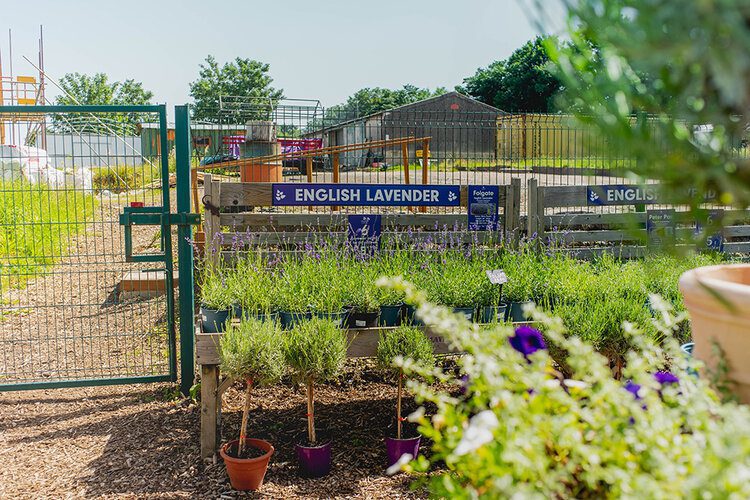
    Located on the right hand side of the entrance to the field is Mayfield Lavender’s outdoor gift shop where you can find just about every lavender product you can imagine from lavender scented perfumes to culinary lavender flowers.

    My personal favourite Mayfield Lavender products are:


    • Sleep Angel pillow mist


    • Lavender lemonade


    You can also shop their products at Mayfield Lavender Nursery.

    The price point is higher than most but at the same time their range of products is impressive.

    Mayfield Lavender Farm Café

    Due to people littering – remember to leave with everything you came with – Mayfield Lavender no longer allow picnics within their lavender field. If you get peckish whilst visiting you have two choices for eating at Mayfield Lavender Farm: the kiosk or the outdoor café.

    The kiosk is located in the centre of the field near the big tree. This chrome trailer sells a variety of drinks, muffins and scones as well as a few gifts such as soap and posies of dried lavender. Under the big tree, next to the kiosk is limited seating where you can pause to enjoy the treat you just purchased – it’s also the only spot of shade in the field.

    The open-air café is located next to the shop at the entrance of the farm. The menu is pretty impressive considering it’s located in a field, offering sandwiches, panini, alcoholic beverages, cakes, cream teas and afternoon tea.

    Luxury Lavender Yoga Experience

    Running from June 1st to August 31st is ‘Luxury Lavender Yoga Experience’ with Amanda Wass. Sign up for this class and you’ll be able to practise yoga either during sunrise or sunset within Mayfield Lavender’s field.

    Is it yet another white person charging people for a yoga class, looks that way, but if you’re boujee like that then it sounds like a super relaxing and stress-free workout to either start or end your day.

    Each session lasts for 1 hour 15 minutes and costs £30 per person, book here if you’re interested.

    Amanda’s yoga classes get you access to the field before/after it opens/closes to the public so if you’re able to go this is your best chance of taking photos with no one else in them.

    What’s the difference between Mayfield Lavender Farm and Mayfield Lavender Nursery?

    Mayfield Lavender Farm is where you will find the 25 acre large field of lavender. It’s where you want to go for all your lavender field fancies such as taking photos for the gram just like every other basic bish on Instagram (myself included), taking deep inhales of one of the best scents in the world and making friends with bees. It’s also where you will find the café and one of two of their shops.

    Mayfield Lavender Nursery has 12 acres of lavender and fruit trees and has a gift shop selling fruit trees and lavender plants as well as their full range of lavender products made with their homegrown lavender. Unfortunately Mayfield Lavender Nursery is undergoing renovations which means for the time being only the shop is available to visit.

    As the nursery is only a 7 minute drive from the field, if you are driving I would recommend going there to shop their lavender products to avoid the long queue at the farm gift shop.

    Which lavender field has the red telephone box?

    If you’ve seen photos on social media of a red telephone box (a British icon) in a field of lavender and wondered where it is, you’re not alone. The red phone box is at Mayfield Lavender Farm located in the south of Greater London, Southwest of Croydon.

    The red phone box is near the start of the field on the right hand side where the café is. Despite arriving before the opening time listed on the website, the queue to the telephone box formed quickly and it was only good for standing next to it for a hasty snap. If you have your heart set on shooting with the phone box then be willing to wait at the gate and race over there as quickly as possible.

    There is also a red tractor within the lavender, located to the right of the phone box, if you want a more country bumpkin vibe to your photos or if you’re bringing kids. The tree in the centre of the field also makes for a beautiful background feature.

    Are there toilets at Mayfield Lavender Farm?

    Yes there are toilets at Mayfield Lavender Farm however they are portaloos and unfortunately even a field of lavender isn’t enough to mask that stank, but as there is no permanent facility on the farm it is the only option available and so we should be grateful they have provided us with something to use.

    It’s not worth thinking you’ll be smart to go to Mayfield Lavender Nursery for the toilet. Whilst it’s being fixed up there is only one toilet available to use in the farm house and don’t expect it to be any kind of cute when you hear farm house. Still, they’re kind to offer it as an option if you’re desperate.

    Is Mayfield Lavender Farm dog friendly?

    The lavender field is absolutely dog friendly provided they are kept on their lead and you clean up after them – and if they do poop in the field, be a good human being and let the people around you know because pretty much everyone likes to sit in the field for photos and no one wants to sit on poop, right?

    I will advise not visiting on a hot day with a dog as there is little to no shade – lavender doesn’t like the shade – so there won’t be many opportunities for your pup to get a respite from the sun.

    Which species and varieties of lavender do Mayfield grow?

    Mayfield lavender plants two species of lavender, and they are the two you will find in most lavender fields across England:


    • Lavandula Angustifolia (English lavender) – known for its brightly coloured flower heads.


    • Lavandula x Intermedia (Grosso) – yields more oil and has a stronger scent.


    For some reason their field isn’t as potent as the others I have visited in England (many other visitors in the field noticed the lack of scent too) so if you’re hoping to inhale that sweet, sweet relaxing scent to calm your nerves then you’ll want to head to the back of the field where their Lavandula x Intermedia ( a hybrid known as Grosso) is planted as it is more fragrant.

    Ask at the counter to smell a scent card which has Mayfield Lavender’s two lavender oil varieties so that you can smell the difference between them.

    Can I pick the lavender in the Mayfield Lavender field?

    Unfortunately unlike Hitchin Lavender field you are not allowed to pick your own lavender within Mayfield Lavender farm. This could be down to the fact that the field is 5 acres smaller than Hitchin or simply because they want to sell their bunches of lavender at an additional cost in their gift shop – understandable. It also ensures the lavender looks full in your photos that you’re obviously there for so we can’t be mad at them.

    Bunches are £4 each or 3 for £10 and can be bought either in the kiosk in the centre of the field, at the gift shop at the entrance to the farm or at Mayfield Lavender Nursery.

    Accessibility at Mayfield Lavender Farm

    Disabled parking is at the very entrance to the field, opposite the shop and café.

    The surface of the car park and field is fairly level but as it’s a field please expect it to be uneven in places. Access to the shop and café is via a slope but the shop (which is outdoors) has a shingled floor surface so this may cause mobility difficulty.

    As lavender grows out wide the rows between the plants can be rather narrow and not necessarily suited for wheelchair access. There is however a grass footpath through the centre of the field.

    Guide dogs are allowed just as all dogs are.

    Conclusion

    Do


    • Drive if you want to arrive early to get photos with less people in the background


    • Go to the red phone box first if you want to avoid the queue for photos


    • Avoid queues at the gift shop by going to Mayfield Lavender Nursery


    • Wear suncream as there is very little shade – summer temperatures in and around London can reach up to 30 degrees Celsius (86 Fahrenheit) so bring water too


    • Try their lavender cream or afternoon tea


    Don’t


    • Pick the lavender


    • Fly your Drone without the appropriate certificates and prior approval


    • Walk across the rows unless there’s a natural gap in between the plants


    • Visit if you’re scared of bees and are likely to aggravate them – you’ll see more bees in a lavender field than content creators at Coachella


    I will shortly be putting together a blog post on all the lavender farms I have visited in England that compares each field and highlights each one’s assets. If you have any questions that you want answered in that blog post please leave them in the comments below or you can email me at gabriella@7g5.cc5.myftpupload.com and I will do my best to answer them.

    Do more on & for the planet, 

    Gabriella

    Pin this post


  • How to make the most of your stay at Shangri-La The Shard, London

    How to make the most of your stay at Shangri-La The Shard, London

    The Shard is a 72-storey skyscraper located in Southwark, just moments away from Tower Bridge. Designed by Italian architect Renzo Piano the triangular shape, 11000 glad panels and fragmented tip resembles shards of glass, hence its name. Atop London’s newer landmark on the 34th floor sits the multi award winning hotel, Shangri-La The Shard.

    Even up until early 2021 the thought of being in London to celebrate Michael’s – my partner of 11 years – 30th birthday didn’t cross my mind. I was convinced we would be in our new home in Canada…

    Time out – if you don’t know, Michael and I were scheduled to move just 3 weeks before the whole world went into a Coronavirus pandemic-induced lockdown when our flights were cancelled, the borders closed and we were shut indoors with all deposits tied up until the day they finally allow us in. It’s been 15 months (to this post’s published date) and counting.

    It wasn’t until the end of April 2021 that I had to accept we wouldn’t be leaving London before 14th June and that I had to pull off a sorry-it’s-not-Canada-but-it’s-still-incredible, despite it being in the city we already know, 30th birthday celebration. Cue the Shangri-La at The Shard in Southwark.

    I booked a night with drinks at their bar, GŎNG, and dinner at their restaurant, TĪNG and it was so wonderful I decided to share it with you on the chance you’re looking to either celebrate something special, have a baller stay on vacation to London, staycation in the heart of the city or swim 200 metres above sea level in their pool that looks out over west London.

    Having celebrated Michael’s 30th I know all the ways to get the most out of your stay so read on for my tips on how to get free cake, champagne and the best seat in the house!

    Rooms at Shangri-La The Shard

    How does putting your feet up in a patented, body-contouring Shangri-La Bed at least 125 metres in the sky sound? Exciting right?

    Starting on level 34 the 202 rooms and suites at Shangri-La The Shard all, yes that’s right all, offer views of the city of London out of floor to ceiling windows. 

    There are 5 categories of rooms and 6 suites all differentiated within their categories by the view they offer. The Superior Shard is the least expensive room in the hotel at an average of £608 per night and offer views of Kent, Surrey and Sussex whilst the Shangri-La suite, taking up most of level 39, has sweeping views of the city from Canary Wharf to the London Eye and is available from a casual £10,000 per night.

    I booked a Premier City View King room at £551 for one night which gave us Northwest views of London that included Buckingham Palace and Hyde Park on the far left and the City of London to our right.

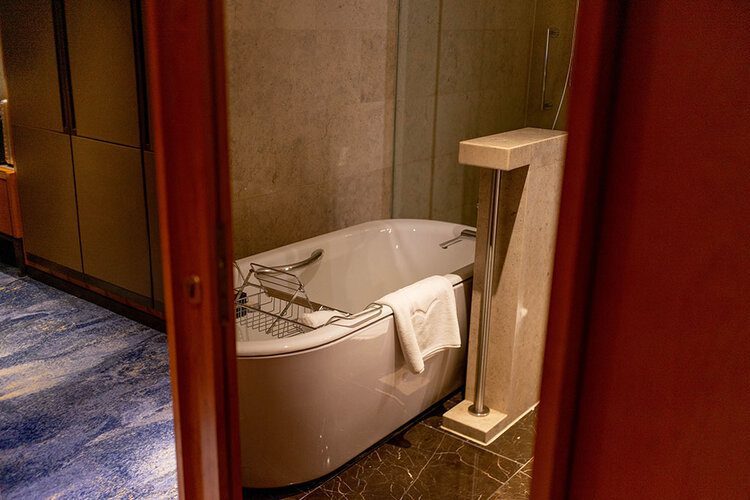
    All rooms and suites have robes so plush you could lose yourself in them and slippers are available for use during your stay and are best enjoyed worn straight out of your soak in the oval bathtub (from which you can watch tv embedded in the mirror) or an exhilarating rinse under the rain shower.

    Tea and coffee is complimentary with the use of the in-room Nespresso machine and there’s also a pair of binoculars that you can use to creep on people minding their own business in the city… or you know just look at buildings in the distance.

    If you aren’t a light sleeper I recommend sleeping with the blinds open so the spectacular view of the city is the last thing you see at night and first as you awaken.

    For prices and to make a reservation click here.

    Check-in and check-out times

    Check-in 4pm
    Check-out 11am

    Golden Circle check-out perks do not apply at Shangri-La The Shard.

    Golden Circle perks 

    Golden Circle is Shangri-La’s guest programme for receiving perks and collecting points. There are three tiers: Gold, Jade and Diamond.

    As a Jade member we received the following during our stay at The Shard:


    • A choice of 3 amenities. I chose cookies, chocolates and beer for Michael.


    • A complimentary stay in your room for your partner.


    • Buffet breakfast for you and your guest.


    • Bonus GC points.


    We have Jade membership via Michael’s AMEX which includes perks for other Shangri-La hotels such as early check-in, late check-out and priority check-in. To see more about their Golden Circle programme click here.

    Gym, spa and Sky Pool at the top of the Shard

    The main reason I booked a night at Shangri-La The Shard was for the opportunity to take a morning swim in the pool. The Sky Pool at the Shangri-La The Shard is not just any hotel pool, it’s the highest pool in all of western Europe. Swimming 623ft in the air over one of the most famous cities in the world was an opportunity we didn’t want to miss.

    From the Sky Pool and adjacent sauna you can look out to all of west London where you can spot some of London’s most iconic landmarks including the River Thames, London Eye, Buckingham Palace and Hyde Park.

    The Sky Pool is quite the experience if not a little cold but the sauna ended up being my favourite. Maybe it’s because I’m short or because the sides of the pool come up quite high that made the view from the pool limited, whereas the floor to ceiling windows of the sauna meant you could take in much more of the view. As the sauna is very close to the window, laying down and looking out gives the illusion of floating in the clouds and was a very endearing spot for our morning meditation.

    Towels, tea, coffee and infused water are all complimentary at the Sky Pool.

    From 8.30pm, after the pool has closed to the hotel’s guests, GŎNG expands into the Sky Pool area. To learn more take a look at my write up on GŎNG, the hotel’s main bar, below.

    Usually use of the Sky Pool and sauna at Shangri-La The Shard is reserved for guests staying at the hotel only. However during certain months the hotel offers a Shangri-La Sky Pass which includes access to both and dining credit for TĪNG for £125pp.

    The gym is kitted out with all of your basic Technogym equipment and each machine is partitioned during the Coronavirus pandemic.

    Open hours

    Gym every day from 6am – 9pm

    Sky Pool every day from 6am – 12pm and 1pm – 6pm

    Children’s swimming times are 9am – 11am and 3pm – 5pm

    Dining at Shangri-La The Shard in London

    There are 5 options for dining or drinking at Shangri-La The Shard: 


    1. GŎNG – the main bar.


    2. TĪNG – the main restaurant where breakfast, lunch, afternoon tea and dinner is served.


    3. Aqua Shard – another restaurant, smaller than TĪNG, that serves lunch, dinner, afternoon tea and weekend brunch.


    4. Oblix – a restaurant split into two: Oblix West and Oblix East, from these two venues you can see either the west or east view of London.


    5. Bar 31 – a ground floor bar with outdoor terrace seating. This bar participates in regular takeovers including a sponsorship with Aperol for summer 2021 which features an Italian menu.


    Window views are not guaranteed at any of these venues but I recommend putting in a request like I did because it doesn’t hurt and if you’re celebrating something special they do their best to accommodate you.

    Cocktails at GŎNG

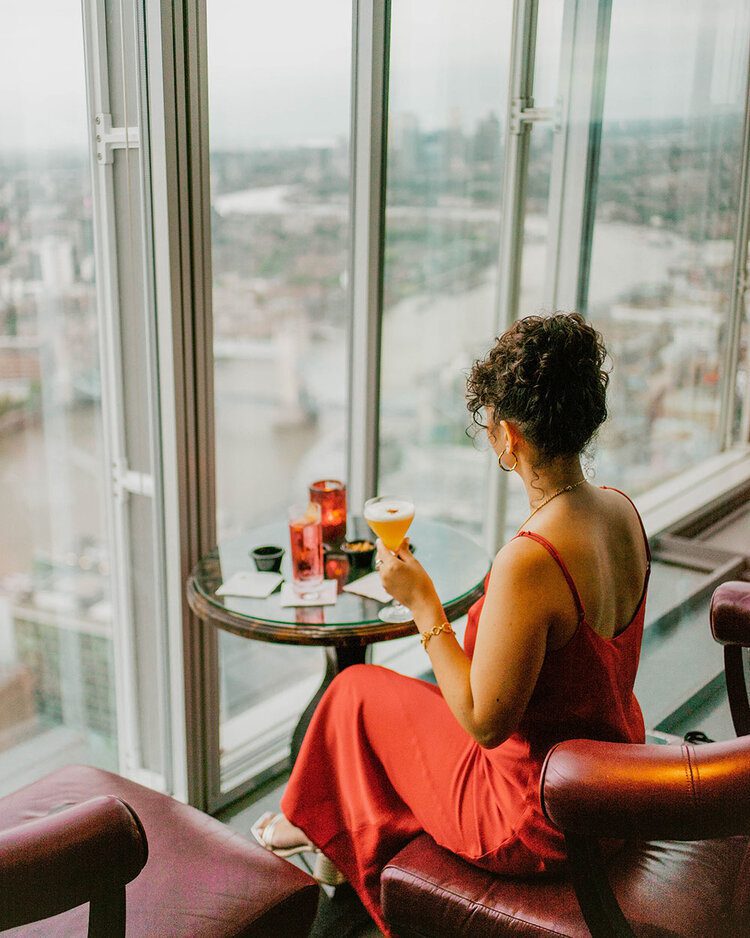
    Located on the 52nd level of The Shard, GŎNG is the highest bar not only in London but all of Europe. GŎNG is the ideal spot to sip cocktails whilst watching the sun go down behind the city of London but it’s particularly special post-sunset when the city is illuminated against the dark sky – magical nights are spent toasting champagne at GŎNG where the electric city below can be admired to its farthest edges.

    “The name GŎNG derives from ‘dougong’, a traditional Chinese architectural element of interlocking wooden brackets, featured in the bar’s distinctive design.” – GŎNG

    The cocktail list at GŎNG is extensive, enticing and will make you want to return to try more. Sure, you can order your classics but why limit yourself when their menu features creations using mango, saffron, guava, chai and yuzu and if that doesn’t tickle your fancy their impressive Sake & Shochu list honours the hotel’s Asian origins.

    Michael had the Saffron & Mango which was made with Johnnie Walker, black mango chutney, apple juice and saffron methylgel whilst I had the Mango & Wine made with Havana Club, 3y Martini Ambrato, Sauvignon Blanc wine, grenadine and Slimline Fever Tree Tonic.

    A menu of sushi, tacos, Bento boxes and gyozas mean you can enjoy a light lunch or dinner at GŎNG however, complimentary nuts are served with drinks if you only fancy a nibble.

    A unique feature of GŎNG is that come 8.30pm, once the pool has closed to guests, you can reserve a table next to the Sky Pool for a minimum spend of £45. Swimming in the pool is not allowed though so leave your swimwear at home folks.

    Open hours

    Monday – Wednesday: 4pm – 11pm

    Thursday – Sunday: 12pm – 11.30pm

    The dress code for the bar at GŎNG is smart casual. There’s a minimum spend of £30 per person over 18 years old and all guests must be over 18 after 5.30pm.

    Make your booking for GŎNG here.

    Tasting menu at TĪNG restaurant

    TĪNG is Shangri-La The Shard’s main restaurant and is found on level 35 of the skyscraper. It’s one of the many spots in the hotel where their themed afternoon tea is served but it is best known for it’s Asian and British menu.

    TĪNG serves an à la carte menu or a tasting menu of either 3 or 5 courses all with plant based alternatives.

    In the weeks between our stay and publishing this post the menu has changed and what was a British or Asian set menu has now combined forces to become a fusion menu. When we dined there we had one Asian and one British so we could try both and looking at the current menu (summer 2021) they seem to have combined the best of both. 

    The five course set menu is £78 per person or £138 per person with wine pairing.

    “Derived from the Chinese word for ‘living room’, TĪNG offers a dynamic dining experience influenced by Asian and British culinary cultures.” – TĪNG

    Floor to ceiling windows mean those seated at the windows have a spectacular view but a window seat is not guaranteed. If you do get the chance to request one, try for a view of Tower Bridge because it’s the prettiest view at night.

    My top tip if you’re planning on ordering the five course tasting menu at TĪNG is to book an earlier table as this dining experience will likely last around 3 hours on a quiet evening in the restaurant. We were seated at 8pm and didn’t leave until 11pm and were grateful to only be taking the elevator up a few floors to our room that night. In hindsight, as we had a room I should have ordered room service so we could dine with our personal view – something to consider if you’re staying.

    Open hours

    Lunch

    12pm – 2.30pm 

    Afternoon Tea

    12pm – 4pm 

    Dinner

    5pm – 10.30pm

    Make your booking for TĪNG here.

    Afternoon tea in the clouds at Shangri-La The Shard

    As we were only staying one night at Shangri-La The Shard we did not have time for their afternoon tea, however, from what I saw it looks like quite the spectacle and I fully intend on returning for it so watch this space.

    There is a liquid afternoon tea served at GŎNG and a more traditional afternoon tea served at TĪNG.

    Breakfast at Shangri-La The Shard

    Our breakfast the day after Michael’s birthday was our favourite part of our stay, enjoyed more so after an early morning dip in the pool and made particularly special by the table’s view of Tower Bridge.

    As mentioned above our Golden Circle membership gave us complimentary buffet breakfast for two but you can add it at £27pp. The buffet breakfast includes all the key components to a fry-up, fresh fruit, cereals, yoghurt, deli meats and more pastries than you can shake a stick at.

    PFH Top Tip: for the best chance of a table with a view – they aren’t guaranteed – arrive early for breakfast.

    Speaking of arriving early for breakfast, when we arrived in our room I spotted a notification on the tablet that said if we had breakfast before 8am we would be offered a complimentary Bellini or mimosa so you bet we took advantage of that. Be sure to check the tablet if you stay at the Shangri-La at the top of The Shard.

    Getting there early also means you can stay longer, we enjoyed our breakfast for almost two hours, taking in the view whilst reflecting on our stay – it was magic.

    Open hours

    Monday – Friday: 7am – 10.30am

    Saturday, Sunday & Bank Holidays: 7am – 11am 

    Birthday celebrations at Shangri-La

    Whilst celebrating Michael’s 30th birthday the team at Shangri-La The Shard truly spoilt him. There was a luxurious chocolate birthday cake accompanied with a card in the room upon arrival, whilst enjoying drinks at GŎNG we were each brought a complimentary half glass of champagne (a regular glass is priced at £20 a glass), a beautiful birthday plate was brought over at dinner and we were given a table with a view of Tower Bridge both at GŎNG for drinks and TĪNG at breakfast the next day.

    Having stayed in various hotels around the world for all sorts of celebrations, these little extra gifts from Shangri-La The Shard are amongst my favourites and helped to create a special experience for a significant celebration of Michael’s life and achievements thus far.

    If you are considering celebrating at Shangri-La The Shard, I hope this allows you to trust in being able to create magic memories with them.

    For special occasions email GongHostess.SLLN@shangri-la.com.

    Shangri-La The Shard offers a host of different add-ons for celebrations but I will say they can be pricey and many of them aren’t good for the environment – A LOT of balloons involved which don’t biodegrade and can end on land and in the ocean and eaten by critters so please avoid these.

    For ideas on low-waste celebratory decorations take a look at what I did for Michael’s 30th birthday here.

    The View From The Shard

    The View From The Shard is London’s highest viewing platform. If you, for your own reasons, aren’t planning to stay at Shangri-La The Shard then the 360° view is still within your reach if you are open to paying the minimum ticket fee of £25pp.

    However, when the minimum spend for a table at GŎNG, the highest bar in Europe, is just £30 might I suggest you book a table for cocktails and/or a light meal rather than pay a minimum of £25 per person for a ticket to The View.

    Accessibility 

    A complimentary ticket is given to the carer accompanying a disabled guest which can be picked up on arrival. It is recommended that the disabled ticket is pre-booked.

    There is a small lift to the left of the stairs at the entrance on Joiner Street.

    The automatic door to the ticket hall measures 900mm/35.5ins wide.

    Floors are mostly wood and foldable chairs are available upon request.

    The counters at the gift shop has a hearing loop system installed.

    Open hours

    Usually 10am – 10pm but they can vary so check their website here to be sure.

    In conclusion


    • You can have a more luxurious experience sipping cocktails rather than going to the viewing platform


    • Let the hotel know in advance if you’re celebrating


    • You don’t have to book a room to experience the Sky Pool


    • Get to breakfast early


    • Consider in-room dining


    Did you stay at Shangri-La The Shard and found this blog post useful? Let me know in the comments below!

    Do more in & on the planet, Gabriella

    Pin this post


  • Wimbledon viewing party snacks

    Wimbledon viewing party snacks

    Wimbledon is back on our tellies! I don’t know about you but the sound of subdued applause, grunts of exertion and low-tone commentary on a point system that has no reason or rhyme is the nostalgic sound of summers gone by.

    As a travel blogger who has been grounded by the pandemic for 15 months (at the time of publishing) I’ve had to think outside of the Royal box (laugh at my tennis joke!) so here I am, serving up (laugh again) ideas for your Wimbledon-at-home experience this and every summer that Wimbledon is on, or any tennis championship for that matter.

    Whoever you’re watching the tennis with this year, these drink and snack ideas will help level up your experience whilst watching Wimbledon at home.

    To be as inclusive as possible all of my suggestions below are suitable for vegetarians and can also be made vegan, and to make things easy for you I’ve also put a shopping list together at the end of this post.

    Here are the drinks and snacks you need to serve up the perfect spread for a Wimbledon viewing party.

    Wimbledon viewing party drinks

    Pimm’s No1 Fruit Cup

    Drinking Pimm’s in the summer is synonymous with watching Wimbledon. 

    Pimm’s is a spiced and fruity gin-based spirit served as a long drink with lemonade or ginger ale.

    Learn more about the origin of Pimm’s No1 here.

    How to make the perfect pitcher of Pimm’s

    Recipe Here

    What you need to make a simple glass of Pimm’s 


    • 50ml Pimm’s No1


    • 150ml lemonade


    • 1 sliced strawberry


    • 3 slices of cucumber (1 for garnishing)


    • 1 sprig of fresh mint


    • Ice


    If you want to make the perfect pitcher of Pimm’s then take a look at my popular summer recipe blog post.

    Gin & tonic

    The G&T is the most classic English cocktail of all time. Celebrate the Wimbledon Championships  being back on our TV sets with official gin of Wimbledon: Sipsmith. Serve an ace (see what I did there) and make your gin and tonics with Sipsmith’s Strawberry Smash gin, their special edition Wimbledon themed gin.

    Sipsmith’s Strawberry Smash gin has been distilled with Hugh Lowe’s (the official strawberry supplier for Wimbledon) 2020 strawberry harvest. 

    Serve Sipsmith’s Strawberry Smash with tonic and strawberry slices or take a look here at Sipsmith’s suggested cocktail recipes.

    Robinsons squash

    Robinsons is the official soft drink of Wimbledon and is perfect for those who won’t be drinking alcohol. 

    Robinsons make concentrated squashes and cordials ready for you to dilute with water into a refreshing drink to quench your thirst whilst watching the tennis. Robinsons has turned almost every fruit into one of their squashes so there’s one to please everyone (who likes fruit).

    PFH Fun Fact: Robinsons squash was created at The Championships, Wimbledon in 1935. Their first flavour was Lemon Barley Water for the players to keep them hydrated during their matches.

    Get double strength to reduce the amount of plastic you purchase as you only need half the amount and recycle your bottle responsibly if you don’t plan on upcycling it.

    Wimbledon viewing party snacks

    Pimm’s Drizzle Loaf Cake

    Recipe here

    Strawberries and cream

    Strawberries and cream were first combined during the reign of Henry VIII in the 1500s, since then it has been a firm British favourite during the summer.

    The tradition of serving strawberries and cream at the Wimbledon tennis championships originated in 1877 but no one really knows why. Popular beliefs are that strawberries were in season during the tournament and that eating strawberries was very popular during the Victorian Period. Consider them the Victorian equivalent of a grande Starbucks cup that appears all across your social media feeds (please try to use reusable cups).

    PFH Fun Fact: the strawberries sold at Wimbledon are picked on the Hugh Lowe farm at 4am on the day that they are to be served.

    A serving of strawberries and cream at Wimbledon includes at least 10 strawberries. Serve them with oat cream for a vegan alternative.

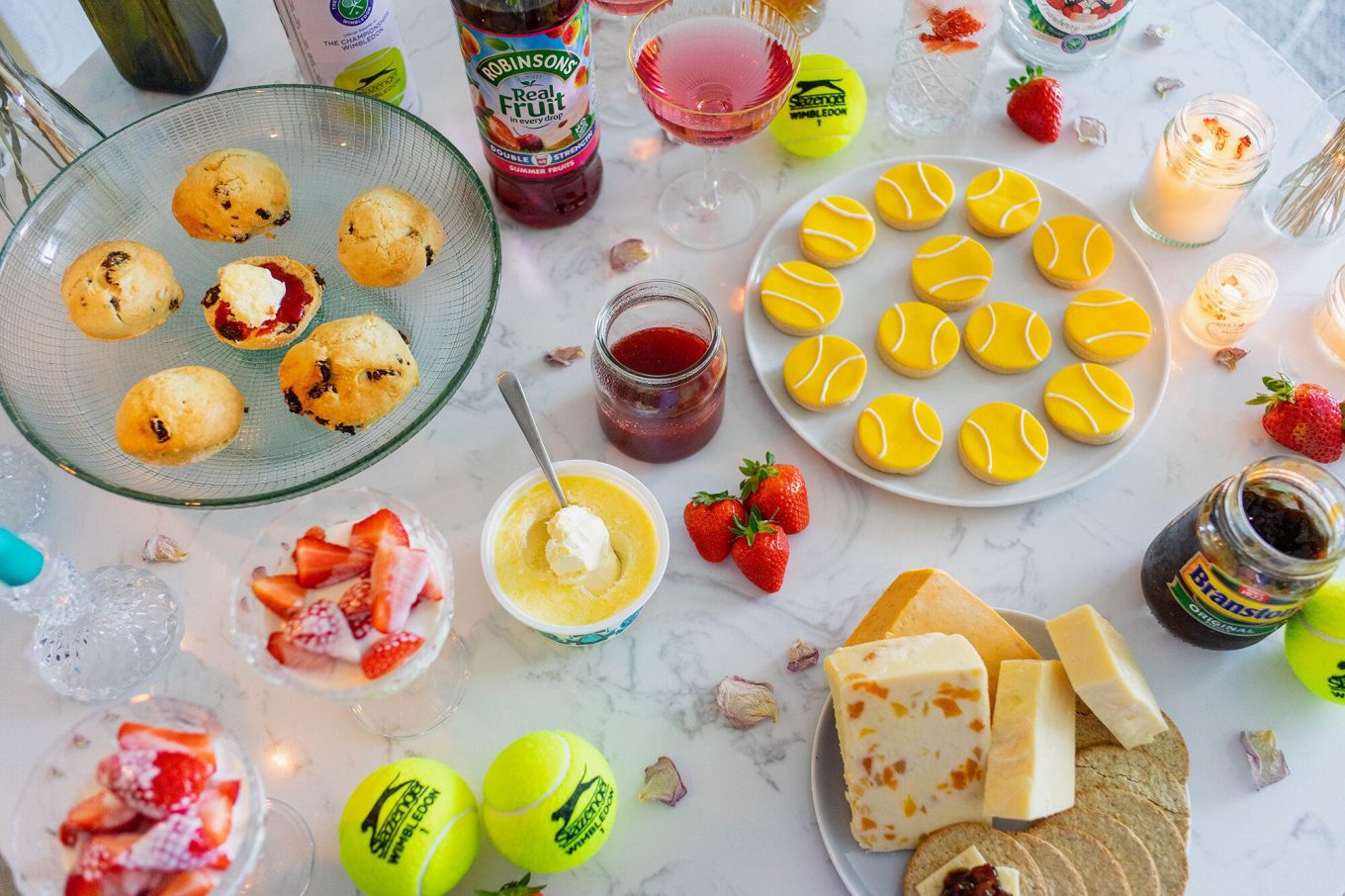
    Scones served with clotted cream and homemade strawberry jam

    Few sweet treats are as quintessentially British as a scone served with clotted cream and jam. As it’s a Wimbledon themed spread you’re putting together I suggest serving strawberry jam, or to make things really special why not try your hand at making fresh strawberry jam with my homemade jam recipe blog post. I made a jar of strawberry jam for this blog post in under one hour and it tastes better than any strawberry jam I’ve ever had. To speed up your jam making process, blend your strawberries in a smoothie maker or food processor before adding them to the sugar.

    As for your clotted cream, it can’t be anything other than Rodda’s, made in Cornwall. In saying that I am aware that if you’re reading this in North America and want to put this tennis themed spread together you won’t be able to get your hands on the best cream in the world. For you I suggest whipping up some double cream.

    English fruit scone recipe

    Recipe Here

    Learn to make freshly baked scones with my recipe blog post here. To make vegan scones simply swap out the egg for 3tbsp of chickpea water, the butter for margarine and the milk for any milk alternative.

    Tennis ball sugar cookies

    My sugar cookies take less than an hour to make and once cool you can decorate them in under half an hour. They only take 8-10 minutes to bake, require very little baking skills, are easy to decorate and really pull the theme together. Click here for the recipe.

    If you’re not vegan don’t worry, my sugar cookie recipe wasn’t originally vegan. Where I use egg replacement use 1 egg and you can use dairy butter instead of margarine.

    To make tennis ball sugar cookies, use a round cookie cutter and find a yellow fondant icing. Mix up some icing sugar into a thick consistency and pipe on the white curves or you can purchase pre packaged piping icing if you don’t have your own bag at home.

    English cheese and crackers

    For your savoury accompaniment to all of these sweet treats serve up some crackers and classic English cheeses such as cheddar, Wensleydale and Double Gloucester. Take a look in your local deli to support a small business.

    Easy Sugar cookie recipe

    Read here

    Compliment your cheese and crackers with a pickle. For a crowd pleaser go for Branston pickle – it’s a sweet pickle chutney and for a British classic serve Piccalilli – it’s a mustard pickle that was inspired by south asian pickle – or, if you feeling like something different why not give my Mauritian spiced vegetable pickle a go, I’ve linked the recipe here.

    Wimbledon viewing party shopping list


    • Strawberries (at least x2 punnets, one for making jam and one for serving with strawberries)


    • Cucumber


    • Lemon


    • Mint


    • Cheddar cheese


    • Double Gloucester cheese


    • Wensleydale cheese


    • Clotted cream


    • Cream or oat cream


    • Milk or milk alternative


    • Margarine


    • Pickle


    • Tin of chickpeas (for the water as egg replacement or buy eggs)


    • Crackers


    • Caster sugar


    • Plain flour


    • Self raising flour


    • Baking powder


    • Fondant icing


    • Icing sugar


    • Caster sugar


    • Vanilla extract


    • Currants


    • Robinsons Squash


    • Lemonade


    • Indian tonic


    • Pimm’s No1 Cup


    • Sipsmith Strawberry Smash gin


    Don’t understand the rules of tennis and want to grasp it quickly? Take a listen to the Calm app’s sleep story “But seriously, The Rules of Tennis” read by the legend himself John McEnroe.

    Game, set, match and snack!

    Do more on & for the planet, 

    Gabriella 

    Pin this post.


  • 8 beautiful places to visit in Cornwall part 2

    8 beautiful places to visit in Cornwall part 2

    In a follow up to 8 beautiful places to visit in Cornwall part 1 here’s another 8, I know, I spoil you. In this travel guide for Cornwall I’m sharing photogenic places and adventurous things to do in the top part of the county. From learning about complex eco-systems in the magnificent biomes of Eden Project to surfing waves rolling in from the Atlantic Ocean this second part to my Cornwall travel guide will plan out your most memorable trip there.

    1. Summerleaze Beach in Bude

    Take a day trip over to Summerleaze Beach in Bude where some of the highest summer temperatures in Cornwall are recorded so you can not only catch a great tan (don’t forget to wear your reef safe sun cream folks) but it’s the ideal spot to cool off too thanks to the huge sea pool that sits at the base of the cliffs.

    Bude sea pool is a 91m long by 45m wide semi-natural pool that was built in the 1930s to create a safe place to swim. It is both free to use and unrestricted (unless there’s a pandemic).

    For the best position to get a photo of Bude sea pool, head up the path behind the ice cream shops and stand safely at the top of the cliffs above. Hopefully the sun will catch the water for you and you’ll get some beautiful sea sparkles in your photo.

    2. Tintagel Castle 

    Tintagel Castle is a medieval fort built in the 1200s but ruins onsite are known to date back to the 4th Century AD. Cross a bridge suspended high above rough waters and enter the legendary birthplace of King Arthur. Work your way around the one way system that will take you up to the top of the cliff and down to the visitor centre.

    If the legend of King Arthur and Merlin tickles your fancy you can also visit Merlin’s Cave, thought to be Merlin’s home, at low tide.

    Land Rovers and step free access is available to most of this heritage site.

    If on foot, wear sensible footwear as the ground is uneven and a it’s a trek just to the castle and back from the village alone.

    As interesting as the castle ruins are it’s the views of the coastline from them that’s the most photogenic.

    Tickets must be booked in advance with English Heritage as they only allow access on a timed schedule. Tickets will give you access to the castle’s remains which offer spectacular views of the rugged area of coastline.

    After your visit to Tintagel Castle, potter through the village where you’ll find many tearooms to enjoy a Cornish cream tea in their garden.

    3. Port Gaverne

    One of my favourite memories from our trip to Cornwall was standup paddleboarding with Cornish Rock Tors at Port Gaverne. 

    Our instructor, whose name has sadly escaped me, was the best you could have asked for. Not only did he make sure we knew exactly what we were doing before getting out on the water but he had the patience to let us build up our confidence before we left the port to reach the open water. With him we explored a cave, attempted tricks and even took a moment of calm to practice some yoga – anyone remember Michael doing a headstand on a paddle board out of nowhere when he cannot walk down the street without tripping over?

    2 hour sessions are £40 per person and include wetsuit rental.

    SUPing isn’t all Cornish Rock Tors offers, they also do coasteering, kayaking and sea swimming. Also they’re a single-use plastic free business with a Surfers Against Sewage’s Plastic Free Champion certification, so yay for that!

    Save time searching for almost non-existent parking by parking in St. Endellion Car Park and walk 5mins down to Cornish Rock Tors. When you’ve finished paddleboarding, walk to Port Isaac, which is only 10 minutes in the other direction to St. Endellion Car Park for lunch. Port Isaac is where much of the filming for the ITV series Doc Martin took place.

    4. Polzeath

    Polzeath beach attracts more surfers than you can shake a shortboard at. The large beach and on-beach parking means that the waves are more accessible than some of the smaller, more limited destinations.

    For this reason it’s a pretty ideal place to learn to surf and there’s heaps of surf schools to choose from. I will say it gets busier for this reason though so if you seek less distraction look for a quieter location but it is where you’ll find some of the most experienced surf instructors.

    We joined friends on a lesson with George’s Surf School which is considered to be within the “Top Ten Surf Schools in the World” by The Guardian. Their patience and guidance will motivate and comfort you no matter how you progress in your lesson. Your instructor won’t just help you stand but they will also correct you so each time you catch a wave you’re not just standing and falling but actually improving on your technique.

    Wetsuits are available to rent for a small fee from multiple vendors on the beach.

    Polzeath beach has a community atmosphere that makes you feel like summer will never end. There’s multiple restaurants right on the beach including the hot-spot rum bar out the back of Surfside Polzeath. For beach babe apparel check out Fusion on Dander’s Hill.

    5. Newquay

    Newquay is a coastal town in north Cornwall that is known best for being a top location for surfing thanks to the strong surf coming in from the Atlantic Ocean. Fistral Beach and Watergate Bay are the two most popular places to surf with Watergate Bay being where the English National Surfing Championships are held every year. Yeww!

    Fancy yourself as a surfer but can’t catch a wave to save your life? I feel you and Newquay is the place for you to kit yourself out in all the surfer themed apparel your heart desires.

    Best surf apparel shops in Newquay 


    • Ann’s Cottage Surf Shop


    • Watershed


    • Married to the Sea


    • Northshore Surf Shop


    • The Wave Project – an amazing organisation who offers complimentary surf therapy classes to people with various mental health diagnoses, profits from the shop help to keep those classes funded.


    Newquay airport, located 15 minutes outside of the town, has regularly scheduled flights (when there isn’t a pandemic) to Spain, Germany, Ireland, London, Liverpool, Manchester, Glasgow and Edinburgh. 

    Where to stay in Newquay

    If you’re happy to spend extra on a beautiful place to stay in Newquay then I highly recommend booking a stay at Tolcarne Beach Village on Tolcarne Beach. 

    Tolcarne Beach Village offers four types of rooms: beach cabins, beach houses, apartments and colonial rooms (yeah the name makes me uncomfortable too).

    We stayed in one of the colonial rooms, Ganges Suite and the room is one of the most beautiful and well designed interiors I have ever stayed in. Every detail of the room from the antique dressing table to the record player makes you feel like you’ve stepped into a time gone by. Pop a record on, light the fire, draw a bubble bath and take in the sea view from the balcony whilst you wait for it to fill up. In the morning take a cuppa out onto the balcony in one of their robes and spy on the early rising surfers.

    At low tide you can walk into Newquay from Tolcarne Beach.

    Lorem ipsum dolor sit amet, consectetur adipiscing elit. Ut elit tellus, luctus nec ullamcorper mattis, pulvinar dapibus leo.

    6. Eden Project

    As an eco-activist who regularly writes about sustainable travel, I’m sure it’s not hard for you to imagine why visiting the Eden Project was one of my favourite things to do in Cornwall. 

    The first of two biomes is a humid tropical forest filled with rope bridges weaving you through palm trees, waterfalls, hibiscus flowers and more – it honestly felt like I’d been magically transported back into the Malaysian jungle.

    The second biome is a mediterranean South African, Western Australian and Californian climate that boasts a cacti garden, olive trees and even a little vineyard. There’s even a terrace right in the centre where you can sip sangria surrounded by hot pink bougainvillea.

    Within each dome and the surrounding grounds is heaps of information about various threats to our planet’s complex and wonderful eco-systems from mass palm oil farming in South America to bush fires in Australia. The educational material is both informative and easy to digest plus it offers further reading and shares organisations that you can support who are making a difference for all of us and the future of our planet

    What’s better than the entrance being less than £30 per adult (which funds the good work that they do)? The ticket is an annual pass so you don’t have to pay again to return within a year.

    PFH Top Tip: 

    If you’re visiting on a chilly day, layer up so you can shed one or two whilst you’re in the warm and humid biomes.

    Be sure to visit the gift shop for a host of eco-conscious and low-waste products from their very own skincare and kitchenware to reusable nappies and clothing.

    7. The Hidden Hut at Porthcurnick

    We were pulled to Porthcurnick beach for one thing only and that was The Hidden Hut. Ran by Simon Stallard & Jemma Glass, The Hidden Hut is a beach cafe turned beach dining experience.

    If you’re a frequenting reader here then you’ll probably know how much love I have for fish and chips on the beach, but The Hidden Hut elevates seafood on the sand. You won’t find a deep-fat fryer here, instead they cook fresh locally sourced ingredients that the use their outdoor stove and bakery oven to whip up chowders, dhal, grilled fish, briskets, soups, stews, Cornish pasties, sausage rolls, cakes and more.

    The menu changes to cater to seasonal local produce but here’s an idea of what you could expect to see:


    • Wood fried pork sausages served on a tomato and bean salad topped with a rosemary crumb and tomato basil dressing


    • Beef brisket and pork shoulder chilli with feta, jalapeños, sour cream and bulgar wheat


    • Smoked Cullen skink chowder topped with chives, spring onions, sourdough croutons and served with a freshly baked roll


    • Spinach and chickpea dhal with raita, pickled red onions and a coriander flatbread.


    • Roasted onion, leek and cider soup with sage and blue cheese sourdough croutons served with a freshly baked roll.


    Good, right?

    Outside of pandemic restrictions, The Hidden Hut hosts a weekly ‘feast night” and “Beach Breakfasts” where they set out a long table on the beach and anyone with a ticket is encouraged to dine socially. You bring the plates, cutlery and wine and they’ll serve the food. 

    Thankfully the daily lunch menu doesn’t require booking but to avoid an even longer wait and disappointment if your choice sells out, get in the queue early because that thing will tail down to the beach. Michael got into the queue at 11.45 and was able to see the menu at 12.15pm. By 12.30pm he had returned with the food – take note that this was mid-September and the wait will be much longer during the height of summer.

    Come prepared with your travel cutlery and a towel to enjoy your meal on the beach.

    How to find The Hidden Hut

    The Hidden Hut was originally built pre-war (don’t ask which one, I couldn’t find it) intentionally to be difficult to find.

    Parking is extremely limited for Porthcurnick beach. Arrive early to nab street parking on a road that I can’t even find the name for so I’ve included a screenshot of it below. Once full of cars, the dead-end road isn’t wide enough to turn around so if you have the space when you arrive, park facing the way you came from to save reversing until you reach a driveway to turn in. 

    Take the slipway at the end of this road to the beach and don’t be surprised if you still can’t see The Hidden Hut. From the centre of the beach turn your back to the water and head inland but off to the left where a path will lead you up to this secluded restaurant.

    It sounds fussy but it is worth it to eat at The Hidden Hut.

    8. Falmouth 

    Spend the afternoon in Falmouth where you can enjoy lunch looking out to the harbour and potter around outdoor activity shops in town with a takeaway coffee (they’ll serve it into your reusable cup) from Beacon Coffee. We stopped for lunch at Indidog Eatery where I indulged in an Asparagus grilled cheese sandwich which was the best grilled cheese sandwich I have ever had (not to mention it’s Instagrammable). Before leaving take a nosy in Falmouth Art Gallery on Webber Street and/or visit the National Maritime Museum.

    Part 1 of 8 beautiful places to visit in Cornwall is available here so if you’re planning on booking your staycation in Cornwall, take a look for tips on visiting St Michael’s Mount or swimming in the UK’s most beautiful art deco lido.

    Do more on & for the planet, Gabriella

    Pin this post


    As an Amazon associate I earn from qualifying purchases.

  • 8 beautiful places to visit in Cornwall part 1

    8 beautiful places to visit in Cornwall part 1

    Reflecting on my staycation to Cornwall I have put together a two part guide that shares some of the most beautiful places to visit in the county of Cornwall. This first part of my Cornwall travel guide focuses on the Instagram-worthy southern tip of the county and explores beautiful seaside towns, a legendary castle, white sandy beaches and the very ends of the country. So if planning a trip that involves taking a dip in an Art Deco lido, dining in restaurants that look out to cute harbours and hiking dramatic coastal paths excites you ,then you’re in the right place with the first part to my Cornwall travel guide. 

    Planning a staycation in Cornwall? Take a look at 8 beautiful places to visit in Cornwall part 2 for more on visiting the top half of Cornwall where I share about visiting the incredible Eden Project, which company to learn how to surf with and where to find a secret restaurant on the beach.

    1. St Michael’s Mount near Marazion

    St Michael’s Mount is a very small rocky island, just off the shore of Marazion, that is home to a medieval castle and gardens and a village with no more than 53 houses that can only be accessed by boat during high tide. During low tide St Michael’s Mount can be accessed from the beach along a cobbled pathway that becomes partly submerged during mid tide and non-existent once the tide has rolled all the way in. To bare witness to the path disappearing I suggest booking your tickets a couple of hours before the tidal cut off, by the time you get onto the island and have taken a leisurely stroll around the castle and gardens the water will be creeping up onto the path.

    Michael miscalculated how long it would take us to get to Marazion and by the time we made it on the St Michael’s Mount we only had 40mins to get around the castle and back down before the tide came in and trust me when I said we had to run to make it round and down in time. The tide comes in fast too, so don’t dawdle as you make your way back along the path unless you want wet ankles.

    Once you’ve made it back to the beach, turn back to take some Insta-worthy photos of the St Michael’s Mount as the tide creeps over the path.

    St Michael’s Mount off the coast of Cornwall came into the possession of the monks who also owned Mont St Michel, its sister isle, in Normandy in 1066 but it wasn’t until the 12th Century that the church and priory still seen today on the mount was constructed. The actual castle wasn’t built until the 14th Century but has been heavily involved in centuries of rich history including the War of the Roses, the Civil War and the Spanish Armada. Legends surround the island from a giant to mermaid sightings to spiritual miracles including a tale of Saint Michael – the patron saint of fishermen – appearing on the island to ward fishermen from certain peril. 

    The castle had been home to the St Aubyn family since the 17th Century and with the National Trust the family have been able to open the castle grounds to the public between the months of April and October. As you weave through each room you’ll come across peculiar relics brought to the castle by various family members over the years.

    Once you’ve explored the hallowed halls of the castle grounds make your way to the gardens. Due to the location of St Michael’s Mount, the island has its own microclimate that allows for the gardens to bloom the likes of Agave (best known for making Tequila), Puya, and Agapanthus (better known as Lily of the Nile or African Lily). Take the winding path down from the castle through the gardens and out to the lawn where you can enjoy a picnic or at the very least an ice cream.

    You must book your ticket to St Michael’s Mount in advance as it’s a very popular location and visiting times are entirely dependant on the tide times which limits entrance every day.

    2. Penzance 

    Whilst in Penzance book a swim in Jubilee Pool, an Art Deco lido that opened to the public in 1935. Holding 5 million litres of water, it is the largest seawater pool in the UK and only goes 1-2 degrees Celsius above the temperature of the sea. Its unique triangular shape is to protect it from large swells when storms roll in. 

    Entrance to the main pool is less than £5 per person, book your tickets here.

    If you just want to visit Jubilee for a photo because it’s too cold for you then you can enter the terrace where the Jubilee Pool Café is located for free.

    Where to stay in Penzance

    For most of our staycation spent exploring Cornwall we were based in an AirBnb in Plymouth, Devon but we did stay in a couple of hotels and one of them was Artist Residence in Penzance. Artist Residence is a boutique hotel tucked away into a Georgian house on a quiet street in Penzance, you wouldn’t believe it has 16 rooms, 3 suites, a restaurant, bar and outdoor terrace within. Mix-matched decor bring an eclectic vibe to these airy rooms that are moments away from Jubilee Pool, the town centre and opposite the oldest pub in Penzance, The Turk’s Head.

    PFH Top Tip

    Artist Residence uses full-sized toiletries that they refill so you can pack less in your wash bag knowing that they’ve got you covered.

    3. Porthcurno

    When planning a trip to Cornwall you must visit Porthcurno, it’s one of the most beautiful and photogenic beaches I have ever seen and what makes it even more special is that it’s in England. Now I know that the majority of Brits knew we had beaches like Porthcurno but having grown up on the east coast with the North Sea it blew my mind to see white sandy beaches with the kind of calm, turquoise waters you associate with far flung tropical islands. I mean I’m beyond grateful to have grown up and worked my teens – early twenties on the beach but Porthcurno is operating on another level to my beloved West Runton. 

    From Google Maps it doesn’t look like there’s much going on at multi-award-winning Porthcurno beach, in fact it doesn’t actually seem like a beach is there but it has to be my favourite beach in Cornwall and if you get the chance to visit you’ll understand why. The combination of soft white sand and crystal clear water that is sheltered by tall rugged cliffs makes for the ideal beach day. Try your best to visit on a sunny day because when the sunlight hits the water it becomes almost electric in colour.

    To really take in the glory of Porthcurno take the South West Coastal path up to the Minack Theatre – an open air theatre built into the granite cliff – as you ascend take a moment to pause and admire the beach from above, it’s where these photos of Porthcurno were taken.

    Lifeguards are usually on duty between May and September but check the RNLI website to be sure.

    4. Land’s End

    A visit to Cornwall should include a trip to Land’s End if for nothing more than to say you’ve been to Land’s End: the most westerly point of England but unlike most of Cornwall, Land’s End appears to have become more of a gimmick than a place of wonder. 

    There’s plenty to keep children amused including the interactive Aardman and Arthur exhibitions but in general you won’t need to spend too much time here once you’ve passed through the End to End exhibit, seen the iconic Land’s End sign, admired the rugged granite cliffs that drop down into the wild waves of the Atlantic and maybe purchased a souvenir or two from The First and Last House. Not to say Land’s End isn’t worth visiting, it wouldn’t be on my list if not, but it might not be as fulfilling as hiking the coastal paths, catching a wave or soaking up the sun on golden beaches so don’t schedule a whole day here.

    5. Sennen Cove

    On a windy day, park up facing the sea at Sennen Cove and watch as enormous waves roll in and crash upon the rocks in such a dramatic fashion you’ll have your eyes peeled to spot the Little Mermaid hanging out on them.

    PFH Top Tip:

    Save money by visiting during off-peek times where there won’t be anyone charging you to take a photo with the official Land’s End sign.

    6. St Ives

    St Ives is one of the most idyllic and Instagrammable seaside towns in Cornwall. Once a fishing village, the harbour makes for the most wonderful photos and view to enjoy with an ice cream from Moomaid of Zennor. 

    I won’t say more about St Ives because I have a full guide on visiting this beautiful coastal town which I want you to read as I so kindly made it for you, so click here for 10 things to do in a day at St Ives, Cornwall. It covers everything from where to get your morning coffee to kick off the day to where you can go to spot seals.

    7. Lizard Point

    Right at the end of the Lizard Peninsula, Lizard Point is the southernmost point of mainland Great Britain. Take the South West Coastal Path from Lizard Point to Kynance Cove for sweeping views of the craggy coastline. The walk will take 45mins – 1 hour one way and will offer plenty of spots to take beautiful photos whilst giving you a healthy dose of exercise.

    PFH Fun Fact:

    The biggest rescue made by the RNLI was made here in 1907 along with three other lifeboat crews. Over 16 hours they rowed back and forth to return 456 passengers from SS Suevic safely to shore.

    8. Kynance Cove

    Kynance Cove is known for it’s array of serpentine rock formations that create a complex coastline of sea stacks, islands and caves. At low tide a white sandy beach is revealed, which unfortunately we did not get the chance to see, and when the sun touches the water it lights it up to a glassy turquoise similar to that of Porthcurno on a sunny day.

    Even if the tide is in you can still roam the cliffs and enjoy the view.


    Do more on & for the planet, Gabriella

    Pin this post


  • 10 iconic London landmarks you must see

    10 iconic London landmarks you must see

    Visiting landmarks is one of the most popular things to do when travelling to somewhere new. Landmarks represent the culture and history of the place you’re visiting, they tell stories and inspire your own, plus they make for great photo ops! 

    A city like London is ever-changing which means many of the locations on this list of 10 London landmarks have only been an addition to the city within the last 20 years and yet it seems like they’ve been there forever. Others however have had centuries of attention and experience with tourists such as Westminster Abbey which dates back to the year 960.

    What makes our capital’s landmarks that extra bit special is the rich royal association with so many of them, but if that isn’t your jam then I also include modern structures that make up our city’s famous skyline. I’ll include a little bit about the structures, where to find them and tips on where to go to get photos of them too, there’s also a map at the end to make it easier for you to navigate on your next trip to London.

    1. Buckingham Palace

    Located: City of Westminster

    With it being the most watched title on Netflix, chances are you’ve watched The Crown. If by chance you haven’t, it’s like a fancy reality TV show that makes you feel both jealous and sorry for the most famous family in the world, it’s basically KUWTK but with less class… if you didn’t at least laugh with pity over that, you can go and read some other fabulous travel blog!

    Get your royal fix with a visit to one of the most popular destinations for worldwide travellers coming to London: Buckingham Palace.

    Home to the Queen of England, Buckingham Palace is located in the City of Westminster at the end of The Mall, a 0.58 m/0.93 km long red road which is featured in various celebratory ceremonies such as the Trooping of the Colour.

    The palace spans over 39 acres and has 755 rooms.

    The best way to get unobstructed photos of the palace is to hold your camera between the cast iron gates. If you want to be in the photo then I suggest walking over to the Queen Victoria Memorial monument located straight opposite the palace gates. From up there you will be able to get a photo with the palace as your backdrop.

    Click here for information regarding visiting some of the rooms of Buckingham Palace.

    2. Westminster Abbey

    Located: City of Westminster

    If Buckingham Palace gave you a thrill and you want another fix of Royal fancy pants-ness, then head to Westminster Abbey. This Grade I listed house of worship as we see it today took 500 years to build – let that sink it for a moment – and has hosted many world famous ceremonies since the completion of the two main towers in 1745.

    Westminster Abbey is famously known for where 23 million people worldwide saw the future King of England, Prince William, marry Catherine Middleton and 200 million people heard (ahh the days of radio) Queenie pops marry Prince Phillip. Along with 16 other royal weddings that have taken place within these hallowed grounds it is also the location of every Coronation of British Monarch since 1066.

    Westminster Abbey is usually free to visit but is closed for public visits during the COVID-19 pandemic. It is however open for individual prayer. Once it’s open again I suggest visiting as you will be able to see the world famous Coronation Chair. Since its creation in the 14th Century, 26 monarchs have been crowned in the Coronation Chair. 

    Stand on the pavement (sidewalk) where Victoria Street meets Storey’s Gate for the best view.

    3. Big Ben and the Houses of Parliament

    Located: City of Westminster

    The Houses of Parliament is the informal name for the Palace of Westminster where the House of Commons and House of Lords meet to form the Parliament of the United Kingdom. 

    The current palace that stands today wasn’t the original one. The original medieval palace was completed at the start of the 11th Century and its purpose was to serve as the primary residence to the monarchy in the start of the 11th Century. Parliament didn’t start gathering there until the 13th Century. Fire safety wasn’t great in London though as you’ll be able to work out from this blog post and in 1834 the palace burnt down. It was rebuilt in the 1800s and though it is no longer home to the Royal family it does still remain a property of the Crown.

    Featured on one of the nation’s favourite sauce bottles (HP’s Brown Sauce) and arguably the most iconic film location in London is possibly the most famous clock in the world, Big Ben. Completed in 1859, he has witnessed six monarchs and 41 Prime Ministers since the very first chime. 

    Big Ben actually refers to the great bell of the clock whilst the clock tower is named Elizabeth Tower, after Queen Elizabeth II to commemorate her Diamond Jubilee. Big Ben and the Palace of Westminster became a UNESCO World Heritage Site in 1987 and, like many others on this list, is a Grade I listed building.

    Unfortunately Big Ben has been undergoing a face lift since 2017 which is set to finish in 2021, which means he’s currently hidden under scaffolding and for the protection of the construction workers’ ear drums, only chimes to bring in the new year and to commemorate Remembrance Sunday until he can resume his regular chime schedule. Do not dismay, sure, it makes for pretty pants photos but it’s all to conserve the tower. Great things to take away from this is that a lift is being installed so that the tower becomes accessible to those with different abilities, The Ayrton Light (the green light above the clock face that indicated when Parliament is sitting) will be upgraded to low-energy LEDs, plus it will be restored to its original colours.

    If you still want to mark the times with a photo there two of the best locations are from Westminster Bridge and the walkway under Westminster bridge, facing dead opposite Big Ben on the south bank of the River Thames. 

    4. Trafalgar Square

    Located: City of Westminster

    Trafalgar Square is a public square that was built to commemorate the Battle of Trafalgar, a victory over France and Spain during the Napoleonic Wars in 1805. Despite the battle being won in 1805, the square wasn’t actually opened until 1844. 

    Within the square is the National Gallery, a statue of Lord Nelson (Nelson’s Column) which is surrounded by four seven ton lions, two large water fountains that feature mermaids, dolphins and tritons and four great plinths, three of which have statues whilst the fourth does not. The Fourth Plinth was left bare due to insufficient funds but since 1999 has been home to various works of contemporary art. Permanent proposals for the plinth are still being discussed but rumour has it, it’s being reserved for when Queen Elizabeth passes.

    For the best photos of and with Trafalgar Square, take them from the steps out front of the National Gallery, from the edge of the water fountains with the National Gallery in the background or in front of the famous lions. Please note that you can no longer climb onto the lions as over their lifetime the bronze has been worn dangerously thin and could collapse.

    5. London Eye

    Located: South Bank along the River Thames

    The London Eye, otherwise known as the Millennium Wheel was opened to the public in, you guessed it, 2000! as part of the city’s millennium celebrations. When it opened it was the tallest ferris wheel in the world (it’s now the fourth).

    There are 32 capsules numbered from 1 to 33 but number 13 is missing from the wheel for superstitious reasons. Each one can carry up to 25 people and a full rotation lasts 30mins. The views are panoramic and on a good day you can see as far as Windsor Castle (Windsor is where Prince Harry and Megan Markle got married, if you don’t know).

    PFH Fun Fact: the London Eye was only supposed to me a temporary instalment but its popularity got it an indefinite position on the bank of the River Thames. If my photo albums weren’t already packed for Canada I would share my old developed film photos of a pre-teen Gaby on the London Eye with the bushy eyebrows I wish I still had. If I ever make it to Canada, remind me to share them with you.

    To find out four of the best places to take photos of and with the London Eye, take a look at my blog post, 10 most Instagrammable places in London, England.

    Book tickets for a ride on the London Eye here.

    6. Tower Bridge

    Located: Tower Hamlets and Southwark

    Up next is the often-confused-for-London-Bridge Tower Bridge. The most famous suspension bridge in London was built in the late 1800s and takes the London Inner Ring Road across the River Thames.

    Any person or vehicle can access the bridge deck unless the bridge is opening for marine vessel (I’ve only had one lucky chance to see in my life thus far, it feels like a scene from inception) and if you want to explore the glass floor, the high-level walkway and Victorian engine rooms, it costs a small entrance fee. Just take note that whilst London is in tier 3 or any form of lockdown during the COVID-19 pandemic, the high-level walkway will be closed.

    It has in the last decade, like everywhere else photogenic on this planet, become a sought after Instagrammable location and as someone who put it in their own London Instagram guide I’m not knocking that but the reason I’m bringing it up is because I need you to know this: It is not safe, smart or responsible to straddle the railings whose sole purpose is to stop you from getting hit by the busy two-way traffic on the bridge. Too many people hop onto these railings and spread their legs into oncoming traffic. I’ve seen it on the gram and I’ve seen it in person and trust me, a red bus isn’t stopping for your pins, okay? Don’t do it! You can get amazing content without risking a fractured leg.

    On the topic of photos, check out the blog post I mentioned above to find out two locations to get photos of and with Tower Bridge: 10 most Instagrammable places in London, England.

    7. St. Paul’s Cathedral 

    Located: City of London

    This Anglican cathedral sits atop the highest point in the city of London, Ludgate Hill. Completed in 1710 this cathedral designed by Sir Christopher Wren (who I’ve spoken about here) only took 35 years to build – compare that to Westminster Abbey’s 500 – and replaced the original Gothic St. Paul’s Cathedral which was destroyed in the Great Fire of London (1666). It has since become a Grade I listed building.

    PFH Fun Fact: St. Paul’s Cathedral is the second largest church building in England, the first is Liverpool Cathedral.

    Aside from being an iconic landmark and beautiful house of worship, St. Paul’s Cathedral is famously known for some very high profile ceremonies such as the funeral of these questionable leaders: Lord Admiral Nelson, the Duke of Wellington and former Prime Ministers, Sir Winston Churchill and Baroness Thatcher. It’s also where a staggering 750 million people tuned in to see next in line to the throne, Prince Charles, marry The Peoples’ Princess, Lady Diana Spencer.

    Other celebrations include jubilees, services that marked the end of both World Wars (it’s worth taking a look at photos of St Paul’s Cathedral surviving the Blitz FYI) and two milestone birthdays for Queen Elizabeth II. In summary, St. Paul’s Cathedral is a pretty big deal.

    There are many options for getting a snap of or with St. Paul’s Cathedral. Four of the most popular are:


    • From the Millenium Bridge which crosses over the River Thames.


    • Within One New Change shopping centre located opposite. Stand in the narrow entrance between the tall glass walls and the cathedral will be centred.


    • From the top of One New Change shopping centre. There’s a viewing platform that looks out over parts of the city including St Paul’s Cathedral.


    • The best spot is within Festival Gardens right next to a red telephone box. I’ve popped a little Google Maps screen shot below to indicate where to go.


    8. Piccadilly Circus

    Located: West End

    Featured heavily in films such as Bridget Jones’ Diary, Harry Potter and the Deathly Hallows Part 1, Bend it Like Beckham, Mission: Impossible – Rogue Nation and Fast and Furious 6, Piccadilly Circus is a major traffic junction famous for its video and neon advertisements.

    The first advertisement to go up in Piccadilly Square was for Perrier and as the years went by more and more were added and by the 70s most of the surrounding area was covered with illuminated billboards. Since then the adverts have reduced and now only one building hosts them. In 2017 the final six screens were removed and replaced by one ultra high-definition curved screen that can display numerous ads at once.

    PFH Fun Fact: The term “it’s like Piccadilly Circus” is used to describe a very busy location. These days you’ll find it’s far more quiet than say Oxford Circus, but the saying is still in use.

    Stand with or next to Eros fountain, located right in the centre of Piccadilly Circus to get photos of the famous neon advertisements. Check out 10 most Instagrammable places in London, England for another Instagrammable spot here.

    9. The Gherkin

    Located: City of London

    The Gherkin or as it’s formally known, 30 St Mary Axe, is a bullet shaped glass building in London’s financial district. In stark contrast to many of the Grade I listed buildings in this blog post it is a contemporary landmark but has become one of the most widely recognised buildings in the city since it opened in 2004. You may recognise it from Harry Potter and the Half Blood Prince.

    For a photo with The Gherkin, head towards St Andrew Undershaft Church and stand on the corner of St Mary Axe and Leadenhall Street.

    10. The Shard

    Located: Southwark

    Taken from our apartment.

    The Shard is the newest landmark to London on this list. This stretched out glass pyramid can be seen for miles as it stands out on its own, just a little to the side of the other popular skyscrapers such as the “Walkie Talkie”, the “Cheese Grater” and the aforementioned “Gherkin”. 

    The 72-storey Neo-futurism skyscraper opened in 2013 and is the second tallest building in London. If you’ve got a little more than spare change put away then book a stay or maybe just afternoon tea at the Shangri-La located at the top for panoramic views of the city.

    Head to Lovat Lane for a photo on an old cobbled lane with The Shard in the background, it’s an architectural juxtaposition.

    Travel safely, Gabriella

    Pin this post


  • Best Christmas light displays in London – a walking tour

    Best Christmas light displays in London – a walking tour

    It’s Christmastime in the city… different city but same vibe. 

    Having just come out of a second nationwide lockdown in the UK, there was one simple thing I did during it which brought me so much joy and that was go for a walk with Michael to see all of the beautiful Christmas lights in central London. Sure, it’s something I do every year whilst doing my Christmas shopping, or when I’ve made a trip out to go ice skating at the Natural History Museum or to meet friends for drinks. Though with all of those options cancelled for Christmas 2020, I found myself in a position where there was nothing to distract me from the simplicity of gazing up at sparkling Christmas lights whose sole purpose is to bring a little sparkle and festive spirit into our dark evenings. It was magical and exactly the healing I didn’t realise I needed after spending three weeks indoors (with the exception of exercise and supermarket shops).

    Covent Garden

    After mapping out a little route for Michael and I, I decided that it was something I eagerly wanted to share with you. Though I have created this guide in a time where all of the usual things I would do in London during the holidays have been cancelled, it is something that I know will stand the test of time. So whether you’re turning to this guide as someone in the UK this year (2020) or in years to come when the world has healed and you’re going on holiday/vacation here, one thing London can give to you this and every holiday season is sparkling displays of hope, joy and light.

    Covent Garden 

    Start your walking tour of London’s Christmas lights in Covent Garden by making your way to the piazza where you have two displays to appreciate. The first is the set of sponsored trees in front of the market and the second is their famous tree, just around the corner. Their 60ft tree is adorned with over 30,000 red and white lights and really is breathtaking. 

    If ever you’re in London during the holidays and the weather is a bit wet and gloomy, head over to Covent Garden to see the tree because the lights from the tree bouncing off the puddles below will warm your soul.

    PFH Fun Fact: The annual Covent Garden tree comes from Woods Farm and for every tree they cut down, they plant another three.

    Leicester Square

    From Covent Garden, head over to Piccadilly whilst making a stop at Leicester Square. Hanging from the trees in the square are a collection of lights that look as though the stars are within reach. It’s not the most impressive display but it’s a good one to stop at on your way to the knock out ones.

    Fortnum and Mason

    When you reach Piccadilly Circus you will be drawn toward Regents Street but first I want you to walk down Piccadilly Street until you reach Fortnum and Mason. Each year their storefront display changes and this year it has been made up to look like a gigantic 2020 advent calendar, it really shouldn’t be missed. 

    Whilst here, get a little closer and take a look at their eight beautiful Christmas window displays and if the store is open, pop inside for the best food hall in all of London (which is always seasonally themed) and head up to their Christmas floor.

    If you do get the opportunity to visit Fortnum and Mason in 2020 (there’s not much time left so hurry) this year’s festive window display is extra special as each window is dedicated to eight moments from Fortnum’s past Christmases including 1930, 1934, 1936, 1957, 1962, 2008, 2015 and 2020 – pay attention to the right hand corner of the displays as they feature the original Christmas brochure from that year. 2020 in particular was brought to life by Spanish illustrator Lalalimola and includes some quirky kitchenware characters enjoying a festive meal around a lively table – think Fortnums meets Beauty and The Beast.

    New Bond Street

    From Fortnum and Mason, pass through Burlington Arcade (just seconds down Piccadilly St.) to head towards New Bond Street. When you get to the end of Burlington Arcade make a left towards Tiffany and then turn right onto New Bond Street.

    Here you will be met by lights strung up between the building above plus you get the treat of all the luxury stores’ individual lights. One that you shouldn’t miss because it’s not only gorgeous but fast becoming an iconic Instagrammable spot during the festive season is Cartier.

    Shoes have been gifted by Dune – they are Poste in brown croc.

    Each year Cartier makes the exterior of their stores sparkle as magnificently as their contents inside with sparkling garlands, strings of lights and the world famous big red bow. The store is wrapped up as the most perfect gift you could ever receive.

    Regent Street 

    From New Bond Street walk down Burlington Gardens which turns into Vigo Street before joining Regent Street.

    Personally I think Regent Street has the best Christmas lights in all of London. Every year the angels descend and line the sky down the entire length of the street from Piccadilly Circus to Oxford Circus. 

    If you ever need your festive spirits lifted then stand on the island in the middle of Regent Street and gaze up at the glittering angels. Works for me, every time. Oh and how handy, this spot also happens to be a brilliant spot for a photo! For the best angle, stand where the road straightens up so the lights line up behind you.

    Carnaby Street 

    Once you’ve said hello to the Regent Street angels, turn off onto Beak Street to make a left onto Carnaby Street for their annual display. Each year their theme changes to comment on something of social significance. This year was all about choosing love, no matter how that looks for you and everyone else. The 2020 neon display share high energy vibes and reminds us that we’ve all endured something crappy this year but we can always choose love above anything else.

    Previous displays include (my favourite) one made from ocean plastic which highlighted our plastic pollution crisis, a dedication to Queen, there was the Christmas carnival back in 2017 and Rock N’ Roll one of 2012.

    Oxford Street

    Finally, do a Chris Martin and take your feet to Oxford Street for the end of your PFH Christmas lights tour of London.

    From the end of Carnaby Street, take a left onto Great Marlborough Street to join back up with Regent Street which you can continue down until you reach Oxford Circus. Whether you turn left or right you’ll be able to admire the Oxford Street Christmas lights as they’re strung on both sides until the road changes.

    For 2020 the 2019 display has returned (yay for reusing them) but this time instead of #’s (yeah that was thirsty) they’re displaying something a little more wholesome: messages to our essential and key workers who have been busting their guts to keep things running. Yep, that trumps #festivefeelings.

    Mele Kalikimaka, Gabriella

    Pin this post


  • British Christmas mince pies recipe (no suet)

    British Christmas mince pies recipe (no suet)

    Mince pies are small, sweet pies traditionally served at Christmas as an afternoon treat with a cup of tea or coffee. There are various versions of mince pies available to shop, from sweet to savoury pastries, sober to boozy mincemeat fillings and with all sorts of additions such as nuts and cranberries but this recipe makes a festively spiced mincemeat with a simple savoury shortcrust pastry. If you’re unfamiliar with mincemeat (not mince meat) then rest assured that it is not made from meat, it is a combination of dried fruits and peel mixed together with sugar and spices such as nutmeg, cinnamon and cloves.

    Fun facts about mince pies


    • The concept of spiced fruit came to England from the middle east in the 13th century


    • They’re traditionally religious and represent the birth of Jesus, the key spices – nutmeg, cinnamon and cloves – symbolise the gifts given by the three wise men


    • Originally they were rectangular to represent Jesus’ cradle


    This mince pie recipe will show you how to make both the mince pie filling and the pastry. This is important because to save money and time most Brits (who aren’t just buying pre-made mince pies) will buy a jar of ready-made mincemeat, but I have been informed that mincemeat isn’t available in North American supermarkets as well as various other places around the world. So, I’m helping you to make this British classic from scratch, don’t worry it’s super easy and requires little to no baking skills!

    So one thing I should note about this recipe is there’s one ingredient that is found in all pre-made jars of mincemeat on British supermarket shelves but isn’t in mine: suet. The reason I chose not to put suet in is because traditional meat suet isn’t vegan or vegetarian (if you didn’t know, it’s made from animal fat) and though there is vegetarian suet, that contains gluten. I’ve put together a recipe that can be made gluten free, dairy free, vegan and vegetarian and suet just didn’t make the cut. So instead I’ve used butter because it’s gluten free and can be swapped out to dairy free margarine without hesitation. 

    Swaps to make this allergy friendly are:

    Gluten free 


    • Gluten free self raising flour


    Dairy free 


    • Margarine


    Vegan 


    • Margarine


    • Dairy free milk to glaze instead of egg


    Vegetarian


    • This recipe is vegetarian, it doesn’t use meat!


    Despite having a chef and a professional cook in the family who have helped me out with many of the recipes here on PFH, when it came to mince pies I turned to Michael’s Nanny (that’s grandma for any confused North American readers) who hands down makes the family’s favourite mince pies. I don’t even like mince pies unless they’re hers. She has the contrast between spiced, sweet and savoury down and though I believe what really makes hers the best is that they’re baked with love (or maybe it’s more to do with the fact that she gets me piddled on her home made sloe gin every year), I’ve done my best to bring her pastry recipe to you, so you too can have a little British magic at home this festive holiday season.

    When planning to make these, take note that you’ll want to leave at least 24 hours between making the mincemeat filling and baking the pies. The mincemeat mixture needs at least 24 hours for the flavours to infuse and intensify, giving your pies that beloved festively spiced flavour.

    Right then, if you bothered to read any of that it’s finally time to get to the recipe! 

    Makes 24

    Equipment


    • 12 case muffin tin (x2 if baking all 24)


    • Measuring cups/scales


    • Spoon measurements


    • Mixing bowl


    • Wooden spoon


    • X2 jars with lids


    • Grater


    • Large wax wrap


    • Rolling pin


    • Round cookie cutter (size depends on the size of your muffin tin)


    • Star cookie cutter (for the lids)


    • Fork


    • Pastry brush


    Filling ingredients


    • 375g / 2½ cups, 13½ oz of mixed fruit and peel


    • 125g, ½ cup, 4½ oz soft brown sugar


    • 1tbs vanilla extract


    • 1tsp ground mixed spice


    • ½ tsp cinnamon


    • 150g, ⅔ cups, 5 ½ oz grated butter


    • 1 medium orange – juice and zest


    • 1 lemon – juice and zest


    • 1 Bramley apple – peeled, cored and grated


    If you want these to be a little boozy then add 1 tbsp of brandy when you add the vanilla

    Pastry Ingredients 


    • 250g, 2 cups, 16oz Self Raising flour


    • 114g, ½ cup, 4oz butter (just do 8oz margarine if you’re going vegan or dairy free)


    • 114g, ½ cup, 4oz margarine (extra for greasing)


    • 16 – 20 tsp water


    • 1 Egg or 2 tbsps of dairy free milk


    • Icing sugar (for decorating or hiding mistakes)


    Method 

    Mincemeat filling

    1. Measure out the butter and grate it (if you’re using a dairy free butter you can skip grating it, it just makes the harder butter easier to work with) then add to the mixing bowl.

    2. Measure out the mixed fruit and peel, sugar, vanilla, mixed spice and cinnamon and add to the butter.

    3. Peel, core and chop the apple and add to the mix.

    4. Zest and juice the lemon and orange and add it all to the mix.

    5. Combine all the mince pie filling ingredients by giving them a good stir with a wooden spoon.

    6. Spoon the filling into a couple of jars and leave in the fridge for at least 24 hours to let the flavours fully infuse. I recommend leaving it in the jars for at least 2 days. It will last for about a week.

    Pastry

    Preheat the oven to 180°C/356°F.

    1. Grease the muffin tin with margarine.

    2. Measure out the flour and add it to a mixing bowl.

    3. Measure out the margarine and add it to the bowl.

    4. If you’re using butter, measure it out and cut it into cubes so it’s easier to manage.

    5. Rub the butter and/or margarine into the flour with your fingers to resemble breadcrumbs.

    6. Sprinkle flour on your hands to stop the mixture from sticking to your hands in this next part. Add water by the teaspoon and bring the mixture together with your hands to form a dough. Keep adding teaspoons of water until its formed until a ball that’s not too dry and not too sticky.

    7. Knead the dough a little because I’m telling you to. Honestly I don’t understand kneading but it made it easier to roll out than when I didn’t (I’m a travel blogger not a GBBO contestant, okay).

    8. Cover the dough in the mixing bowl with a wax wrap and place in the fridge for 15mins to make the dough easier to manage.

    9. Sprinkle your surface and rolling pin lightly with flour before thinly rolling out your dough (you can split the dough in half to make it easier to roll out).

    10. Cut out 24 pie bases with a round cookie cutter and transfer the disk to your muffin tins, gently pressing them in for a snug fit.

    11. Fill each pie with a tablespoon of your mincemeat filling, avoid adding too much of the syrup that will have formed in your mincemeat as it will spill out when baking and make it really hard to get the pies out of the tin.

    12. Crack an egg and beat it with a fork or pour 2 tbsps of dairy free milk into a cup and use whichever one to glaze the rim of the pies.

    13. Return to your pastry, bring it together again and roll it out.

    14. Cut out 24 lids with the star cutter and place one on top of each pie, gently pressing down on the edges so they seal to the pie base.

    15. Wash over each lid with either the leftover egg or milk.

    16. Place the trays in the oven and bake for 15-20 mins, until the pastry is golden brown.

    17. Remove from the oven and set aside to cool for 5mins before gently removing each pie from the tin.

    18. Before serving dust the mince pies with icing sugar. You can do this by placing some icing sugar in a sieve then holding it over the pies and tapping.

    If you aren’t eating all 24 right away (I mean at a party, although Michael could probably manage one tray to himself) then you can store them in a tin or air-tight tub and if you want them for a later date then once they’ve completely cooled down, pop them in a sealed container in the freezer.

    Bon appétit!

    If you want to try any other classic British sweet treats check out my other blog post, Great British desserts every traveller must try and if you haven’t already, why not give my banana bread recipe a go! 

    For other festive content take a look at:

    Mele Kalikimaka, Gabriella

    Pin this post